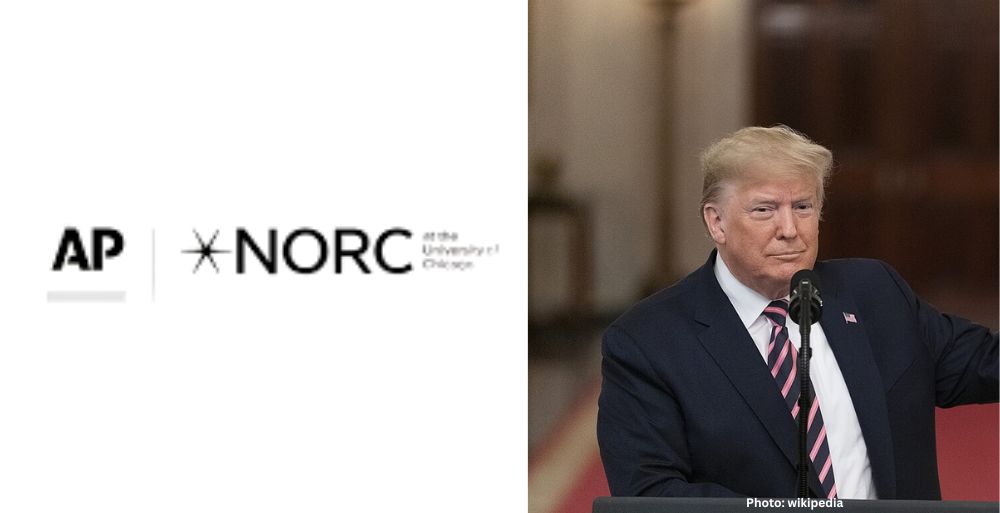
A comprehensive national survey conducted by The Associated Press-NORC Center for Public Affairs Research reveals widespread voter dissatisfaction with President Donald Trump’s handling of the national economy and the rising cost of living. With only 17 percent of American adults approving of his performance regarding consumer costs, and an overall economic approval rating dropping to 26 percent, public confidence has reached a historic low during his second term. Unlike previous economic downturns where voters attributed price spikes to external global events, a solid 65 percent majority now directly blames the president’s domestic and foreign policy decisions—specifically aggressive international tariff structures and the ongoing military conflict with Iran. This shift in public sentiment poses severe electoral headwinds for the Republican Party as candidates head into critical mid-term elections to maintain congressional majorities.
WASHINGTON — Broad-based economic frustration, driven by persistent inflation and compounding geopolitical uncertainties, has severely eroded public approval of President Donald Trump’s administration just weeks before the 2026 mid-term elections. According to the latest findings from a poll conducted by The Associated Press-NORC Center for Public Affairs Research, approval of the president’s handling of the cost of living has plummeted to 17 percent among American adults, while his broader economic management stands at a low of 26 percent.
The survey paints a challenging political landscape for the White House as the administration navigates a volatile combination of trade disputes, high consumer prices, and prolonged foreign military engagement. Overall job approval for President Trump remains constrained at approximately 30 percent, with roughly 60 percent of respondents asserting that the nation is in a measurably worse condition than when his second term began.
Public Attribution Shifts Toward Policy Decisions
A central finding of the survey highlights a significant shift in how the electorate assigns responsibility for financial distress. Rather than attributing elevated prices to global supply disruptions or broad market forces, 65 percent of U.S. adults say President Trump’s specific policy choices are primarily responsible for persistent inflation.
This dynamic stands in stark contrast to previous economic downturns. During the post-pandemic inflationary crest in June 2022, President Joe Biden’s economic approval dropped to 28 percent; however, public attribution was markedly different. In October 2022, prior to that year’s mid-term elections, 55 percent of Americans viewed high inflation as the result of factors outside the administration’s direct control, such as global supply chain backlogs and pandemic recovery dynamics, while 44 percent pointed directly to White House policies. Under the current administration, that trend has inverted, with voters increasingly linking consumer strain to administrative decisions.
“I think he has a lot to do with it,” said Pedro Sanchez, 52, a law enforcement professional and registered voter from Perris, California, who supported Trump in the previous election. “This war in Iran, the tariffs that he’s placing on other countries, obviously are affecting us. Those two things are things he’s been directly involved in that directly affect the economy. I think with Biden, a lot of the stuff was outside of his control. It was all the COVID and how that affected everything else. I don’t think that there was much that he could have done.”
Sanchez noted that diminishing purchasing power has fundamentally altered household budgets. “I used to have a lot more disposable income. I don’t have that anymore. It’s gotten eaten up because of all these increases in the cost of everything,” he observed, reflecting a sentiment shared across demographic lines.
Key Pressure Points: Groceries, Fuel, and Household Budgets
The survey outlines increasing household stress over essential consumer goods, specifically fuel and food. Approximately 50 percent of U.S. adults report feeling “extremely” or “very” concerned about their ability to afford gasoline, a notable increase from the 39 percent recorded in July. A matching 50 percent express severe concern regarding basic grocery expenses.
The persistent rise in daily living expenses has generated disillusionment among voters who anticipated a return to the macroeconomic conditions of the president’s first administration (2017–2021).
“Groceries are just like kind of out of control. It seems like everything is going up,” said Bethany Lnenicka, 41, who manages an agricultural operation in Fairfax, Iowa. Lnenicka, an independent voter who typically aligns with conservative candidates, noted that expectations for a stabilization of costs have not materialized. “It’s just one thing and the next week it’s another thing. It’s just insane. And of course your income doesn’t go up. I just do not feel like it has gotten a lot better.”
This sentiment is reflected in broader metrics within the data: nearly 70 percent of Americans indicate that the president’s performance on managing the cost of living has been “worse than expected.” Crucially, this response includes approximately half of self-identified Republicans surveyed.
Fracture Within the Conservative Coalition
While President Trump maintains strong support on select signature platforms—notably border security and immigration enforcement, where his approval rating hovers near 50 percent—cracks are emerging within his primary base on core fiscal matters.
Roughly 60 percent of Republicans surveyed now express disapproval of the administration’s handling of the cost of living, up from approximately 50 percent in April. This dissatisfaction spans both suburban and rural constituencies where household margins have tightened.
“It definitely doesn’t feel like we have trended in the right direction,” said Kristen Slaven, 41, a mental health therapist residing in Gluckstadt, Mississippi, who routinely votes conservative. Slaven expressed frustration over administrative priorities amid domestic financial pressures. “Obviously wars don’t help. When they’re necessary, I understand. But our focus on renaming bodies of water and pieces of land, that’s just stupid to me when people can’t feed their family. I had hoped that it would be better.”
Similarly, Robert Gault, 66, a retired manufacturing worker from Bradford, Pennsylvania, expressed concern regarding the trajectory of the national economy. “Our president, I thought, was going to help the country, and so far he has not really seemed to have done that with the economy or in general. He’s not really done what I was hoping he would,” Gault stated. “He said, ‘Make America Great Again.’ And I have not seen him do that.”
Despite these growing concerns, a significant segment of the Republican base continues to give the White House latitude. Among self-identified Republicans, 67 percent argue that external macroeconomic variables remain the primary driver of inflation.
“I think inflation is a very difficult thing to tackle,” remarked Fred Naumann, 51, an automotive industry professional from Green Bay, Wisconsin. Naumann maintained his support for the administration’s broader framework, including the implementation of protective tariffs and foreign policy stances regarding Iran, while expressing a preference for reduced central bank interest rates.
Backlash Over Tariffs and Foreign Policy
The administration’s trade initiatives and foreign policy endeavors are facing heightened skepticism from the broader public. Support for trade negotiations with foreign nations has declined to 30 percent, down from roughly 40 percent in March. Furthermore, 64 percent of respondents state that the White House has “gone too far” in levying new import tariffs, an increase from 58 percent recorded in January.
Concurrently, public approval regarding the administration’s military strategy in the Middle East remains depressed. Only 28 percent of Americans approve of the president’s management of relations and conflict with Iran, while 69 percent maintain that the ongoing engagement is not worth the economic and military costs—a modest rise from 64 percent in July.
Electoral Context and Mid-Term Outlook
The economic assessment arrives at a critical junction as the nation prepares for mid-term congressional elections that will determine control of both the House of Representatives and the Senate. With the administration attempting to mobilize its core voters through a rigorous schedule of campaign events, candidate performance in competitive suburban districts may hinge on whether voters view current price levels as temporary volatility or the result of structural policy decisions.
For many candidates, the polling suggests that traditional economic arguments may require recalibration, as consumer frustration over daily expenses continues to overshadow administrative legislative achievements.