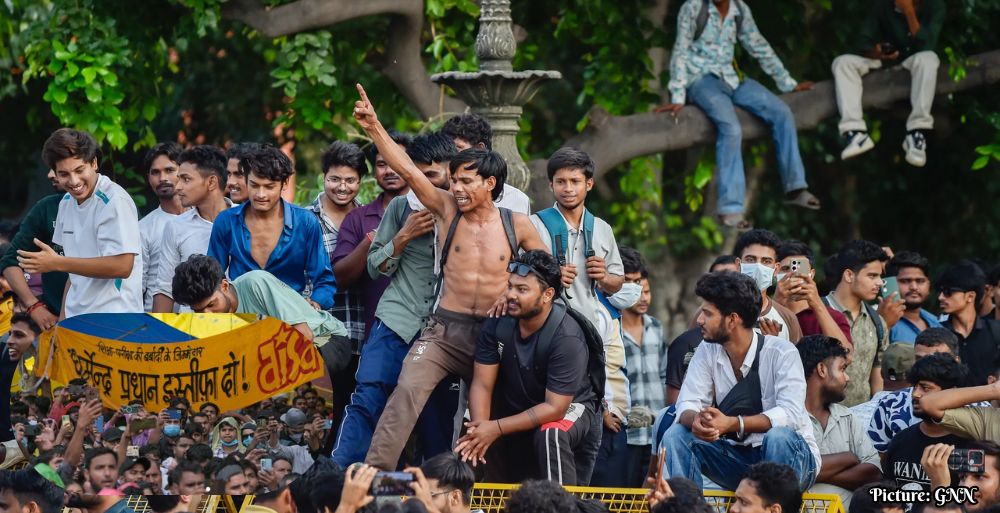
Protests demanding the resignation of Chief Election Commissioner Gyanesh Kumar escalated in Delhi on October 11, 2026, leading to over 2,500 detentions amid accusations of unlawful police action. Political leaders and activists have vowed to continue demonstrations until Kumar steps down, highlighting concerns over electoral integrity.
New Delhi: The Cockroach Janta Party (CJP) spearheaded intensified protests against Chief Election Commissioner (CEC) Gyanesh Kumar on October 11, 2026, amid allegations of irregularities in the electoral roll process. The protests, which have drawn significant involvement from student organizations and opposition parties, are primarily focused on demanding Kumar’s resignation. As tensions escalated, police detained over 2,500 individuals across the capital, raising concerns regarding the legality of these actions and the right to peaceful assembly.
Mass Detentions and Legal Implications
On the evening of October 10, police initiated a crackdown that resulted in the detention of approximately 2,500 people, including a substantial number of activists from the Students’ Federation of India (SFI) and the All India Students’ Association (AISA). Describing these actions as ‘preventive arrests,’ Delhi Police justified them as necessary for maintaining public order amid the mounting protests. However, legal experts and opposition leaders have condemned the detentions, arguing they infringe on constitutional rights.
Notably, prominent CJP leaders Abhijeet Dipke, Ashutosh Ranka, and Saurav Das were among those detained but were released the following day under the condition that they would refrain from disturbing the peace for a year. Dipke characterized their detention as illegal and reiterated their commitment to continue protests until Gyanesh Kumar resigns. He stated, “We will not back down, and we will expand our protests nationwide to ensure our voices are heard.” This statement underscores the urgency and determination of the CJP to highlight what they perceive as systemic electoral injustices.
Supreme Court’s Intervention
In response to the escalating situation, the Supreme Court convened a special session to address the mass detentions and the police’s restrictions on public transport and assembly in the capital. The court directed authorities to allow peaceful gatherings and mandated that essential services, such as the Delhi Metro, operate normally. Justice Bagchi emphasized the need to safeguard citizens’ constitutional rights, stating, “While the right to protest must be exercised within the bounds of law, it should not be unjustly obstructed by excessive police measures.” The Supreme Court’s involvement highlights the judiciary’s role in balancing public order with individual rights, particularly in situations of civil unrest.
Political Reactions and the Opposition’s Stance
The government’s handling of the protests has drawn sharp criticism from opposition leaders. Congress President Mallikarjun Kharge and Rahul Gandhi expressed solidarity with the protesters, planning to march to the Supreme Court to advocate for justice and the resignation of Gyanesh Kumar. Gandhi framed the protests as a collective call from India’s youth, asserting that participants were motivated by a desire for electoral integrity and fairness rather than animosity. He stated, “The youth came out to peacefully protest. They were met with violence, but we will continue to stand united in our demand for democracy. This is not the India we want. We will march to the Supreme Court as one people, united beyond party lines.”
Further amplifying concerns about the government’s approach, Trinamool Congress (TMC) leader Derek O’Brien described the developments in Delhi as “ominous” for the ruling government, suggesting that the protests reflect a deeper, widespread discontent among the populace. Former Kerala Chief Minister Pinarayi Vijayan also condemned the police’s actions as “brutal state terrorism,” underscoring the excessive force used against demonstrators.
International Concerns and Human Rights Implications
The international community has taken note of the situation, with the United Nations Human Rights Office expressing concern over the mass detentions and calling for the immediate release of all individuals arrested. The UN body has urged Indian authorities to respect the right to peaceful protest and ensure that those detained arbitrarily are released unconditionally. The Indian government, however, has dismissed these concerns as unwarranted interference in its internal affairs, reflecting a growing tension between domestic policies and international human rights expectations.
Future Protests and Political Landscape
Despite the heavy police presence and the recent crackdown, protests are expected to persist in the coming days. The CJP and allied groups have pledged to escalate their demonstrations, with plans for a significant protest march on October 12, organized by the opposition coalition known as the INDIA bloc. This march aims to submit a memorandum to the Chief Justice of India, advocating for electoral integrity and once again demanding the resignation of CEC Gyanesh Kumar. AICC General Secretary K.C. Venugopal characterized the upcoming protest as a “second freedom struggle” to protect democracy and voting rights, signaling the opposition’s determination to unify against perceived governmental overreach.
As these developments unfold, the political landscape in India remains fluid, with increasing pressure on the ruling government to address the allegations surrounding the electoral process and the treatment of citizens exercising their right to protest. The outcome of these protests and the government’s response may have significant implications for the broader democratic framework in India, particularly as civil society continues to mobilize against perceived injustices.