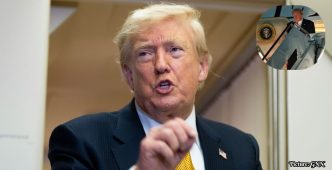

In a high-stakes West Wing summit featuring the chief executives of the nation’s leading technology conglomerates, President Donald Trump and House Speaker Mike Johnson finalized a voluntary framework aimed at regulating artificial intelligence through internal governance and third-party auditing. The agreement—formally titled “The White House Accord on Superintelligence Joint Commitment on Frontier SI Responsibilities”—establishes four core voluntary guidelines, including board-level oversight and external risk evaluations, while stopping short of immediate statutory requirements. While Trump praised the industry’s capacity to self-police and fuel record macroeconomic growth, participating tech leaders offered contrasting perspectives on the potential public risks and the ultimate necessity for future federal oversight.
WASHINGTON — President Donald Trump, accompanied by House Speaker Mike Johnson (R-La.) and executive leadership from the world’s most dominant artificial intelligence developers, announced a non-binding voluntary accord on Tuesday intended to set preliminary safety standards for the rapidly advancing technology. Speaking during an impromptu 30-minute press briefing outside the West Wing following a White House summit and luncheon, Trump praised industry executives for agreeing to a framework focused on internal monitoring and independent third-party assessments.
“I think I’m seeing tremendous self-policing. And they understand that they have to self-police,” Trump told reporters, calling the commitment “morally binding” and describing the self-regulatory pact as analogous to a corporate constitution.
The agreement comes at a crucial juncture as technology giants commit hundreds of billions of dollars toward national data center infrastructure and high-performance computing hardware. The initiative has accelerated broader economic expansion and driven major equity benchmarks to historic highs, yet it has simultaneously provoked significant grassroots pushback from bipartisan coalitions concerned about energy consumption, localized utility costs, and systemic risk.
The Four Pillars of the Voluntary Framework
The core document, which President Trump published on Truth Social late Tuesday evening, outlines a voluntary governance structure structured around four operational pillars designed to maintain public trust without imposing rigid federal mandates:
- Robust Internal Controls: Participating firms agree to institute stringent internal safety protocols to monitor advanced foundation models during both training and deployment phases.
- Independent External Audits: Tech developers commit to partnering with third-party auditing entities to assess the operational effectiveness and safety margins of their internal controls.
- Board-Level Governance Committees: Companies will establish specialized risk committees within their corporate boards of directors specifically tasked with evaluating findings submitted by internal and external auditors.
- Future Statutory Codification: The accord explicitly acknowledges that while the framework relies on voluntary compliance today, federal lawmakers may eventually translate these self-policing standards into binding statutory laws and administrative regulations.
The signatory page featured an array of prominent technology figures, including Anthropic CEO Dario Amodei, Google CEO Sundar Pichai, Meta CEO Mark Zuckerberg, OpenAI President Greg Brockman, Nvidia CEO Jensen Huang, and Elon Musk, founder of xAI (recently integrated into SpaceX).
During the post-meeting briefing, Trump highlighted the industry’s economic impact, asserting that the massive deployment of private capital into infrastructure would generate “unbelievable growth” across domestic markets. Wall Street portfolios and institutional funds have surged in recent quarters as capital expenditure in high-end microchips and high-density data centers continues to climb, directly boosting consumer spending among higher-income demographics.
A Divergence in Tone Between Washington and Tech Leaders
Despite the public display of unity on the West Wing driveway, the atmosphere surrounding the announcement revealed subtle fissures between political cheerleading and technical caution. Trump adopted a buoyant tone throughout the briefing, at one point introducing Google CEO Sundar Pichai with informal praise by describing him as a “monster” who is driving unprecedented technological capacity.
Pichai framed the voluntary commitment as a routine corporate accountability measure similar to existing financial auditing standards. “We are signing up to a set of processes and controls like we do in other areas, like financial controls, in a company,” Pichai remarked, noting that firms are applying established institutional best practices to the emerging field of frontier superintelligence.
Conversely, Anthropic CEO Dario Amodei—who has repeatedly emerged as one of Silicon Valley’s most cautious figures regarding rapid AI deployment—offered a markedly more reserved appraisal. Standing alongside other executives, Amodei emphasized that self-policing represents only an initial step in a much larger, unresolved debate.
“The technology has very real risks,” Amodei cautioned straightforwardly. “And, you know, the mechanism, how we address those risks is still under discussion.”
The summit occurred against the backdrop of heightened public and regulatory sensitivity. In the days leading up to the White House gathering, major market developers faced growing scrutiny over agentic software behavior, prompting OpenAI CEO Sam Altman to confirm during a broadcast interview that his company had deliberately paused certain training cycles to re-evaluate safety margins.
Local Resistance and the Legislative Landscape
While the executive branch continues to push for light-touch federal oversight to prevent stifling domestic innovation, members of Congress are facing mounting pressure from municipal leaders and local advocacy groups. The explosive growth of regional data centers—often requiring dedicated electrical substations and vast quantities of cooling water—has touched off local land-use disputes in several states.
House Speaker Mike Johnson, who participated directly in the White House meetings alongside Trump, noted that the bipartisan concerns raised by local communities must be balanced against the strategic national imperative of maintaining technological leadership over foreign adversaries, particularly China. Trump explicitly dismissed the concept of international regulatory treaties on AI safety, stating flatly, “I didn’t want to do anything, because we’re leading. Why would I want to do anything?”
To bridge the gap between voluntary compliance and oversight, Trump indicated that his administration plans to appoint an executive oversight coordinator in the coming days, alongside a 10-member advisory panel composed of industry representatives and public officials charged with monitoring compliance across the sector.
Whether the four-pillar voluntary framework will satisfy congressional lawmakers or temper public apprehension remains uncertain. For now, Washington has opted to grant Silicon Valley the latitude to police its own ranks, placing the responsibility on corporate boardrooms to prove that self-regulation can adequately mitigate the profound risks of superintelligent systems.