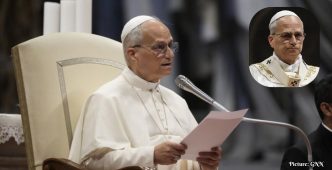
Pope Leo XIV has made history as the first pope to vote in a U.S. general election, reinforcing his commitment to civic engagement and democratic processes.
VATICAN CITY — In a groundbreaking development, Pope Leo XIV has become the first pope in history to cast a vote in a U.S. general election. The Chicago-born pontiff submitted a mail-in ballot ahead of the upcoming midterm elections scheduled for November 3, 2026, a move that underscores his commitment to civic engagement and democratic participation.
The Vatican confirmed this unprecedented action on Friday, stating that Leo XIV, born Robert Prevost, has consistently exercised his right to vote as a U.S. citizen whenever eligible. The Holy See’s press office emphasized that the pontiff believes in the duty of all citizens to participate actively in democratic processes. In addition to his U.S. citizenship, Leo holds Peruvian citizenship and served as a missionary priest and bishop in Peru for over two decades prior to his election to the papacy.
Context of the Upcoming Elections
The timing of Pope Leo XIV’s vote coincides with a politically charged atmosphere in the United States as voters prepare to make critical decisions that could reshape the political landscape. Illinois voters are set to decide on the re-election of Governor J.B. Pritzker to a third term, alongside filling an open U.S. Senate seat following the retirement of long-serving Democratic Senator Dick Durbin. While former President Donald Trump is not on the ballot, he has been actively campaigning to maintain Republican control of Congress as his presidency approaches its conclusion.
On October 3, 2026, the pope requested a mail-in ballot from his registered address in New Lenox, Illinois, just ten days before undergoing surgery to remove a cancerous tumor from his right lung. Following his release from the hospital on October 17, Leo XIV has gradually resumed his duties at the Vatican. However, details regarding how he returned his ballot remain unclear; it is speculated that family members may have assisted in this process.
Voting History and Political Engagement
Records from the Illinois State Board of Elections reveal that Leo XIV, under his birth name Robert Prevost, has a history of participating in U.S. elections since 2000. His voting history indicates a willingness to engage with both major political parties, having requested Democratic ballots twice and Republican ballots three times. Notably, he has participated in every general election since 2000, with the exception of the 2020 and 2022 elections.
Throughout his papacy, Leo XIV has not shied away from engaging with U.S. political discourse, often addressing issues that resonate with his faith and moral teachings. His positions on various political matters have included strong advocacy against the death penalty and calls for the humane treatment of immigrants. These stances have drawn criticism from some conservative circles, notably from Trump, who labeled the pope as “weak” and aligned with the “radical left.”
Responding to Political Critiques
In response to the criticisms from Trump, Leo XIV has steadfastly maintained his commitment to advocating for the church’s message. He stated, “I’m not afraid of the Trump administration or of speaking out loudly about the message of the Gospel, which is what the church works for.” This public feud has seen a decrease in tension in recent months, with Vatican officials expressing a desire to rebuild trust and cooperation with the U.S. administration.
The Vatican’s foreign minister, Archbishop Richard Paul Gallagher, highlighted the importance of maintaining open lines of communication, noting that the Holy See effectively utilizes the U.S. ambassador to the Vatican as a conduit for dialogue. This approach has reduced the necessity for higher-level discussions, indicating a strategic shift in how the Vatican engages with U.S. politics.
The Broader Implications of Civic Participation
Pope Leo XIV’s decision to vote in the U.S. signifies a broader engagement of religious leaders in political processes, illustrating a commitment to civic responsibility that resonates with many American Catholics. Following the announcement of his vote, the U.S. Conference of Catholic Bishops emphasized the importance of faith in political participation, urging Catholics to prioritize human dignity and the common good in their civic duties. Chieko Noguchi, the Conference’s director of public affairs, stated, “As Catholics and Americans, we are blessed to be able to participate in our nation’s political and public life.”
As Pope Leo XIV navigates the complexities of his dual role as a spiritual leader and a U.S. citizen, his actions may pave the way for greater involvement of religious figures in political matters. This development raises important questions about the intersection of faith and civic responsibility in a diverse democracy, highlighting the potential for religious leaders to influence social and political discourse.
In summary, Pope Leo XIV’s historic vote not only marks a significant moment in the intersection of religion and politics but also reaffirms the imperative for individuals to engage in the democratic process. His actions may inspire a renewed commitment among citizens to participate actively in shaping their political landscape, reflecting the values of civic engagement that he champions as both a pope and a citizen.