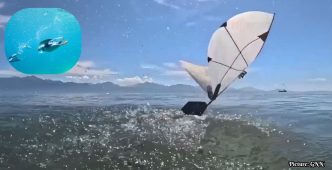
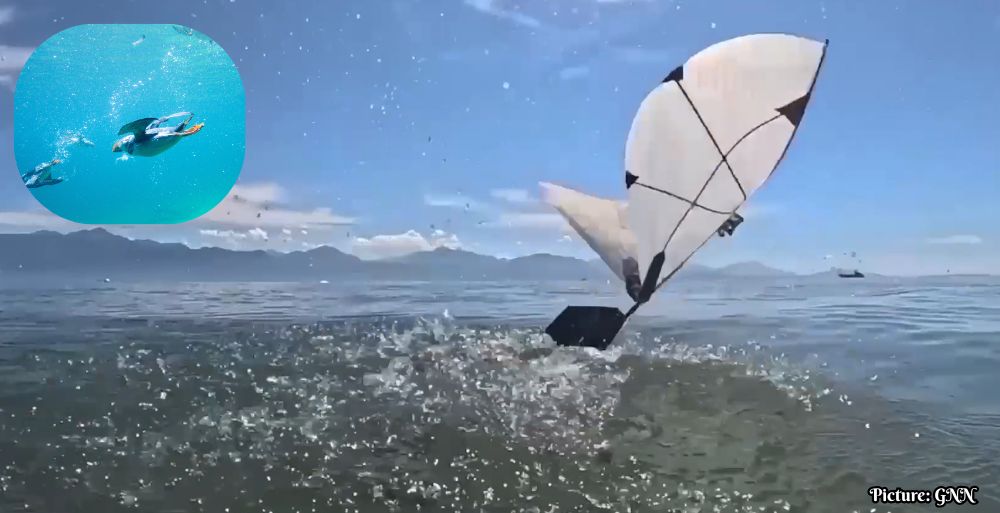
A team at the Massachusetts Institute of Technology has created a $300 flapping robot capable of flying and swimming, designed to monitor and protect marine environments.
The Massachusetts Institute of Technology (MIT) has introduced an innovative flapping robot that can both fly and swim, with potential applications in ocean monitoring and environmental protection. This development was led by a team of researchers from MIT’s aero-aquatic robotics lab, who have engineered the robot, known as a flapping aerial-aquatic vehicle (FAAV), for a cost of approximately $300.
Design Inspiration and Engineering Challenges
Inspired by diving birds such as petrels and puffins, the MIT team studied the biomechanics of these species to understand how they transition between aerial and aquatic environments. Raphael Zufferey, the lead author of the study and an assistant professor of mechanical engineering at MIT, explained that while prior research focused on the wings of diving birds, it had not successfully translated these findings into a fully operational robotic system.
Zufferey stated, “No one had ever figured out how to transform that into a fully moving robot.” The research involved mapping the flapping frequency of various diving birds and how these frequencies vary according to wingspan, with larger birds exhibiting lower flapping rates. Ultimately, the team produced a lightweight robot weighing 250 grams (approximately 9 ounces) powered by a battery-operated motor, featuring nylon wings and a tail treated with water-repellent nanoparticles.
Technical Specifications and Capabilities
The FAAV is engineered to operate efficiently in both air and water, but it does not mimic the wing folding of diving birds. Instead, the design incorporates a more flexible wing that minimizes amplitude—the vertical movement of the wing during flapping—allowing for reduced drag in water. Zufferey emphasized that the robot does not differentiate between flying and swimming; it simply aims to maintain a programmed frequency of wingbeats regardless of the medium.
In terms of performance, the FAAV can achieve a flight speed of just over 6 meters per second (approximately 13.4 miles per hour) and a swimming speed of nearly 1 meter per second (2.2 miles per hour). Theoretically, it can cover distances of 6 kilometers (3.7 miles) in the air or swim 2 kilometers (1.2 miles) on a single battery charge, although these claims have yet to be verified through testing.
Testing and Future Developments
The robot has undergone extensive testing over the past year in a controlled water tank in Massachusetts and subsequently in Lake Geneva, Switzerland. The research team focused on optimizing the angle at which the robot dives into water—determined to be 70 degrees—for effective launch and aquatic maneuvering. While the FAAV performs well in mild wave and wind conditions, its capabilities in more severe environments remain limited in its current prototype.
Commenting on the engineering achievement, Maaten Furlong, director of engineering science at the National Oceanography Centre, noted, “Developing a vehicle capable of operating effectively in both air and water is a significant technical challenge.” He further acknowledged that integrating these two operational modes represents a notable advancement in engineering.
Potential Applications in Oceanography
Following the initial success of the FAAV, the MIT team is pursuing grants and other funding opportunities to further advance the project. Zufferey expressed aspirations for the robot to serve as a future tool in oceanographic studies, stating, “Scientific sampling at sea is expensive, and there are use cases for a relatively cheap, lightweight aerial-aquatic vehicle.” The FAAV could be deployed to autonomously fly predetermined routes and dive underwater to collect samples, potentially in challenging environments such as toxic algae blooms or near icebergs.
Moreover, Zufferey suggested that the robot could be equipped with cameras for wildlife monitoring, expanding its utility in ecological research. However, Furlong raised critical questions regarding the vehicle’s payload capacity, durability, regulatory compliance, and its operational effectiveness in open ocean conditions. He noted that the class of combined aerial and underwater vehicles has not been fully explored, primarily due to the technical challenges involved and the unclear operational advantages.
Cost-Effectiveness and Scalability
Despite the challenges, Zufferey believes in the potential for the FAAV to become a viable tool for ocean scientists, who prioritize obtaining high-quality data through reliable and cost-effective methods. The current cost of the robot’s components stands at around $300, with Zufferey estimating that improvements in materials and design could raise the production cost to a maximum of $1,000—considered economical for oceanic research endeavors.
Looking ahead, Zufferey has established a new lab at MIT equipped with a larger water tank and higher ceilings, positioning the team for future testing and further development of the FAAV.