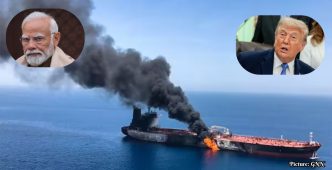
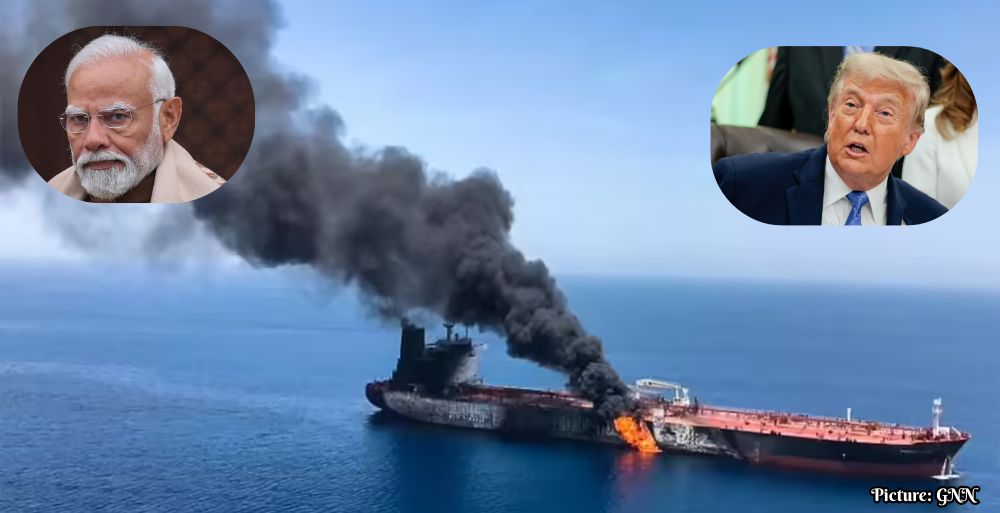
A major diplomatic crisis has erupted between India and the United States following the deaths of three Indian merchant mariners killed during a U.S. military airstrike on a commercial oil tanker in the Sea of Oman. The incident involving the Palau-flagged M/T Settebello represents the first confirmed seafaring fatalities resulting from Washington’s naval blockade of Iranian ports. Coming amid a broader U.S.-Israeli conflict with Iran, the strikes have triggered public outrage across India and placed immense political pressure on Prime Minister Narendra Modi. With India supplying roughly 15% of the global merchant marine workforce, the incident has exposed the vulnerability of international labor in geopolitical crossfires. It threatens to severely destabilize the Washington-New Delhi strategic partnership just days before a critical bilateral meeting at the G7 summit in France.
U.S. Blockade Strike Inflicts Indian Casualties in the Sea of Oman
NEW DELHI — A precision strike by United States military aircraft on a commercial oil tanker in the Sea of Oman has killed three Indian seafarers, igniting a wave of public fury across India and plunging relations between New Delhi and Washington into a volatile new phase of friction.
The incident occurred on Wednesday morning when the M/T Settebello, a Palau-flagged vessel laden with Iranian crude oil, was transiting international waters. According to operations reports, a U.S. military aircraft fired precision-guided munitions directly into the vessel’s engine room. The kinetic strike immediately ignited a catastrophic fire, sending thick columns of black smoke billowing into the maritime corridor and triggering a massive international rescue operation.
The three Indian nationals found dead in the wreckage are the first merchant mariners confirmed killed since Washington initiated its aggressive naval blockade designed to choke off Iran’s energy exports. The U.S. Central Command (CENTCOM) defended the military action in a formal statement, asserting that the vessel’s command hierarchy had repeatedly failed to comply with lawful instructions and maritime interception warnings issued by American naval forces enforcing the blockade.
However, the rationale has done little to soothe tempers in New Delhi. The Indian government, which has grown increasingly alarmed over the safety of its massive seafaring diaspora amid the escalating U.S.-Israeli war with Iran, moved swiftly to lodge a formal diplomatic protest. On Thursday, the Ministry of External Affairs (MEA) summoned Washington’s Chargé d’Affaires in New Delhi to demand an immediate cessation of kinetic operations against commercial shipping.
“The attacks that are happening must stop,” said MEA spokesperson Randhir Jaiswal during a tense press briefing on Thursday. Jaiswal’s delivery was measured but stern, reflecting the gravity of an administration facing a burgeoning domestic crisis.
A Pattern of Maritime Escalation
The destruction of the M/T Settebello was not an isolated event, but rather part of a highly intense, multi-day U.S. interdiction campaign in the Persian Gulf and Gulf of Oman that has repeatedly placed Indian workers in harm’s way.
According to Indian maritime records and MEA disclosures, a vast majority of the 28 crew members aboard the Settebello were Indian nationals. Just 24 hours prior to Wednesday’s fatal strike, another 24 Indian sailors had to be pulled from the water in a high-stakes rescue operation after their commercial tanker, the M/T Marivex, was similarly struck and disabled by U.S. forces.
The operational tempo slowed little on Thursday, when U.S. forces targeted a third vessel—the Guinea-Bissau flagged M/T Jalveer—firing missiles into its engine room to prevent the transport of Iranian petroleum. While the Indian crew members aboard the Jalveer were ultimately reported safe, the sequence of three targeted strikes on civilian-crewed vessels within a 72-hour window has fundamentally altered New Delhi’s calculus regarding the conflict.
The geopolitical timing of the casualties could scarcely be more problematic for the Modi administration. Prime Minister Narendra Modi is scheduled to travel to France next week for the Group of Seven (G7) leaders’ summit, where he is slated to hold high-stakes, one-on-one bilateral talks with U.S. President Donald Trump.
Modi has notably refrained from issuing an immediate public statement regarding the deaths, a silence that has drawn sharp rebukes from domestic labor coalitions and political adversaries alike. Maritime unions are demanding that the government leverage India’s global economic position to penalize unilateral military actions that endanger international workers.
“When a foreign military kills Indian workers in international waters, the government of India must speak—loudly and firmly,” the Centre of Indian Trade Unions (CITU) said in a fiery public manifesto released on Friday.
The Human Toll and the Global Labor Supply
Behind the geopolitical maneuvers lies a profound human tragedy that has captivated the Indian domestic press. The families of the deceased mariners are demanding transparency from both Washington and New Delhi regarding the final moments of their loved ones.
“I have only one demand: that my son’s remains be brought back,” said Rajesh Sharma, the father of one of the slain seafarers, speaking to the Indian news agency ANI. His voice shook with a mixture of grief and anger. “I want to know what happened in his last moments. Was he given any rescue assistance? What circumstances led to the deaths of three crew members from our country?”
Another grieving parent, Ramji Chaurasiya, recounted his final conversation with his son, which occurred less than 24 hours before the American munitions tore through the Settebello’s hull. “He said everything was alright,” Chaurasiya told reporters before breaking down into uncontrollable tears.
The crisis underscores a systemic vulnerability within the global shipping ecosystem. India is one of the world’s primary exporters of merchant marine labor. According to data provided by Manoj Yadav, General Secretary of the Forward Seamen’s Union of India (FSUI), there are currently more than 300,000 Indian seafarers active in the global shipping registry. Because flag-of-convenience vessels—such as those registered in Palau or Guinea-Bissau—routinely hire Indian officers and crew due to their high technical competency, thousands of Indian citizens are actively operating within the volatile shipping lanes of the Middle East at any given moment.
Yadav reported that the recent string of U.S. strikes has induced widespread “panic and fear” throughout the merchant fleet, leaving hundreds of sailors effectively stranded in Gulf ports as shipping lines scramble to assess risks. Yadav openly questioned the tactical necessity of using lethal kinetic force against unarmored commercial targets.
“The U.S. forces do not need to strike a commercial ship that carries no ammunition,” Yadav argued, pointing out the asymmetry of the engagement. “They could easily board the ship and detain the vessel if they required compliance.”
Domestic Fallout and Strategic Realignment
The opposition Indian National Congress (INC) party has seized upon the tragedy, framing the mariners’ deaths as a definitive failure of Prime Minister Modi’s personalized foreign policy paradigm.
“The Prime Minister, who has repeatedly showcased his personal rapport with President Donald Trump as a diplomatic achievement, cannot evade responsibility when that relationship fails to protect Indian lives,” the INC noted in an official party statement. In response, India’s Ministry of Ports, Shipping, and Waterways issued a brief statement asserting that the state “stands firmly with the bereaved” and is expediting the repatriation of the remains.
Strategic experts warn that the political fallout will be difficult for the Modi government to insulate from the broader bilateral relationship. Ties between New Delhi and Washington—both key pillars of the Quadrilateral Security Dialogue (Quad) aimed at countering Chinese influence in the Indo-Pacific—have faced severe strain over the past twelve months.
Frictions intensified markedly following a diplomatic dispute last May, when President Trump publicly claimed to have successfully mediated between India and Pakistan during a brief, lethal border skirmish. New Delhi flatly rejected the claim, as it violates India’s long-standing doctrine barring third-party intervention in the Kashmir dispute. Economic relations have been further bruised by a series of steep, protectionist U.S. tariffs levied against core Indian industrial exports.
Compounding India’s strategic anxiety is Washington’s visible diplomatic re-engagement with Islamabad. President Trump has frequently praised Pakistan’s defense chief, Field Marshal Asim Munir, who has positioned himself as a vital intermediary in backstage negotiations between the U.S. State Department and Tehran.
While the State Department has attempted to patch relations with New Delhi—appointing a permanent ambassador and dispatching Secretary of State Marco Rubio on a high-profile diplomatic mission to India last month—the maritime deaths have radically altered the optics.
“This issue has already become an irritant in a wobbling relationship,” said Kanti Bajpai, a prominent political scientist and visiting senior fellow at India’s Centre for Social and Economic Progress.
Bajpai warned that if additional strikes yield more non-combatant casualties, the domestic political pressure on Modi could force a diplomatic retrenchment. “Some public expression of regret from the U.S. would be helpful,” Bajpai observed. “傷 India has four so-called foundational military agreements with the U.S., and it may have to remind the American side that it takes two to uphold the spirit of those agreements.”
Whether the Trump administration will offer a formal apology remains uncertain, but the deaths in the Sea of Oman ensure that the upcoming G7 summit will no longer be a routine display of democratic solidarity, but rather a tense crucible for the future of U.S.-India ties.