
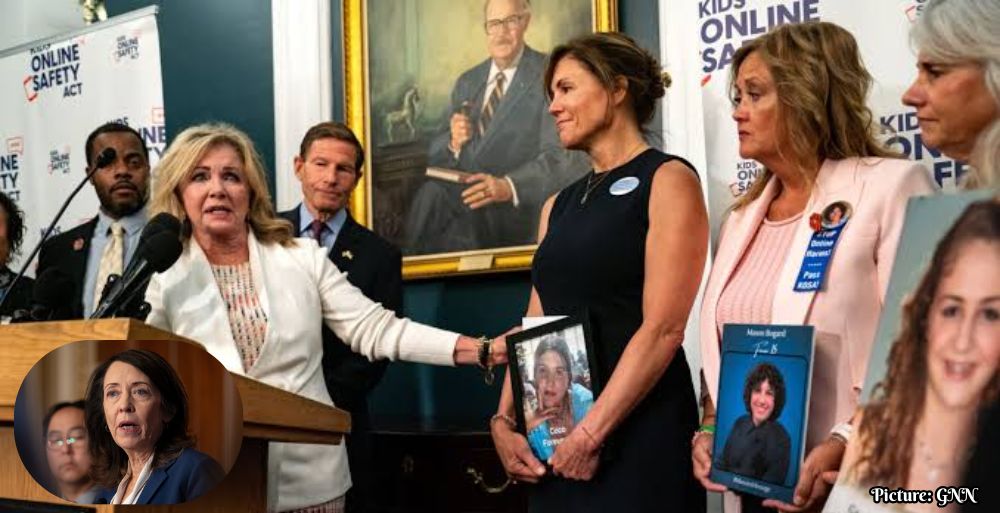
A escalating legislative conflict has emerged within the Democratic party as prominent senators explicitly warn House lawmakers against advancing a heavily altered version of the Kids Online Safety Act (KOSA). Senate Commerce Committee Chair Maria Cantwell and Senator Richard Blumenthal argue that the House’s sweeping legislative package, known as the Kids Internet and Digital Safety (KIDS) Act, strips away fundamental corporate accountability measures—specifically the “duty of care” legal standard. The senators caution that passing a compromised bill will invite aggressive tech industry lobbying in the Senate, potentially derailing years of bipartisan negotiations aimed at protecting minors from algorithmic harms and digital exploitation.
WASHINGTON — A deep legislative rift has widened between the chambers of Congress over federal efforts to regulate major tech platforms and safeguard minors online. High-ranking Senate Democrats have launched a coordinated campaign urging House lawmakers to soundly reject a revised, bipartisan child safety package scheduled for a floor vote under an expedited procedural mechanism.
The core of the dispute centers on the newly modified version of the Kids Online Safety Act (KOSA). The provision has been bundled into a broader legislative vehicle designated as the Kids Internet and Digital Safety (KIDS) Act, or H.R. 7757.
Senate Commerce, Science, and Transportation Committee Chair Maria Cantwell (D-WA) and Senator Richard Blumenthal (D-CT), the original co-sponsor of the Senate’s version of KOSA, issued direct warnings to their House counterparts. They asserted that the House version compromises foundational regulatory principles and risks exposing the entire legislative effort to destabilization by corporate interests.
The legislative showdown comes as the House leadership readies the package for floor consideration under suspension of the rules. This procedure bypasses standard amendment processes and requires a two-thirds majority for passage, reflecting an aggressive push by proponents to clear the lower chamber.
However, Senate leaders argue that the House bill represents a substantial regression from the version that overwhelmingly cleared the Senate in the previous congressional term by a bipartisan vote of 91–3.
The Gutting of Corporate Accountability: The “Duty of Care” Dispute
The primary policy friction point between the two chambers involves the complete removal of the “duty of care” provision from the House version of the legislation. In the original Senate bill, the duty of care established a binding statutory obligation. It legally mandated that social media companies and digital platforms actively design their products to prevent and mitigate specific, well-documented harms to minors.
These harms include medically recognized mental health conditions such as suicidal behavior, depression, eating disorders, and substance use disorders, as well as digital threats like cyberbullying and physical exploitation.
The House Energy and Commerce Committee altered this framework during its internal markups, advancing a package along party lines via a 28–24 vote. The revised House text replaces the enforceable duty of care with a requirement that companies simply “establish, implement, maintain, and enforce” internal policies regarding content.
Furthermore, the House version introduces explicit disclaimer language stating that the bill cannot be construed to impose a structural duty of care, alongside an “actual knowledge” standard that triggers compliance only when a platform possesses empirical proof that a user is a minor.
Speaking to a packed room of journalists at a Friday press briefing, Senator Blumenthal expressed deep concern over the strategic implications of the House’s structural modifications. His demeanor was visibly urgent as he addressed the room.
“If it is passed by the House it will come to the Senate,” Blumenthal stated, emphasizing the procedural reality that a altered House bill would force a complicated reconciliation process. He warned that senators would immediately face intense pressure from the tech industry’s “armies of lawyers and lobbyists,” who he argued are prepared to “confuse and exploit” structural misunderstandings between the competing legislative texts.
“We need to stop this bill in the House, and we need to prevent the White House from forming an alliance with Big Tech on this issue,” Blumenthal added, explicitly characterizing the version pushed by House leadership as a “sham.”
Senator Cantwell matched this sharp assessment, targeting what she viewed as a deceptive branding exercise by the lower chamber. “But that’s why we’re here today, because we’re not going to let bad legislation with a good title just get across and think somebody’s done something,” Cantwell told reporters.
Broader Structural Vulnerabilities and State Preemption Risks
The criticisms leveled by the Senate committee leadership extend beyond the baseline corporate mandates to encompass structural legal vulnerabilities within the broader KIDS Act framework. The sweeping House package merges KOSA with an updated version of the Children and Teens’ Online Privacy Protection Act (COPPA 2.0), alongside localized measures establishing a federal data broker registry and new age-verification protocols.
Public interest groups, including the Electronic Frontier Foundation (EFF), have raised separate civil liberties concerns regarding these age checks, warning they could inadvertently compromise consumer data privacy across the wider internet.
From a regulatory standpoint, Cantwell and Blumenthal emphasized that the House package incorporates expansive federal preemption language. This text could inadvertently shield major tech firms from ongoing litigation. A coalition of 40 state and territorial attorneys general previously signaled their preference for the Senate’s regulatory framework, largely because multiple jurisdictions are actively pursuing consumer protection lawsuits against tech platforms under state common law.
Senate leaders warn that the preemption clauses in the House’s KIDS Act could effectively retroactively dismiss those active, legally successful state-level cases.
“Let me be clear: the Senate is not interested in having these cases preempted,” Cantwell affirmed during the briefing, noting that state-level litigation currently represents the most functional mechanism for holding platforms accountable for addictive algorithm designs.
The Ted Cruz Factor and the Path to August Recess
The internal legislative dynamics are further complicated by upcoming political maneuvers within the Senate Commerce Committee itself. Ranking Member Ted Cruz (R-TX) is preparing to release his own comprehensive child safety package, which he has pledged to bring to a formal committee markup ahead of the congressional August recess.
Cruz has not yet publicly released the exact text of his package. However, it is widely anticipated to merge elements of KOSA with strict prohibitions against targeted advertising aimed at minors, an outright social media ban for children under the age of 13, and enhanced regulatory oversight regarding minors’ interactions with artificial intelligence chatbots.
When questioned earlier in the week about whether he would consider integrating the House’s altered, non-duty-of-care provisions into his forthcoming Senate package, Cruz noted simply that “negotiations are ongoing.”
This ambiguity has amplified concerns among initial KOSA supporters that upper-chamber Republicans might pivot toward the House’s regulatory model to secure broader consensus or shield corporations from liability.
Blumenthal stated that while he remains cautiously optimistic that Cruz will “stay true to his first vote in favor of KOSA,” the evolving situation presents a distinct risk that lawmakers might “take the bait” and abandon the bill’s foundational accountability pillars in exchange for an expedited legislative victory.
With families who have suffered losses linked to digital platform design flaws standing directly behind the senators at the press conference, the message to the House was unified: passing a watered-down framework would effectively erase years of deliberate, bipartisan progress.