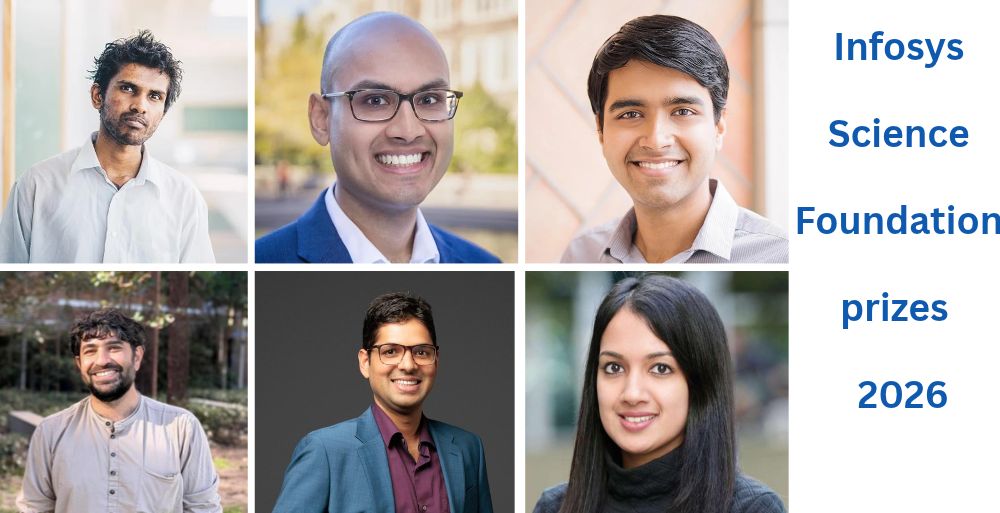
The Infosys Science Foundation has awarded the Infosys Prize 2026 to six distinguished researchers across various fields, each receiving a gold medal and a $100,000 prize for their groundbreaking work.
Bengaluru, India — On November 12, 2026, the Infosys Science Foundation (ISF) announced the winners of the prestigious Infosys Prize 2026, celebrating exceptional contributions in six diverse categories: Economics, Engineering and Computer Science, Humanities and Social Sciences, Life Sciences, Mathematical Sciences, and Physical Sciences. This year’s awards reflect the foundation’s ongoing commitment to fostering innovation and scientific advancement.
The selection process for this year saw a notable increase in engagement, with 222 applications received compared to 150 in the previous year. Kris Gopalakrishnan, a trustee of ISF, pointed out that the Engineering and Computer Science category attracted the highest number of applicants. This increase underscores the growing interest and investment in research and innovation within these disciplines.
In a significant shift, beginning in 2024, the Infosys Prize will focus on honoring researchers under the age of 40. This strategic change aims to recognize and support emerging scholars at an earlier stage in their careers, thereby inspiring future generations of innovators. Srinath Batni, President of ISF, emphasized the importance of early recognition, stating, “Recognizing exceptional researchers early in their careers is particularly important, as it gives them the encouragement and opportunity to pursue bold questions, challenge established thinking, and make lasting contributions to their fields.” This approach aligns with global trends that advocate for the support of young talent in academia.
Winners of the Infosys Prize 2026
The recipients of the Infosys Prize 2026 have made significant impacts in their respective fields:
Economics
Karthik Sastry, an Associate Professor of Economics and Public Affairs at Princeton University, received the award for his notable contributions to climate change, technological innovation, and the analysis of business cycle fluctuations. The jury commended his research for providing critical insights into how societies adapt to climate change through technological advancements, highlighting the potential policy implications of his findings.
Engineering and Computer Science
Swarun Kumar, an Assistant Professor of Electrical and Computer Engineering at Carnegie Mellon University, was awarded for his innovative research that expands the capabilities of low-power wireless networks. His work transcends traditional information delivery, incorporating perception and action in physical environments. By merging insights from physics with novel architectures and algorithms, Kumar has made strides in enhancing connectivity, sensing, control, and actuation.
Humanities and Social Sciences
Gautam Bhatia, an Adjunct Professor at Jindal Global Law School and Green Fellow at the University of New South Wales, received the award for his outstanding contributions as a legal scholar. The jury recognized Bhatia for his rigorous arguments that seek to utilize the law as a means to foster a fair and humane society. With five published books and numerous academic articles to his name, Bhatia’s interdisciplinary approach incorporates macroeconomics, sociology, political theory, and moral philosophy, enriching the legal discourse.
Life Sciences
Isha Jain, an Associate Investigator at the Gladstone Institutes and Assistant Professor at the University of California, San Francisco, was honored for her groundbreaking research in oxygen biology. Her discoveries revealed that tissue damage in specific mitochondrial diseases can stem from excess oxygen rather than energy failure, leading to the development of innovative therapeutic strategies. Jain’s work includes the design of small-molecule treatments aimed at regulating oxygen levels, potentially transforming approaches to inherited metabolic disorders.
Mathematical Sciences
Riddhipratim Basu, also an Associate Professor at the International Centre for Theoretical Sciences of the Tata Institute of Fundamental Research in Bengaluru, was recognized for his exceptional contributions to probability theory and statistical physics. His research addressed longstanding challenges such as the slow-bond problem and provided new insights regarding fluctuations in percolation models. Basu’s work contributes significantly to understanding complex systems, an area of increasing relevance in both theoretical and applied mathematics.
Physical Sciences
Manoj Kumar Joshi, an experimental physicist and Assistant Professor at Singapore University of Technology and Design, was awarded for his pioneering work with trapped ions. His research focuses on the development of programmable quantum machines that elucidate the behaviors of complex quantum systems. The jury noted that Joshi’s contributions to quantum simulation hold the potential to unlock discoveries that surpass the limits of classical computing, promising advances in fields such as materials science and chemistry.
The Infosys Prize not only highlights the achievements of these six remarkable scholars but also reinforces the importance of scientific research and innovation in addressing global challenges. By recognizing and rewarding exceptional talent, the ISF aims to encourage young scholars to pursue their work passionately, thus ensuring the continued advancement of knowledge and technology. As India strides forward on the global research stage, initiatives like the Infosys Prize play a crucial role in shaping the future of scientific inquiry and innovation.