
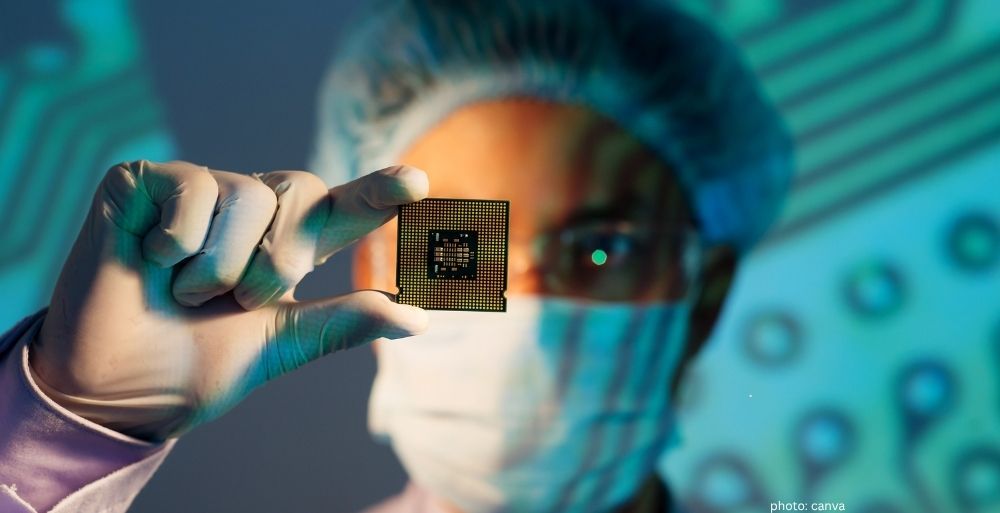
India is ramping up its semiconductor ambitions with a $13.2 billion initiative, seeking to establish itself as a key player in the global chip manufacturing landscape amid rising demand and geopolitical tensions.
NEW DELHI — The Indian government has taken a significant step towards establishing the nation as a global semiconductor hub by approving a $13.2 billion (€11.4 billion) initiative known as Semicon 2.0. This development comes in the wake of escalating global demand for semiconductor chips, which are crucial components in a wide array of technologies, from smartphones to electric vehicles and military systems.
Semiconductors, particularly advanced chips, are predominantly manufactured in Taiwan, which accounts for over 90% of the global supply of these critical components. Any disruption to this industry, especially given the ongoing tensions between the United States and China, could have profound implications for the global economy. The COVID-19 pandemic underscored this vulnerability, as widespread chip shortages forced several automakers to halt production, revealing the world’s over-reliance on a limited number of manufacturers in East Asia.
India’s Semiconductor Ecosystem
The Semicon 2.0 initiative builds upon the previously launched $9 billion India Semiconductor Mission (ISM) initiated in 2021, aiming to develop a comprehensive ecosystem for semiconductor production. This includes not only chip design and fabrication but also advanced packaging, specialty materials, equipment manufacturing, and workforce training. The program is designed to enhance India’s domestic capabilities and reduce reliance on foreign suppliers.
Within this context, companies such as Micron Technology have already established semiconductor assembly and test facilities in India. Thousands of engineers working for major firms like Nvidia, AMD, Qualcomm, and Texas Instruments are already engaged in designing sophisticated chips from research centers located in key Indian cities, including Bengaluru, Hyderabad, and Noida.
Despite this promising foundation, experts caution that India still lags in large-scale manufacturing. V Kamakoti, director of the Indian Institute of Technology in Madras, emphasized the nation’s current strengths in chip design but pointed out that the major challenge lies in establishing a domestic manufacturing ecosystem. “The bigger challenge is manufacturing them,” Kamakoti stated, referring to the need to translate design expertise into large-scale production capacity.
Aiming for a $100 Billion Market
As part of its broader ambitions, the Indian government aims to build a domestic semiconductor market worth between $100 billion and $110 billion by 2030, aspiring to meet up to three-quarters of the nation’s electronics demand through locally designed and manufactured chips. Indian Minister for Electronics and Information Technology Ashwini Vaishnaw has articulated that the next phase of the semiconductor program will focus on integrating more of the semiconductor value chain within India.
Amitesh Kumar Sinha, the chief executive of the ISM, noted that convincing global companies to invest in India has become increasingly feasible, citing the approval of 12 fabrication and packaging projects, three of which are already in commercial production. However, entering the semiconductor manufacturing sector is fraught with challenges, and a leading-edge fabrication plant can cost upwards of $20 billion. Such facilities require a consistent and reliable power supply, significant amounts of ultra-pure water, and a well-established network of suppliers for specialized chemicals and precision equipment.
Strategic Challenges Ahead
Experts emphasize the need for India to prove its capability in manufacturing mature 28-nanometer (28 nm) chips reliably before attempting to produce more advanced 3-nanometer (3 nm) processors, which are primarily used in high-end smartphones and artificial intelligence systems. “28 nm chips will meet the majority of India’s needs. Once that succeeds, we can gradually move to more advanced technologies,” Kamakoti advised.
The geopolitical landscape and the burgeoning demand for semiconductors, particularly driven by advancements in artificial intelligence, present a unique opportunity for India to strengthen its position in the global semiconductor market. Sambit Sahu, a seasoned semiconductor industry veteran, underscored that “the rapid growth of artificial intelligence will drive demand for semiconductors for years to come, creating a window of opportunity for India.”
Nevertheless, skepticism remains about India’s ability to swiftly catch up in the manufacturing arena. A senior semiconductor industry executive, speaking on the condition of anonymity, remarked that while India excels in chip design, the challenges of manufacturing are considerable. “India has built world-class capabilities in chip design, but manufacturing is a different challenge,” the executive noted.
Conclusion
As India embarks on the ambitious Semicon 2.0 initiative, the success of its semiconductor plans will depend not only on the significant financial commitments made but also on the country’s ability to establish a competitive manufacturing ecosystem, complete with skilled workers and state-of-the-art facilities. The outcome of this endeavor could have far-reaching implications for India’s role in the global technology landscape over the next decade.