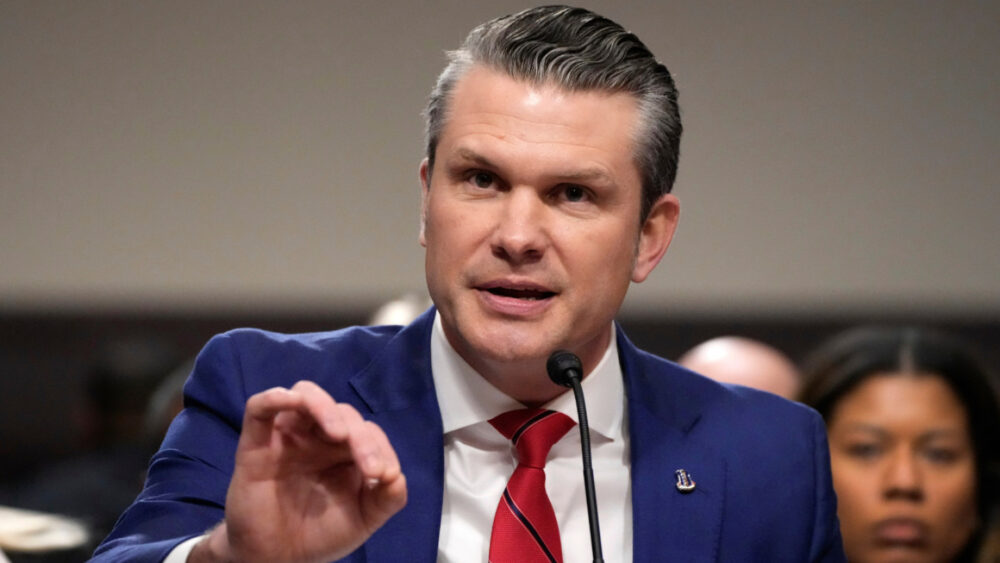
House Republicans voted against an impeachment resolution aimed at Secretary of Defense Pete Hegseth, amidst ongoing partisan tensions following the recent midterm elections.
WASHINGTON, D.C. — On Tuesday, House Republicans successfully blocked a resolution to impeach Secretary of Defense Pete Hegseth, dismissing allegations that he had violated the Constitution through his management of military operations, including the ongoing conflict with Iran. The vote, which ended with a narrow count of 211 to 204, reflected a largely party-line decision, highlighting the divisions within Congress following the Republicans’ recent electoral setbacks.
The impeachment effort was spearheaded by Rep. Thomas Massie of Kentucky, who cited a series of alleged illegal actions by Hegseth, including civilian casualties in Iran and unauthorized military operations in both Venezuela and Yemen. Massie’s resolution described Hegseth as having engaged in “extrajudicial killings” and retaliating against Democratic Senator Mark Kelly for his criticisms of the Pentagon chief. Despite support from top Democrats, the resolution was referred to the judiciary committee, effectively killing the motion for the time being.
Context of the Vote
This vote occurred just a week after the midterm elections, where Republicans experienced significant losses, losing control of both the House of Representatives and the Senate for the first time in over fifty years. The outcome of the elections has left many Republican lawmakers wary of alienating their base, particularly in light of former President Donald Trump’s continued influence and support for Hegseth. Trump publicly celebrated the defeat of the impeachment resolution, calling it the “EXONERATION of a Great American Patriot” on his social media platform, Truth Social.
The Pentagon responded to the vote with a statement declaring it a “total victory” for Hegseth. Sean Parnell, a spokesperson for the Department of Defense, described the referral of the impeachment articles as a win for Hegseth and the military, labeling the allegations as “baseless.”
Democratic Support for Impeachment
Despite the rejection by House Republicans, the issue of Hegseth’s impeachment is not likely to fade away. Hakeem Jeffries, the House minority leader and a prominent figure among Democrats, has spoken out in favor of the impeachment resolution and is expected to assume the role of Speaker when the Democrats regain control of the House in January. In a recent PBS interview, Jeffries emphasized his support, accusing Hegseth of undermining national security and being the architect of a “reckless and costly war of choice in Iran.”
Hegseth, a former Fox News host who has occupied a contentious role within the Trump administration, characterized the impeachment resolution as a politically motivated spectacle. During a press conference at the Pentagon, he dismissed the impeachment effort as a “farce” and a “stunt.” His remarks reflect a broader sentiment among Republicans who have resisted efforts to place blame on him for the conflicts stemming from Trump’s foreign policy decisions.
Partisan Divisions and Military Policy
The conflict in Iran has proven to be a polarizing issue, even among Republicans. Some members have expressed their discontent with the administration’s military strategies, voted in favor of war powers resolutions, and sought to limit President Trump’s authority to conduct military operations without congressional approval. Rep. Warren Davidson, who supported such resolutions, nonetheless rejected the impeachment effort, arguing that it was an attempt to shift blame onto Hegseth for Congress’s and Trump’s decisions.
Hegseth’s tenure as Secretary of Defense has been marked by a series of high-profile controversies, including his management of military personnel and operations. His approach has often been characterized as aggressive, involving the removal of senior military officials and imposing new rules that have led to significant changes within the military’s public relations operations. The ongoing conflict in Iran, which has drawn significant media attention and criticism, has also contributed to rising fuel prices, a factor that Democrats have capitalized on in their midterm campaign narratives.
Details of the Impeachment Articles
The eight articles of impeachment detailed in Massie’s resolution accused Hegseth of multiple constitutional violations, including executing military strikes without Congressional approval and disregarding a war powers resolution passed by both chambers of Congress in June. Among the most serious allegations was the claim that Hegseth ignored laws designed to minimize civilian casualties, with specific reference to a U.S. airstrike on a school in Iran that reportedly resulted in over 168 fatalities.
Additionally, the resolution accused Hegseth of the unlawful killing of at least 221 individuals suspected of drug trafficking in international waters and of acting against Senator Kelly for his public dissent. The final articles of impeachment targeted Hegseth’s involvement in military actions against Venezuela, including attempts to overthrow President Nicolás Maduro, and operations in Yemen that escalated under President Trump’s administration.
Had the impeachment resolution advanced, it would have required Senate approval, where Republicans hold a 53-seat majority. However, it remains uncertain whether such a resolution would have garnered sufficient support for a vote, or if Republican leadership would have allowed it to proceed.