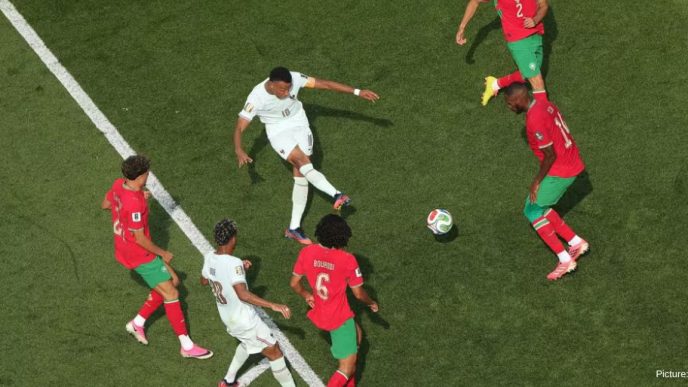
Balogun, the United States’ leading scorer, was reinstated ahead of Monday’s knockout match against Belgium after FIFA’s Disciplinary Committee suspended the implementation of his one-match ban. Despite the ruling, the United States suffered a 4-1 defeat to Belgium in Seattle, ending its hopes of reaching the quarterfinals for the first time in 24 years.
FIFA is facing mounting criticism after allowing United States forward Folarin Balogun to play in the FIFA World Cup 2026 Round of 16 despite an earlier red-card suspension, a decision that came after U.S. President Donald Trump discussed the matter with FIFA President Gianni Infantino.
Balogun, the United States’ leading scorer, was reinstated ahead of Monday’s knockout match against Belgium after FIFA’s Disciplinary Committee suspended the implementation of his one-match ban. Despite the ruling, the United States suffered a 4-1 defeat to Belgium in Seattle, ending its hopes of reaching the quarterfinals for the first time in 24 years.
The decision has drawn sharp criticism from football authorities across Europe.
The Union of European Football Associations (UEFA) accused FIFA of undermining the integrity of the sport.
“When the certainty of rules is no longer guaranteed by its guardians, the integrity of the game is at stake and the credibility of a competition is undermined,” UEFA said in a statement.
Belgium’s football federation also condemned the move, calling it “unprecedented, incomprehensible and unjustifiable” and arguing that it contradicted FIFA’s own regulations.
According to CBS News, sources familiar with the matter said Balogun’s reinstatement followed a phone call from President Trump to Infantino on Thursday. White House World Cup Task Force Executive Director Andrew Giuliani and Commerce Secretary Howard Lutnick were also reported to have communicated with FIFA regarding the suspension.
Speaking at the White House on Monday, Trump defended his intervention.
“I asked for a review because I didn’t think it was a foul.”
He added:
“When they take your best player, or just about, they have some great players … and they say you can’t play, that’s very unfair.”
Trump also argued that preventing Balogun from playing would have “left a big stain” on the tournament.
FIFA maintained that its judicial process remained independent.
In a statement, the organization said Article 27 of its Disciplinary Code allows the Disciplinary Committee to suspend certain sanctions under specific circumstances.
“The FIFA Disciplinary Committee has the discretion to suspend the implementation of any disciplinary measures so long as they do not relate to match manipulation.”
FIFA stressed that Balogun’s punishment had not been overturned entirely. Instead, the committee suspended the one-match ban while imposing a $40,000 fine on the U.S. Soccer Federation.
The governing body said the decision was reached after considering “all of the specific circumstances surrounding the incident and evidence available,” though it did not elaborate on those circumstances.
Infantino rejected suggestions of political interference, acknowledging that he had spoken with Trump while insisting FIFA’s judicial bodies acted independently.
“Yes, I regularly discuss matters related to the FIFA World Cup with the president of the United States… During our conversation, I explained that there was an ongoing legal process involving FIFA’s independent judicial bodies.”
The controversy also prompted criticism from former England captain Wayne Rooney.
“Infantino should be ashamed of this because I think the sportsmanship of the game is in question here.”
Former England defender Gary Neville echoed those concerns, describing the decision as one that “absolutely stinks.”
The Royal Belgian Football Association has formally requested FIFA provide the legal reasoning behind Balogun’s reinstatement and challenged the player’s eligibility before the match. FIFA later ruled Belgium’s request inadmissible, stating the federation was not a party to the disciplinary proceedings.
The incident has reignited debate over the independence of football’s governing bodies, with critics warning that political influence—real or perceived—could damage confidence in the fairness and consistency of the sport’s disciplinary system.