A recent excavation at the Karnak temple complex in Luxor, Egypt, has uncovered a stone slab associated with Roman Emperor Tiberius, raising questions about the integration of Roman authority into ancient Egyptian religious practices.
The Karnak temple complex, one of the largest religious complexes in the world, has long been a focal point for archaeological study, revealing layers of history that reflect the evolution of religious and political life in ancient Egypt. In a significant development, recent excavations have unearthed a stone slab linked to Roman Emperor Tiberius, suggesting a complex interplay between Roman and Egyptian cultures during the imperial period. This discovery is part of an ongoing excavation project initiated in 2022, which is set to continue until 2025, led by a collaborative Egyptian-French archaeological team.
The northern wall gate associated with Pharaoh Ramses III, constructed during the 20th Dynasty, had suffered extensive damage over the centuries. Historical documentation indicates that the site was first recorded in the 19th century, with its lower sections already exposed and unstable. In response to this deterioration, the archaeological team initiated a meticulous restoration project, dismantling, cleaning, and reassembling the stone blocks with scientific precision, rather than conjecture.
Restoration Efforts and Historical Context
The restoration efforts have revealed that several stones used in the construction of the gate were repurposed from earlier monuments, indicating that the site has served as an architectural archive throughout its long history. Decorative elements from the reign of Amenhotep III have been found embedded within the later structure, further suggesting that the Karnak site has been continuously modified and repurposed over centuries. This practice of reusing materials was not uncommon in ancient Egypt, reflecting both a respect for the past and a practical approach to construction.
As work progressed around the gate, archaeologists shifted their focus to the northern wall of the Temple of Amun-Ra. The masonry unearthed during this phase reflects multiple construction periods, indicating that the site was not static but rather a dynamic religious landscape that evolved over time, accommodating various historical epochs. Notably, a paved road linking the Ramses III gate to a major courtyard within the Karnak complex was identified, reinforcing the notion that movement through this area was more structured than previously understood. Mudbrick installations from later antiquity found in the same zone add another layer of occupation, highlighting the continuous significance of the temple complex through different eras.
Roman Presence in Ancient Egypt
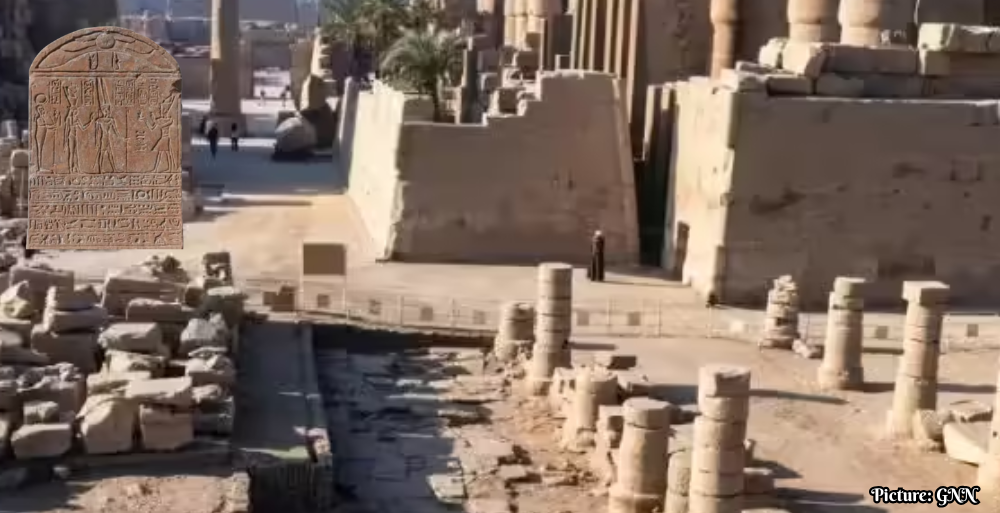
The most remarkable find among these excavations is a sandstone stela measuring approximately 60 by 40 centimeters, linked to Emperor Tiberius. This artifact was discovered near the gate, embedded within layers associated with later settlements. The stela depicts Tiberius in a pharaonic style, presenting him as a participant in traditional religious rituals alongside the Theban triad of Amun-Ra, Mut, and Khonsu. This artistic representation suggests that Tiberius was not viewed solely as a foreign ruler; rather, he was integrated into the local religious framework, reinforcing his legitimacy through shared cultural and religious practices.
The imagery of Tiberius in a traditional pharaonic context is indicative of a broader trend in Roman Egypt where emperors were depicted in ways that aligned them with local beliefs. Such adaptations allowed Roman rulers to establish their authority while respecting and integrating into the existing religious systems. The stele also features a hieroglyphic inscription referencing restoration efforts at the temple, suggesting its role as a commemorative marker rather than merely a decorative object.
Implications of the Discoveries
The discoveries at Karnak not only illuminate the architectural history of the temple complex but also underscore the complex layers of cultural exchange between Rome and Egypt. Experts suggest that as political control shifted over the centuries, the site may have been repeatedly repurposed, reflecting the changing dynamics of authority and religious practice. The presence of Roman artifacts within the Egyptian temple context indicates a mutual influence, where Roman power was absorbed into the local religious landscape rather than supplanting it.
As the excavation project continues, scholars anticipate further insights into the historical interactions between these two ancient civilizations. The findings at Karnak serve as a reminder of the rich tapestry of history that characterizes Egypt’s ancient past, where sacred spaces were not merely static monuments but active sites of cultural negotiation and transformation. The integration of Tiberius into the religious iconography of Karnak exemplifies how rulers navigated the complexities of governance in a culturally diverse empire.
Moreover, the ongoing restoration work within the Karnak complex highlights the importance of preserving and understanding these historical layers. By documenting and reconstructing the site with precision, archaeologists aim not only to restore physical structures but also to uncover the narratives that these remnants of the past hold. The interplay of Roman and Egyptian elements in the temple’s architecture and iconography will likely provide valuable context for understanding the broader socio-political landscape of the region during and after the Roman conquest.