A controversial 8.5-foot-tall satirical sculpture depicting a gilded, nude Donald Trump seated atop a crouching man has sparked widespread debate following its exhibition at the European Parliament headquarters in Strasbourg, France. Created by renowned Danish artist Jens Galschiøt, the artwork—titled The Orange Plague or The King of Injustice—presents a stark visual commentary on the geopolitical, environmental, and humanitarian impacts of current U.S. administration policies. Sponsored by European lawmakers, the mobile installation highlights deep-seated anxieties among international observers regarding ongoing global conflicts, domestic federal execution mandates, and proposed architectural overhauls in Washington, D.C.
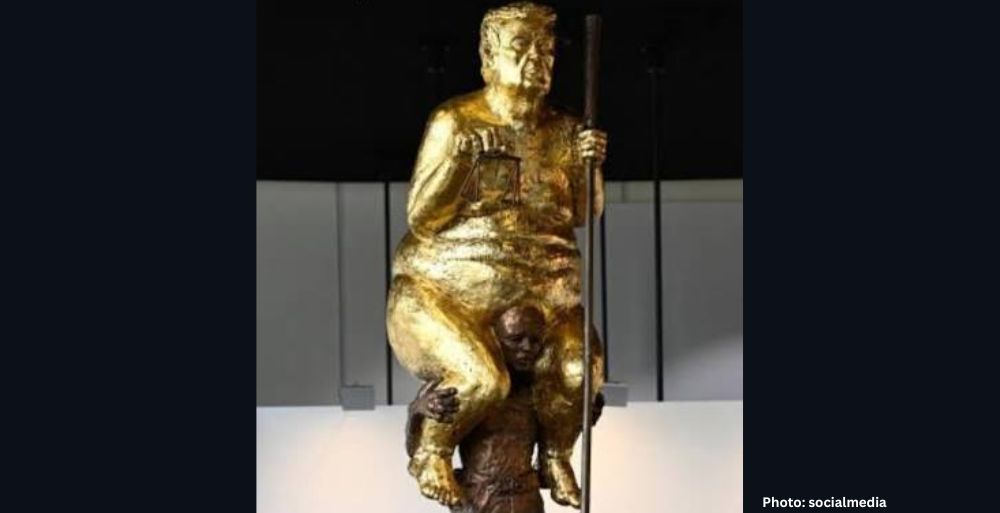
STRASBOURG, France — Inside the central concourse of the European Parliament headquarters in Strasbourg, lawmakers, diplomats, and international visitors recently found themselves standing before an arresting, 8.5-foot-tall (2.6-meter) artwork that has drawn sharp attention to the state of global politics. Coated in 23-karat gold leaf, the provocative sculpture depicts a larger-than-life, nude figure of U.S. President Donald Trump seated heavily on the neck and shoulders of a small, bent man buckling under his physical weight.
In his right hand, the sculptured figure holds a scepter-like golf club, while his left hand balances the scales of justice. Rested near his feet is a gilded golf ball crafted to resemble the physical topography of planet Earth. Placed on the base of the pedestal is a prominent plaque carrying an inscription that frames the work’s central message: “I am sitting on the back of a man. He is sinking under my burden. I will do anything to help him. Except step down from his back.”
The installation, created by Danish sculptor Jens Galschiøt, is officially titled The Orange Plague, though it is also known internationally as The King of Injustice. Brought to Strasbourg through the sponsorship of Danish Member of the European Parliament (MEP) Per Clausen, the exhibition reflects escalating international scrutiny surrounding U.S. foreign policy, global trade disputes, and domestic regulatory shifts.
Artistic Expression and the European Political Landscape
The unveiling of The Orange Plague in Strasbourg highlights a growing willingness among European legislators to visually confront transatlantic policy divergences. Speaking to reporters at the exhibition opening, artist Jens Galschiøt explained that his design draws directly from Hans Christian Andersen’s classic 1837 fable The Emperor’s New Clothes, utilizing raw satirical imagery to challenge what he characterizes as an alarming concentration of political power and environmental disregard.
“This sculpture was created to address the elephant in the room and initiate a necessary global debate regarding how unilateral decisions impact international stability and the rule of law,” Galschiøt stated during a press briefing, surrounded by observers examining the installation. The artist’s previous major works include the iconic Pillar of Shame (1997), erected to commemorate victims of the Tiananmen Square crackdown, establishing his decades-long career of creating public art focused on human rights and state accountability.
Danish MEP Per Clausen defended the decision to host the exhibition within the official halls of European governance despite potential diplomatic friction. “If political leaders or institutions are so thin-skinned that they cannot tolerate a satirical artwork being displayed in the European Parliament, then they lack the resilience needed on the international stage,” Clausen remarked calmly to attending journalists.
The Strasbourg exhibit represents the latest stop in an international tour. The artwork was previously displayed at the COP30 United Nations Climate Change Conference in Belém, Brazil, and is scheduled for transport to Antalya, Türkiye, in early November 2026, coinciding with the gathering of international heads of state for the COP31 World Leaders’ Summit.
Broader Transatlantic Anxiety: War, Inflation, and Global Crises
While the physical statue in Strasbourg has generated visual intrigue, European policy analysts emphasize that the artwork’s core resonance stems from real-world economic and geopolitical pressures straining domestic and foreign populations alike.
The global economy continues to navigate multi-front disruptions, including ongoing hostilities in Eastern Europe following the prolonging of the Ukraine war, alongside heightened volatility in the Middle East surrounding Iranian regional conflicts. These strategic crises have repeatedly rippled through international energy supply chains, causing persistent fluctuations in global crude oil and domestic gasoline prices.
Concurrently, everyday consumers across North America and Europe face sustained inflationary pressures on core staple food items, compounding broader anxieties over household economic stability. These macroeconomic headwinds are further intensified by ongoing disputes surrounding international trade tariffs, border security mandates, and immigration enforcement practices—most notably controversies surrounding the operational conduct and detention metrics of U.S. Immigration and Customs Enforcement (ICE).
Furthermore, public discourse in Washington and abroad remains frequently occupied by the continued judicial and legislative disclosures of high-profile investigative documents, including the lingering release of government files related to the late financier Jeffrey Epstein. Critics argue that the constant churn of media controversy around these files often distracts from fundamental legislative oversight and global security agreements.
Controversies Over Capital Infrastructure and Architectural Changes
The international critique symbolized by Galschiøt’s sculpture coincides with intense domestic debate in Washington, D.C., over the administration’s management of federal heritage sites, capital infrastructure, and civic arts institutions.
A central point of contention involves recent structural modifications within the historic White House complex, where partial demolition and renovation work on the East Wing was initiated without formal prior review by local heritage preservation authorities or municipal historical commissions. Administration officials have maintained that the upgrades are necessary for modernized security and operational efficiency, but historic preservation groups have raised formal legal challenges regarding compliance with federal environmental and architectural protection statutes.
Simultaneously, major governance changes at the John F. Kennedy Center for the Performing Arts have drawn significant scrutiny from national arts organizations. Following executive restructurings that replaced long-serving board members and senior administrative personnel, disputes emerged over facility branding and executive control. After federal courts issued preliminary injunctions restricting unilateral renaming efforts on the building’s exterior, operational programming faced temporary disruptions and funding holds while litigators debated the limits of executive oversight regarding Carrara marble fixtures on the landmark’s façade.
Urban planners and civic historians have voiced additional concern over proposed large-scale monuments within the District of Columbia. Principal among these is a proposed 250-foot triumphal arch structure—referred to in preliminary planning drafts as the “Arc de Trump”—designed to span key vistas within the National Mall corridor. Preliminary impact assessments conducted by the National Park Service indicate that a structure of that scale would directly alter the visual sightlines and historic vistas connecting 37 registered historic sites, including the direct corridor between the Lincoln Memorial and Arlington National Cemetery.
Federal Capital Punishment and Legal Injunctions
Beyond public infrastructure, executive actions regarding the federal judiciary and penal system have generated intense legal debate among constitutional scholars and religious institutions.
While presidential administration officials highlight strict law-and-order mandates as vital for public safety, civil rights organizations have raised formal challenges regarding the administration’s push to resume and expand federal executions. Following a period in which preceding administrations commuted multiple federal death sentences, current Department of Justice directives have positioned three remaining federal death-row inmates for execution.
Legal controversy reached a peak over administrative proposals to permit public media broadcasting of upcoming executions, including a scheduled December proceeding involving a paraplegic federal prisoner. Opponents have argued in federal district courts that televised capital punishment violates constitutional protections against cruel and unusual punishment, while proponents argue that transparency in capital proceedings serves as a public deterrent.
Concurrently, federal courts have intervened regarding the use of taxpayer funds for official executive communications. A federal district judge recently issued a temporary restraining order directing the administration to halt the broadcast of federally funded television advertisements promoting executive policy successes, agreeing with plaintiffs that the promotional broadcasts blurred the legal boundary between informational public service announcements and political advertising.
Educational Background and Philosophical Debates
The public debate surrounding these policy directives has frequently turned toward the philosophical and religious principles guiding federal decision-making. Observers note that while a significant majority of cabinet officials and senior administration personnel publicly identify with Catholic and traditional Christian doctrines, policy choices regarding executive power, capital punishment, and social welfare programs continue to provoke public pushback from religious scholars and clerical leadership.
Commentators have frequently cited the president’s early academic background, including his two years of undergraduate study at Fordham University—a prominent Jesuit institution in New York City—before transferring to the University of Pennsylvania. Religious ethicists and academic scholars often debate the extent to which traditional Jesuit educational principles, which emphasize social justice, institutional restraint, and care for vulnerable populations, are reflected in contemporary executive policy.
As the 8.5-foot gold-leafed sculpture prepares for its next public exhibition in Türkiye ahead of the COP31 global summit, international observers note that the debate it represents is far from resolved. Whether discussing international climate commitments, capital monument construction, or federal judicial execution mandates, the broader geopolitical landscape remains heavily shaped by the ongoing friction between national executive authority and global institutional norms.