As temperatures soar at the 2026 French Open, players voice concerns about match conditions after Jakub Mensik collapses on court following a grueling five-set match.
The 2026 French Open at Roland Garros has become a focal point for discussions about player safety amid extreme weather conditions, particularly after Czech player Jakub Mensik collapsed on the court following a taxing five-set match on Wednesday, May 24. This incident has raised alarms among players and officials regarding the tournament’s scheduling and the management of matches during severe heatwaves.
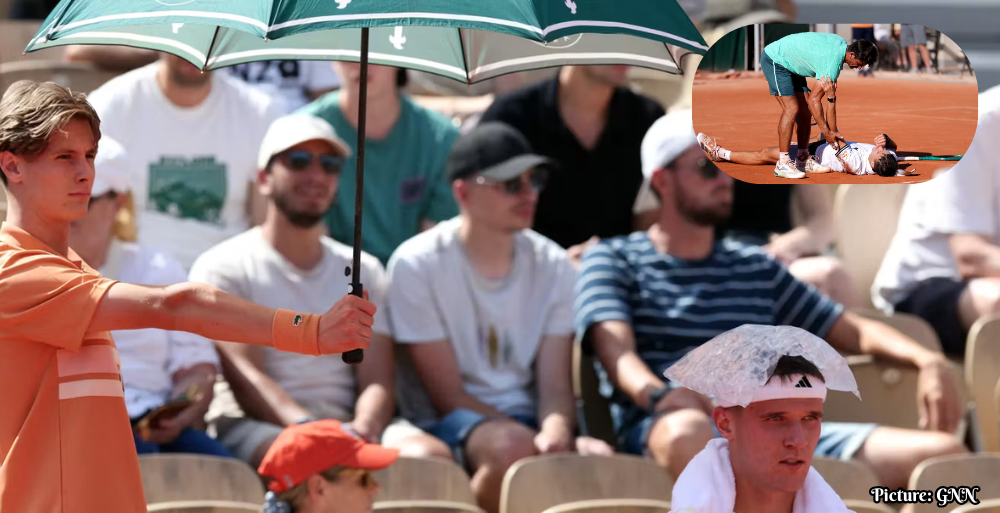
On a day when temperatures climbed into the mid-30s Celsius (around 95 degrees Fahrenheit), Mensik, the 26th seed, endured a marathon match lasting four hours and 41 minutes against Argentina’s Mariano Navone. Mensik ultimately triumphed with a scoreline of 6-3, 2-6, 6-4, 1-6, 7-6 (13-11). However, moments after clinching the victory, he collapsed onto the clay, overcome by exhaustion and cramping.
Medical Response and Player Reactions
Immediately after the match, Mensik was attended to by medical staff who treated him on the court. Ice packs were applied to his head, neck, and chest in an effort to reduce his body temperature. Although he initially struggled to stand, Mensik managed to walk to the locker room with assistance, as he expressed a desire not to be wheeled off the court. After the match, he emphasized the extreme nature of the conditions.
“When I hit the last winner, the emotions went out and my body just turned off,” Mensik stated in the post-match press conference. He further described playing in such weather as “insane,” particularly under the direct sun for over four hours. The player expressed frustration with the strict timing rules enforced during matches, which he felt contributed to his physical struggles. “The rules are rules, of course, but obviously in this heat and in these conditions it’s insane,” Mensik said.
ATP Regulations on Heat and Player Safety
According to ATP regulations, medical timeouts for muscle cramping are not typically allowed, as cramping is categorized as a fitness issue rather than an injury. However, if medical personnel determine that a player is suffering from heat illness, cramping may be treated as part of this condition. The ATP rulebook specifies that treatment for cramping can occur during designated break periods, yet Mensik noted that the time constraints did not allow for adequate recovery.
Novak Djokovic, a veteran of the sport and 24-time Grand Slam champion, also commented on the challenging conditions following his own second-round match against French wildcard Valentin Royer. Djokovic required three hours and 44 minutes to secure his victory and suggested that tournament organizers might need to consider rescheduling matches to later in the evening during extreme heat. “If you have certain days that you have extreme heat and conditions, then maybe that’s something to consider,” he remarked.
Broader Implications for Player Welfare
The conversation surrounding player welfare at the French Open is not new. As temperatures continue to rise globally, sporting events are increasingly scrutinized for their handling of extreme weather. Other players, including women’s 15th seed Marta Kostyuk, have echoed similar sentiments about the difficulty of competing in the oppressive heat. Kostyuk noted, “It’s still hot and it’s very dry. I always felt like I need to drink, I want to drink more and more. It was tough.”
Historical precedents have shown that health and safety measures are critical during competitive play. Previously, matches have been suspended due to extreme conditions, but no match at the French Open has ever been halted specifically for heat-related issues. Tournament officials employ wet bulb sensors to monitor conditions, which can trigger a 10-minute heat break after specific thresholds are reached. In the current tournament, however, such conditions have yet to warrant a suspension.
Future Considerations for Tournament Scheduling
The ongoing situation at Roland Garros raises significant questions about how tennis tournaments worldwide will adapt to changing climate conditions. With players like Djokovic advocating for later match timings, the implications for both player health and fan attendance are considerable. As the French Open progresses, the scrutiny on how organizers respond to heat-related challenges will likely intensify.
In conclusion, the incident involving Jakub Mensik serves as a stark reminder of the physical toll that extreme weather can exact on athletes. As the conversation around player safety continues, it is clear that the governing bodies of tennis must confront these challenges head-on to ensure the well-being of all competitors.