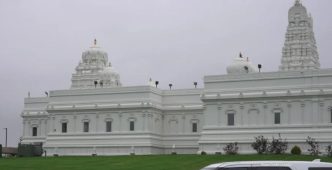
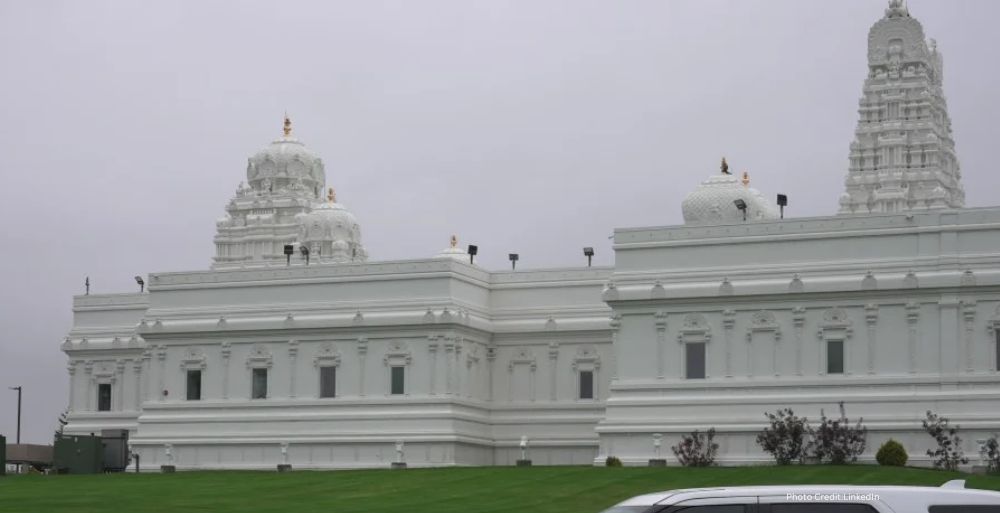
Federal and state law enforcement agencies are increasing security coordination around minority places of worship following an attempted mass shooting at the Sri Venkateswara Swami (Balaji) Temple in Aurora, Illinois, on October 11, 2026. Prosecutors state that a 19-year-old white supremacist attempted an armed assault during Navratri, one of the most significant festivals in the Hindu calendar, but was thwarted when his firearm jammed. The incident marks a severe escalation in a documented multi-year rise in physical vandalism, threats, and targeted violence directed at non-Christian religious sites across the United States and Western nations. Sociologists and security experts note that as immigrant communities transition from temporary rented spaces to prominent, traditionally designed religious landmarks, their increased physical visibility makes them prime targets for extremist violence and hate crimes.
The Aurora Incident and Criminal Charges
AURORA, Ill. — A failed mass shooting at a prominent Hindu temple in suburban Chicago has exposed acute security vulnerabilities and rising hate crime risks facing minority faith communities across the United States.
On Wednesday, October 14, 2026, a circuit court judge ordered 19-year-old Alexandros Paporakis detained without bail following his arrest in connection with an attempted attack on the Sri Venkateswara Swami (Balaji) Temple in Aurora, Illinois. According to charging documents filed by state prosecutors, Paporakis entered the temple grounds on Sunday, October 11—during the celebration of Navratri, a major nine-night Hindu festival—equipped with an assault-style rifle and intent on executing a mass casualty event.
Prosecutors told the court that Paporakis’s weapon jammed upon entry, preventing him from discharging rounds into the gathered congregation. Following the mechanical malfunction, the suspect fled the scene.
The plot was uncovered after co-workers alerted law enforcement authorities to Paporakis’s escalating rhetoric and explicit threats. According to police records, co-workers reported that Paporakis openly espoused white supremacist ideology and stated the day prior to the attack that he “could not wait to kill Indian people” at “the largest Hindu temple in Aurora.”
Furthermore, law enforcement recovered an eight-page manifesto authored by the suspect, titled “Why I Fought: A.K.A. (Aurora Shooter’s Manifesto).” In the document, Paporakis detailed explicit plans to murder as many worshippers as possible while classifying individuals of Indian, Jewish, and Black heritage as “subhumans.” Paporakis faces formal state and federal charges including making a terroristic threat, attempted hate crime, and unlawful possession of a firearm.
Pattern of Extremist Targeting of Religious Landmarks
The attempted mass shooting in Aurora represents the culmination of a broader, well-documented surge in bias-motivated attacks targeting minority houses of worship across the Western world.
Data compiled by civil rights organizations and law enforcement agencies indicates a steady acceleration of physical hostility directed at Hindu temples, synagogues, mosques, and gurdwaras over the past decade:
- Hindu Places of Worship: In March 2025, civil rights groups recorded the 10th act of vandalism or burglary at a U.S. Hindu temple since 2022 following the defacement of a site in Chino Hills, California. Subsequent attacks in late 2024 damaged Swaminarayan temples in Melville, New York, and Sacramento, California, where perpetrators spray-painted anti-immigrant slogans including “Hindus go back.” In June 2025, shots were fired into a Krishna temple in Spanish Fork, Utah, while congregants prayed inside. Most recently, in early October 2026, bricks were thrown through the windows of a Swaminarayan temple near Cleveland, Ohio.
- Synagogues and Mosques: Globally, religious facilities face parallel threats. In October 2025, two worshippers were killed in an anti-Semitic attack on a synagogue in Manchester, England, during Yom Kippur, followed days later by an arson attack on a mosque in Peacehaven, East Sussex. These follow historical mass-casualty events, including the 2018 Tree of Life synagogue shooting in Pittsburgh, Pennsylvania, which claimed 11 lives, and the 2012 white supremacist shooting at a Sikh gurdwara in Oak Creek, Wisconsin, which left six dead.
Architectural Visibility and the Sociology of Diaspora Sacred Spaces
Academic experts studying religious diaspora communities note that the targeting of sites like Aurora’s Sri Venkateswara Swami Temple is intrinsically linked to the physical evolution of immigrant institutions in Western nations.
In the initial decades following major non-European migration waves to North America and Europe, congregations typically met in inconspicuous, rented facilities—such as converted warehouses, school cafeterias, or suburban storefronts. However, as these communities established deep financial and generational roots, many transitioned to constructing purpose-built, traditional structures.
Aurora’s Balaji temple exemplifies this transition. Built in accordance with classical South Indian architectural standards (Shilpa Shastras), the soaring, ornate structure stands in stark visual contrast to the surrounding Midwestern farmland and suburban arterial roads.
For practitioners, these temples are not merely community centers or national symbols; they are consecrated spaces housing murtis—deities understood by devotees to embody the literal presence of the divine. Daily rituals include waking, bathing, dressing, and offering food to the deities, with congregants attending for darshan (the act of visual communion with the divine).
However, scholars point out that to hostile outside observers and far-right extremists, highly visible, non-Western architecture is viewed primarily as an ideological symbol of demographic shift, immigration, or racial difference. When public discourse frames sacred sites primarily through political or nationalistic lenses, extremist actors increasingly view these buildings as proxy targets for their resentment.
Security Infrastructure and Community Vigilance
The persistent threat environment has fundamentally altered the physical experience of attending worship services for millions of Americans. Synagogues, mosques, gurdwaras, and Hindu temples across the country have been forced to implement institutional security measures reminiscent of high-security public infrastructure.
Congregations increasingly rely on private security guards, high-definition camera grids, perimeter fencing, and mandatory bag checks or metal detectors. While religious leaders acknowledge that these measures create an uncomfortable tension with the traditional openness and sanctity of houses of prayer, most view them as mandatory risk mitigation steps in the current climate.
Security analysts emphasize, however, that physical barriers represent only one component of public safety. The prevention of mass casualty events relies heavily on early detection and civil reporting. In the Aurora case, the intervention of ordinary citizens—specifically, Paporakis’s co-workers who took his violent statements seriously and immediately alerted law enforcement—prevented what could have been one of the deadliest hate crimes in Illinois history.
As federal law enforcement agencies review safety protocols for minority religious institutions ahead of upcoming religious observances, civil rights advocates are calling for increased federal security grants, improved hate crime reporting metrics, and a national push to recognize and protect sacred spaces from politically motivated violence.