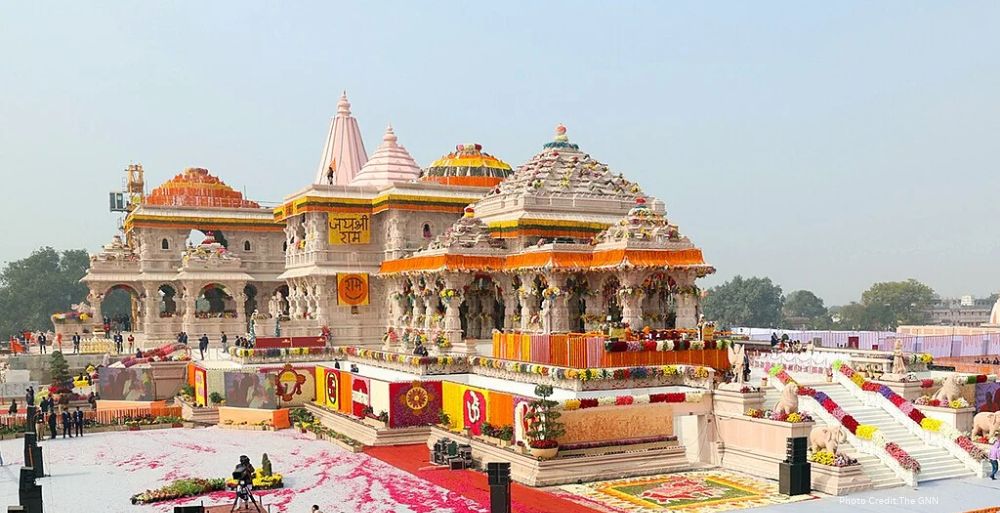
Today I am giving you the complete physics behind the Ayodhya Ram Mandir. The news shows you the rituals, the crowds, and the politics. But as a scientist, I look at the engineering. I look at the materials. I look at the forces of nature that had to be overcome to build something that will stand for a thousand years. What stands in Ayodhya is not just a place of worship; it is a masterclass in applied physics, executed by the finest minds of this country.
Let me take you layer by layer, from the ground beneath the temple to the sky above it, and the invisible shield that protects it.
First, the Foundation.
The land near the Sarayu river is not solid rock. It is loose, sandy soil. You cannot build a massive stone structure on that. It will sink. So the engineers from IITs and L&T did something brilliant. They excavated 15 meters of loose soil and debris. Then, they replaced it with 47 layers of engineered soil and Roller Compacted Concrete—a 15-meter thick artificial hill. This artificial rock foundation is designed to hold the temple steady for over a thousand years. They ran over 50 computer models to simulate earthquakes and soil liquefaction. The temple is designed to absorb earthquakes 50 times stronger than those that have occurred in the region so far.
Second, the Rejection of Steel.
The most important decision was the complete absence of iron and steel in the main structure. Steel has a property called corrosion. The life of iron is merely 80 to 90 years. Over decades, moisture and oxygen will eat it away. So the engineers went back to our ancient tradition of dry-stone interlocking. They used granite pins and copper plates. Copper is a rust-free metal. It does not corrode. It will last for millennia. They used the physics of the material to ensure endurance, not the chemistry of modern alloys.
Third, the Brain Behind the Build.
The structure has thousands of uniquely carved stone pieces. No human drawing could coordinate this complexity without errors. So they used Building Information Modeling, or BIM. They created a digital twin of the entire temple before a single stone was placed. This 3D model simulated the spatial relationships, eliminated clashes, and guided the artisans with millimetric precision. It is the same technology used to build modern aircraft, applied to a temple.
Fourth, the Idol.
The Ram Lalla idol is carved from Krishna Shila, a black stone found in the Kali Gandaki river in Nepal. This stone is not ordinary. Geologically, it is Shaligram, a fossilised ammonite that is said to be over 6 crore years old. Chemically, it is inert. When milk and offerings are poured over it, the stone does not react. The milk can be consumed safely as prasadam. The stone is dense, non-porous, and resistant to weather. We are using a material that time itself cannot destroy.
Fifth, the Sound.
A bell weighing 2,100 kilograms has been installed. It is made of Ashtadhatu, an alloy of eight metals—gold, silver, copper, zinc, lead, tin, iron, and mercury. The specific ratio of these metals determines the acoustic frequency. The sound of this bell can be heard up to 15 kilometers away. This is not just a loud noise. It is a specific vibrational frequency designed to create a psychological and physiological state of stillness in the listener. Sound is a physical wave. The bell is an instrument for directing that wave.
Sixth, the Light.
On Ram Navami, the sun’s rays hit the forehead of the deity. This is not a miracle. It is applied optics. Scientists from ISRO and several IITs worked on this. Using a series of four mirrors, four lenses, and brass pipes, they crafted a solar alignment that would reflect sunlight with pinpoint precision onto the deity’s forehead, forming a radiant 75mm disc known as the Surya Tilak. The alignment is so precise that it lands on the forehead for a few minutes at noon. It is the exact same principle used in semiconductor photolithography—directing light with absolute precision using optics, not electronics. They used an infrared filter to block the heat and coated the pipes with black powder to prevent light from scattering.
Seventh, the Invisible Shield.
And finally, the most critical layer that protects everything above—the security apparatus. This is not just a fence; it is a living, intelligent system. The temple is protected by a multi-layered security cover that includes AI-powered cameras, anti-drone technology, and bomb detection systems.
Over 10,000 CCTV cameras, many equipped with AI analytics, monitor the site. These are not just recording devices. They track crowd density, detect suspicious behaviour, and alert security personnel in real-time. The anti-drone system can detect and intercept any unmanned aerial vehicle within a 2.5-kilometre radius. During a trial, a drone was shot down and examined by a bomb disposal squad to confirm there was no threat. The security plan also includes mine detection units, BDS squads, X-ray scanners, handheld metal detectors, vehicle scanners, and a dedicated team of 6,970 security personnel. The temple is protected by a digital immune system, a physical barrier, and a human intelligence network, all working together.
The Deeper Truth.
This temple is a synthesis. The foundation is modern geotechnical engineering. The structure is ancient material science—copper and stone. The planning is digital. The idol is geological. The bell is acoustic. The light is optical. The shield is electronic and human intelligence.
Our ancestors built with these principles. They knew that stone outlasts steel, that copper outlasts iron, that geometry and light can be used to create stillness. What the engineers of Ayodhya have done is to rediscover that knowledge and apply it with modern tools.
This is what I want you to understand. When we align our intelligence with the laws of nature, we can build things that endure. Not for a lifetime. For a thousand years. And we can protect them with the same intelligence that built them.