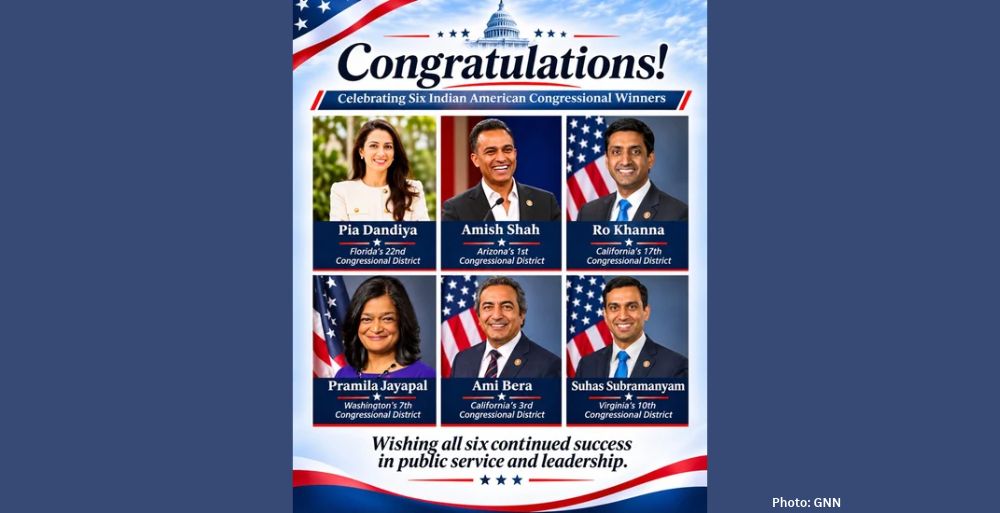
In the 2026 midterm elections, Indian American candidates made significant strides, securing congressional seats, state offices, and legislative leadership roles across the United States.
Indian American candidates achieved historic victories in the 2026 midterm elections, with a notable presence in both congressional and local races. A total of six candidates of Indian origin were elected to the U.S. House of Representatives, marking a substantial increase in representation within the federal legislature. Additionally, various state and local offices were filled by Indian American representatives, further solidifying their influence in American politics.
Pioneering Victories in Congress
Among the standout victories were Pia Dandiya of Florida and Dr. Amish Shah of Arizona, both of whom made history as the first individuals of Indian descent elected to the U.S. House from their respective states. Dandiya, a 39-year-old educator and former White House Fellow, won approximately 52 percent of the vote in Florida’s 22nd Congressional District, defeating Republican Casey Askar. Dandiya’s background includes founding a high school in Harlem aimed at economically disadvantaged students, underscoring her commitment to education.
In Arizona, Dr. Amish Shah, an emergency medicine physician and former state legislator, captured the 1st Congressional District seat, defeating Republican Jay Feely. Shah, whose parents immigrated from Gujarat, previously made history as the first Indian American elected to the Arizona legislature in 2018, advocating for healthcare affordability and bipartisanship throughout his political career.
Incumbents Secure Re-Election
Four incumbents also successfully retained their congressional seats. Suhas Subramanyam of Virginia won re-election in the 10th Congressional District, defeating Republican Dave Beckwith by a substantial margin. Subramanyam, a former advisor to President Barack Obama, had previously made history as the first Indian American elected from Virginia.
In California, Dr. Ami Bera, the longest-serving Indian American in Congress, secured his eighth term in the 3rd Congressional District, overcoming Republican Robb Tucker. Bera’s deep involvement in healthcare and foreign affairs has made him a prominent figure on Capitol Hill.
Ro Khanna and Pramila Jayapal, both Democrats from California, also won re-election, with Khanna representing Silicon Valley’s 17th Congressional District and Jayapal representing Seattle’s 7th District. Khanna, known for his role as co-chair of the Congressional Caucus on India and Indian Americans, defeated Republican Ritesh Tandon, while Jayapal, a leading progressive advocate, has been influential in immigration reform and workers’ rights.
Local and State Leadership Achievements
Beyond Congress, Indian Americans made notable gains in state and local elections. Aruna Miller was re-elected as Maryland’s lieutenant governor, a position she first assumed in 2022, becoming the first Indian American woman to hold such office in the U.S. Miller, who immigrated from India at age seven, has emphasized infrastructure and public services during her tenure.
Nithya Raman triumphed in the Los Angeles mayoral race, becoming the first Indian American and first Asian American to lead the city. Raman’s campaign focused on housing affordability and homelessness, reflecting growing concerns among residents of California’s largest urban center. Following her victory, she expressed gratitude for the opportunity to serve the diverse communities of Los Angeles.
Historic Legislative Leadership Roles
Ranjeev Puri emerged as Michigan’s first Indian American House Speaker after his re-election from District 24. Puri’s rise to leadership follows the Democrats’ return to the majority in the Michigan House. His background as the first Sikh American in the state legislature highlights the evolving diversity of representation in Michigan politics.
In Arizona, Priya Sundareshan was selected to lead the state Senate, marking another significant milestone for Indian American representation. Her leadership role coincides with the Democrats gaining control of both chambers of the Arizona Legislature for the first time in 60 years. Sundareshan, a graduate of MIT and a seasoned legal expert, has quickly ascended in state politics since her election to the Senate in 2022.
Expanding Representation Nationwide
The success of Indian American candidates extended to various state legislatures across the country. In Maryland, Amar Mukunda was elected to the state Senate, while in Illinois, Nabeela Syed flipped a Republican-held seat to secure her position in the state Senate after previously becoming the youngest female member of the Illinois General Assembly.
In North Carolina, Jay Chaudhuri won another term in the state Senate, having been the first Indian American elected to the North Carolina General Assembly. Similarly, in Vermont, Kesha Ram Hinsdale continued her legislative work after previously breaking barriers as the first woman of color in the Vermont State Senate.
Other notable victories included Jyot Singh in Georgia, who became the first Sikh American in the state legislature, and Pooja Sethi in Texas, who made history as the first Indian American woman elected to the Texas Legislature. Their elections reflect a growing trend of increasing diversity and representation in U.S. politics.
As the 2026 midterm elections concluded, nearly seven decades after Dalip Singh Saund became the first person of Indian origin elected to Congress in 1957, the political landscape for Indian Americans continues to expand, offering new opportunities for leadership and representation at all levels of government.