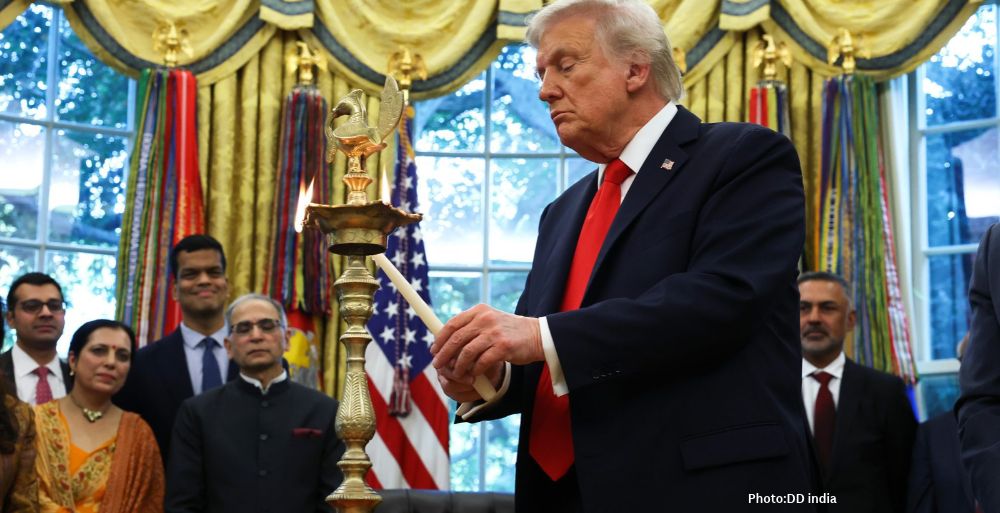
During a Diwali celebration at the White House, President Donald Trump was presented with the Hanuman Chalisa, a gesture symbolizing cultural ties between the United States and India.
Washington, Nov 7 – President Donald Trump hosted a Diwali celebration in the Oval Office on Friday, marking a significant cultural observance that included the presentation of the Hanuman Chalisa, a revered Hindu devotional text. The event, described as a private gathering, was attended by various guests, including entrepreneur Vishal Gondal, who presented the text while expressing hopes for strengthened India-U.S. relations.
Gondal shared his experience on social media platform X, stating, “Honored to celebrate Diwali with President @realDonaldTrump and proud to gift him with a copy of the Hanuman Chalisa, Tulsidas’s hymn to Lord Hanuman that millions of us recite for courage, devotion, and strength.” This gift not only underscores the cultural exchange between the two countries but also reflects the growing influence of the Indian-American community in the United States.
Details of the Celebration
The White House scheduled the Diwali celebration for 1:30 PM EST, designating it as a private event with no press access. During the ceremony, diyas, or traditional oil lamps, were lit to symbolize the triumph of light over darkness, a central theme of the Diwali festival. Gondal articulated his aspirations for friendship between India and America, framing the celebration in a context of shared values and cooperation.
A photograph shared by Gondal displayed the Hanuman Chalisa, which was elegantly presented in a cream-colored cover set against red fabric. The cover features a depiction of Lord Hanuman in a kneeling position, holding a text, surrounded by lotus motifs and adorned with metallic corner protectors.
In a group photograph taken during the celebration, attendees, dressed in a mix of traditional Indian attire and formal suits, posed around the president’s desk, which was adorned with various items including books, telephones, and a model aircraft. The image conveyed a blend of cultural and political symbolism, reflecting both the significance of Diwali and the formal setting of the Oval Office.
Program Highlights
Gondal also posted an image of a program detailing a half-hour ceremony that included remarks from the president and the lighting of a diya shortly after the event began. Notable attendees mentioned in the program included Secretary of State Marco Rubio, FBI Director Kash Patel, and National Institutes of Health Director Jay Bhattacharya, although their attendance was not independently verified.
Other prominent figures expected at the gathering included Indian Ambassador Vinay Mohan Kwatra, IBM CEO Arvind Krishna, Micron Technology CEO Sanjay Mehrotra, celebrated chef Vikas Khanna, and businesswoman Ruby Dhalla. These individuals epitomize the diverse contributions of the Indian-American community to various sectors in the United States.
Personal Reflections on the Occasion
Gondal expressed his personal feelings about the event, noting, “I never imagined celebrating Diwali in the Oval Office. Being there with President Trump, I felt his magnetic presence firsthand.” This sentiment illustrates how the occasion was not only a political event but also a culturally significant moment for those present, reinforcing the importance of such gatherings in fostering understanding and goodwill.
Historical Context of Diwali Celebrations at the White House
Diwali observances at the White House date back to 2003 during the administration of President George W. Bush. However, it was President Barack Obama who, in 2009, became the first sitting president to light a diya within the White House, a gesture that was widely interpreted as an effort to promote inclusivity towards the Indian-American community. The continuation of this tradition under the Trump administration emphasizes the significance of Diwali as a festival that promotes cultural understanding and international friendship.
The celebration of Diwali at the White House not only honors a major festival in Hindu culture but also serves as a reminder of the broader theme of unity among the diverse communities within the United States. As the Indian diaspora continues to expand and influence various sectors, events like these highlight the importance of cultural diplomacy, which plays a pivotal role in strengthening international relations.
The gathering in the Oval Office fits within a broader narrative of how cultural events can serve as platforms for dialogue and understanding. By recognizing and celebrating the traditions of diverse populations, the U.S. administration reinforces its commitment to appreciating multiculturalism, a value that is increasingly relevant in today’s globalized world.
In conclusion, the Diwali celebration at the White House, marked by the presentation of the Hanuman Chalisa, encapsulates the ongoing engagement between the United States and India and serves as a testament to the rich tapestry of cultural traditions that contribute to the nation’s identity.