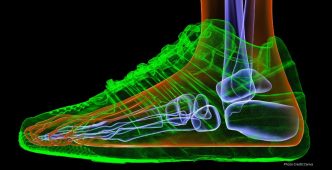

The University of Chicago study demonstrates significant differences in ankle bone structures between modern shoe-wearers and indigenous barefoot individuals, providing insights into how footwear impacts human evolution.
A recent study conducted by researchers at the University of Chicago highlights the dynamic nature of human bones, revealing how footwear influences bone structure and potentially impacts our understanding of human evolutionary history. The research, which utilized advanced CT scanning technology, compared the ankle bones of modern individuals who wear shoes with those of indigenous populations who typically go barefoot.
The study, led by Hannah Farrell, a former postdoctoral researcher at UChicago and now a faculty member at the University of North Texas Health, is centered around the analysis of trabecular bone—the spongy tissue found within the ends of bones. Trabecular bone is crucial for providing structural support and shock absorption, adapting over time in response to the physical forces exerted by various activities, such as walking, running, and climbing.
“A lot of people think the skeleton is a fixed thing, but it’s constantly changing during your life in response to your behavior,” said Zewdi Tsegai, PhD, Assistant Professor of Organismal Biology and Anatomy at UChicago and senior author of the study. “So, we’re using this plasticity of the skeleton to try to understand how living people vary and then taking that back to fossils to reconstruct behavior.”
Methodology and Findings
In their research, the team analyzed ankle bones from two distinct groups: 40 individuals from modern, post-industrial societies where shoe-wearing is common, and 13 skeletons from indigenous populations of the Andaman Islands, southern Africa, and Central Africa who have historically remained barefoot. This comparison was made possible through the collaboration with the Natural History Museum in London, which provided access to the skeletal remains.
Focusing on the talus bone, a central weight-bearing bone in the ankle, the researchers found notable differences in trabecular bone distribution between the two groups. The modern individuals exhibited increased trabecular bone density in the back of the talus, suggesting that wearing shoes may lead to a redistribution of weight, potentially due to the elevated heel associated with most footwear. Additionally, these individuals showed more bone density on the inside of the talus near the big toe, indicating how shoes alter weight distribution during movement.
Conversely, the indigenous individuals, who are accustomed to walking barefoot, displayed increased trabecular bone at the front of the talus, suggesting a forward flexing motion associated with activities like climbing or squatting. “We are seeing quite clear distinctions in the internal bone structure, which was a very nice surprise for me,” Farrell remarked. “What has been really cool is that our results are mirrored in real-life anatomical studies that people are doing with modern humans, which makes our results a little bit stronger as well.”
Implications for Understanding Human Evolution
The insights gained from this study are not only significant for understanding modern human biomechanics but also hold considerable implications for the study of human evolution. By examining the ways in which modern behaviors influence bone structure, researchers can better interpret the skeletal remains of our ancestors and infer their habitual activities.
“Quite often the humans we have access to study are going to be modern, shoe-wearing humans like you and me, and the big question there is: Is that a good comparison for what we expect bipedality to look like in the fossil record?” Farrell stated. This research underscores the importance of recognizing variability within modern human populations, which can provide deeper insights into the subtle differences that may exist in the fossilized remains of our ancient predecessors.
Tsegai emphasized the value of connecting current human behaviors with bone structure, indicating that such correlations can allow researchers to make informed inferences about the evolution of bipedalism. “If we can find variation within one modern species, that means that the subtle differences that we might find in fossils are meaningful,” he noted.
The study, titled “The impact of footwear on human talar trabecular architecture,” was published on September 28, 2026, in the Journal of Anatomy. In addition to Farrell and Tsegai, the authors include Andrea Luková from the Max Planck Institute for Evolutionary Anthropology in Leipzig, Germany, and others from institutions in Austria and the University of Wisconsin–Milwaukee. This collaborative effort highlights the interdisciplinary nature of modern scientific research, as it seeks to bridge the gap between contemporary studies and our understanding of human history.