The Indian men’s national cricket team completed a sweeping golden double at the Asian Games on Saturday, October 3, defeating arch-rivals Pakistan by 19 runs in a high-scoring T20 final at the Korogi Park Athletic Stadium in Nagoya, Japan. Driven by half-centuries from Abhishek Sharma and Tilak Varma, India posted a formidable total of 211 for six before stifling a valiant 96-run chase from Pakistan’s Hasan Nawaz. Played against a backdrop of deep geopolitical tensions that saw both team captains forego traditional pre-match handshakes, the victory caps an impressive continental campaign that follows the Indian women’s team gold medal performance earlier in the tournament.
NAGOYA, Japan — Amid tight security and intense international interest, the Indian men’s cricket team claimed the gold medal at the Asian Games on Saturday, handing rival Pakistan a 19-run defeat in a fast-paced T20 final at the Korogi Park Athletic Stadium.
The victory delivered a comprehensive “golden double” for Indian cricket in Nagoya, coming less than two weeks after the nation’s women’s squad earned top honors on September 22 by defeating Sri Lanka by 147 runs in their respective final.
Before a compact yet vibrant crowd of expatriate supporters and local spectators, India survived a furious second-innings counterattack led by Pakistan’s middle-order batter Hasan Nawaz, whose brilliant 96 off 51 balls kept the chase alive until the final delivery. Pakistan was ultimately restricted to 192 for six in their 20 overs, falling short of what would have been a record-breaking run chase in their T20 international history.
Geopolitical Friction Framed on Neutral Ground
The high-stakes final highlighted the ongoing geopolitical rift that continues to dictate South Asian sporting relations. Bilateral cricket series between India and Pakistan remain suspended due to persistent diplomatic standoffs, leaving major multi-sport events like the Asian Games and ICC neutral-site tournaments as the sole venues where the two nations compete.
The political strain was visible prior to the opening toss. In a stark departure from standard international cricket etiquette, the two team captains refrained from exchanging customary handshakes on the pitch. The frosty pre-match posture reflected the delicate diplomatic context surrounding the fixture, which was staged on a specially converted baseball field in central Japan.
Upon securing the final wicket on the last ball of the match, the victorious Indian players immediately paraded their national flag around the perimeter of the field to prolonged cheers from the South Asian contingent in the stands, celebrating a triumphant conclusion to their continental campaign.
“When you play against Pakistan, the environment is always charged, regardless of the venue or the crowd size,” remarked an Indian team official in the mixed zone following the medal ceremony, speaking on condition of anonymity due to team media protocols. “The focus remained strictly on execution and maintaining tactical discipline under pressure.”
First Innings: Early Acceleration and Middle-Order Recovery
After winning the toss and electing to bat, India signaled its aggressive intent during the opening overs. Fifteen-year-old batting prodigy Vaibhav Sooryavanshi set an immediate tempo, launching consecutive sixes off Pakistan bowler Saad Masood during a second over that yielded 24 runs. While Sooryavanshi fell four balls later for a quickfire 15, his opening partner, Abhishek Sharma, sustained the high scoring rate.
Abhishek reached his half-century off just 20 deliveries, capitalizing on a series of missed chances by the Pakistan fielders. The left-hander was dropped twice in the outfield and narrowly survived a run-out attempt on 46 when an off-target throw from Ahmed Daniyal missed the stumps with Abhishek stranded mid-pitch.
Following Abhishek’s departure for 61, Pakistan’s bowling attack temporarily checked India’s momentum. Wicketkeeper-batter Ishan Kishan was dismissed for 20, and captain Shreyas Iyer fell shortly after for 21, reducing India to a vulnerable 133 for five by the 15th over.
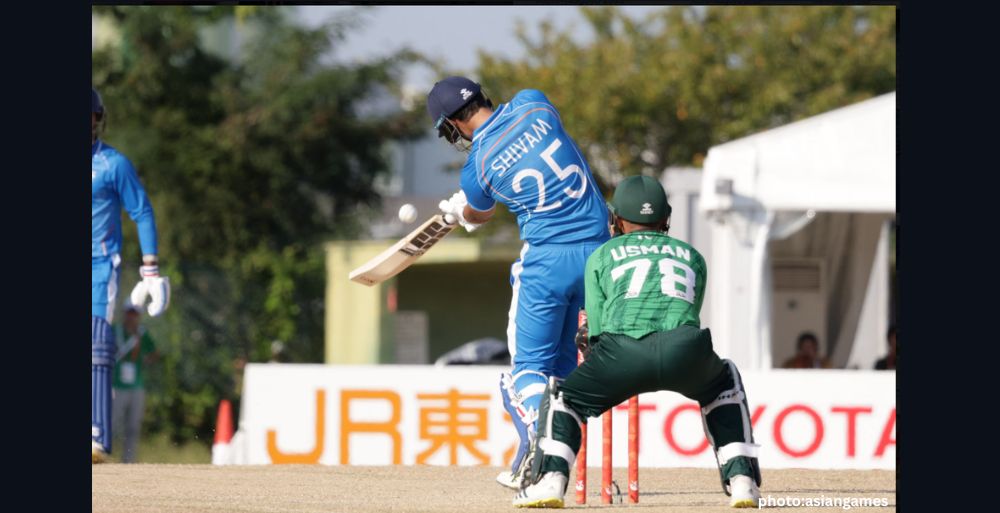
However, a sixth-wicket partnership between Tilak Varma and Shivam Dube revitalized the Indian innings. The duo added 62 runs over the final five overs, with Varma striking four sixes to finish on an unbeaten 51 off 32 balls. Dube contributed a rapid 27, including two clearance hits over the boundary, propelling India past the 200-run threshold to finish at 211 for six.
Second Innings: Hasan Nawaz Leads Pakistan’s Counterattack
Chasing a target of 212 required Pakistan to surpass its highest successful run chase in T20 international cricket—a previous benchmark of 208 for three established against Sri Lanka in Pallekele.
Pakistan’s pursuit started cleanly, with openers Sahibzada Farhan (10) and Maaz Sadaqat (23) assembling 33 runs within the first 3.4 overs. Following Sadaqat’s dismissal, middle-order batter Hasan Nawaz assumed control of the innings, adapting quickly to the surface conditions at the converted facility.
Hasan reached his half-century off 28 balls, anchoring a critical 87-run partnership with Saim Ayub. The pairing pushed Pakistan into a competitive position before Dube broke the stand at the start of the 15th over, inducing an mistimed shot from Ayub that was caught by Washington Sundar at square leg, leaving Pakistan at 126 for four.
Undeterred by the loss of partners, Hasan continued to strike boundary hits, maintaining a required run rate that kept Pakistan within striking distance. Entering the final three overs, Pakistan required 52 runs with six wickets in hand.
Climax, Bowling Adjustments, and Tournament Wrap-Up
The match turned decisively in India’s favor during the 18th over, when Sundar dismissed dangerous lower-order hitter Abdul Samad, caught at long-on.
With Pakistan needing 44 runs off the final 12 deliveries at 168 for five, Indian captain Shreyas Iyer re-introduced veteran fast bowler Jasprit Bumrah. Bumrah executed a precise penultimate over, relying on yorkers and pace variations to concede just 11 runs.
Entering the final over, Pakistan faced an improbable requirement of 33 runs. Tasked with closing out the match, Dube conceded a series of singles and boundaries before removing Hasan on the final delivery of the game. Attempting one last clearance to reach a century, Hasan was caught in the deep for 96. His 51-ball effort included seven sixes and five fours.
In the bronze-medal playoff held earlier in the day at the same venue, Sri Lanka secured the podium spot with a 63-run victory over Bangladesh.
The gold medal conclusion marks the end of the Asian Games cricket program in Nagoya, with India expanding its overall medal tally across both the men’s and women’s divisions.