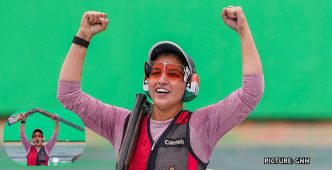
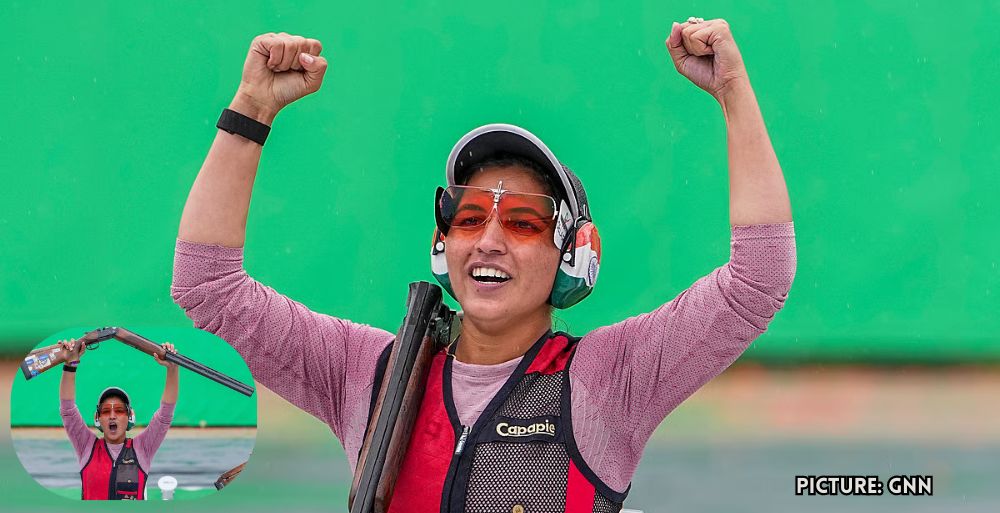
A remarkable journey from illness to triumph, Neeru Dhanda has become the first Indian woman to win an individual gold medal in trap shooting at the Asian Games, breaking a 45-year drought for India in this discipline.
Ten days prior to her historic victory, Neeru Dhanda found herself in a hospital bed, grappling with a severe illness that cast doubt on her ability to compete in the Asian Games held in Nagoya, Japan. Despite a challenging recovery and nearly a month without training, Dhanda emerged victorious on Tuesday, marking a significant milestone for Indian shooting sports.
In the final at the Urenocho shooting range in rural Toyota, Dhanda showcased exceptional skill, hitting 28 out of 30 targets and setting a new Asian Games record. Her performance not only earned her the gold medal but also placed her ahead of China’s Sun Yunong, who secured the silver with 26 hits. This victory represented India’s fifth gold medal at the ongoing Games and underscored a turning point for a sport that has historically seen limited success for the country.
Significance of the Victory
Dhanda’s achievement holds profound significance beyond the individual accolade. It marks the first time an Indian woman has claimed this title at the Asian Games, breaking a long-standing pattern of Chinese dominance in the event. The last Indian to win gold in trap shooting was Randhir Singh in 1978, while the women’s trap event, introduced in 1990, has been largely controlled by Chinese competitors, with the exception of Japan’s Yukie Nakayama in 2010.
Dhanda, a former kabaddi player, has not only made history but has also revitalized interest in trap shooting in India. Her triumph signals a new era for the sport, as she becomes a role model for aspiring shooters, particularly women, hoping to make their mark on the international stage.
Challenges and Recovery
Prior to her arrival in Japan, Dhanda faced significant health challenges. After contracting an infection during a national training camp in New Delhi, she spent several days bedridden, during which she was unable to eat and could only manage to drink water. Despite these setbacks, her coach, Mansher Singh, an Arjuna Award winner, provided continuous encouragement. He reassured her that short-term training disruptions would not diminish her potential.
“Every day, he kept me motivated, saying, ‘Nothing happens, even if you don’t train for four-five days, it doesn’t make any difference. You are super, and you will remain a star’,” Dhanda recounted. This support network played a crucial role in her mental preparation as she transitioned from illness to competition.
Peter Wilson, India’s trap shooting coach, expressed amazement at Dhanda’s rapid recovery and performance under pressure. “Ten days ago she was in hospital for three days. She was really, really sick and it was touch and go whether she would come,” Wilson stated. “She shot for two days here. She is very talented, but she puts a huge amount of work in.”
Path to Success
Dhanda’s journey to becoming a champion began in Jind, Haryana, where she was inspired by her cousin, Lakshya Sheoran, who won silver in the trap event at the 2018 Asian Games. Encouraged by her family, she took up the sport and relocated to Bhopal to train at the Madhya Pradesh State Shooting Academy, which offered her access to better resources and coaching.
Her dedication has yielded significant results, including a gold medal at the Asian Championship last year and the distinction of being the first Indian woman to win an individual trap gold at an ISSF World Cup event in July. However, the Asian Games posed a unique and formidable challenge, particularly in light of her recent health issues.
Competing Under Adverse Conditions
The weather on the day of the final was far from ideal, with rain pouring down and affecting the shooters’ grip and focus. Dhanda, however, found solace in her prior experiences, having trained in similar conditions in India. She noted, “The challenge here was that rain was coming from above, falling on the hands, you feel it, and the mind strays a bit from the process.”
To overcome the distractions, she focused on the fundamentals of shooting, reminding herself to maintain concentration despite the adverse conditions. “Neeru, this will happen; even if a storm comes, don’t look down on yourself, keep looking up, elevate your process, polish yourself,” she recalled as her personal mantra during the event.
Dhanda’s disciplined approach was evident throughout the final. By the conclusion of the competition, she had established a clear lead over her competitors, demonstrating not only her skill but also her resilience. “This was not easy. I made it look easy so that future juniors and other Indian players who are currently training in trap shooting, shotgun, and overall — meaning for the whole shooting team — can go on to win gold, thinking that if Neeru can do it, so can we,” she stated, emphasizing her desire to inspire the next generation of shooters.