Introduction
The inaugural meeting of the National Federation of Churches in India (NFCI) marked a significant milestone in the journey of Christian unity and collaborative witness in India. Held on 18 September 2026 at St. John’s National Academy of Health Sciences (SJNAHS), Bengaluru, the gathering coincided with the Fifth National Ecumenical Bishops’ Fellowship (NEBF) Meeting and brought together approximately 45 participants, including archbishops, bishops, church heads, and delegates representing diverse Christian denominations across the country. The meeting reflected a shared commitment to addressing contemporary challenges facing the Christian community while strengthening ecumenical cooperation and solidarity.
A Call for Unity Amidst Contemporary Challenges
The proceedings commenced with an Ecumenical Prayer Service for Christian Unity, setting a spiritual tone for the deliberations that followed. Delivering the welcome and inaugural address, Cardinal Anthony Poola, Archbishop of Hyderabad, President of the Catholic Bishops’ Conference of India (CBCI), and Chairman of NFCI, emphasized the urgent need for collective action among churches in India.
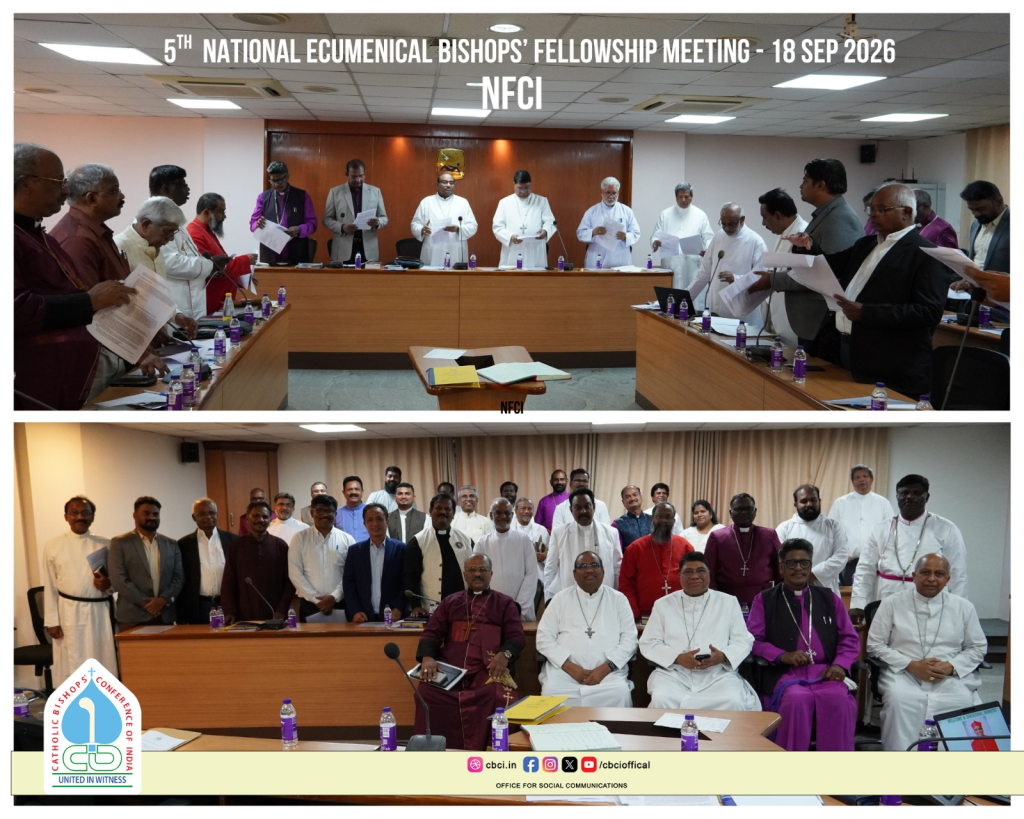
Reflecting on the challenges confronting Christian communities, Cardinal Poola observed that “the Churches in India are in a critical situation facing many serious challenges and grave difficulties,” which underscore “the urgent need of a united front to face them.” He explained that the establishment of NFCI emerged from discussions during the previous fellowship meeting in May 2026 and described the federation as an important step forward for the ecumenical movement in India. Significantly, he characterized NFCI as “a gift of God for us for which we should be grateful to the Holy Spirit, the bond of love and communion.”
His remarks highlighted the federation’s inclusive vision, with membership open to bishops and church leaders from all Christian denominations, irrespective of their affiliation with existing councils or synods. The formation of NFCI thus represents an effort to foster broader cooperation and visible unity among India’s diverse Christian traditions.
Addressing Legislative and Policy Concerns
A major focus of the meeting was the response of churches to emerging legislative developments, particularly the proposed FCRA Amendment Bill 2026. Following the presentation of the minutes of the previous NEBF meeting by Rev. Fr. Dr. Anthoniraj Thumma, Secretary of the CBCI Office for Dialogue and the Desk for Ecumenism, Archbishop Joseph D’Souza, President of the Good Shepherd Church in India (GSCI) and All India Christian Council (AICC), Convenor of NFCI, delivered an introductory address outlining possible strategies for engagement.
Archbishop D’Souza urged member churches to actively respond to the proposed amendments and the deliberations of the Joint Parliamentary Committee (JPC). While supporting the submission of formal memoranda expressing concerns about the legislation, he stressed that NFCI should seek direct engagement with policymakers. According to him, the federation should “ask for a meeting with JPC,” thereby ensuring that the concerns of Christian institutions and communities are adequately represented in ongoing legislative discussions.
This emphasis on coordinated advocacy reflected the broader purpose of NFCI as a platform capable of providing unified responses to issues of national importance affecting churches and Christian organizations.
Youth Empowerment and the Future of the Church
Another prominent theme of the meeting was the role of young people in shaping the future of church and society. In his message, Brother Dr. Paul Dhinakaran underscored the importance of investing in youth leadership and participation.
Describing the present era as “the day of the youth,” he called upon church leaders to empower younger generations and equip them with opportunities to contribute meaningfully to social and ecclesial transformation. His remarks highlighted the growing recognition that sustainable change within both church and society depends upon active youth engagement, leadership development, and the cultivation of future generations of Christian leaders.
Ecumenical Dialogue and Advocacy for Christian Rights
The open forum provided participants with an opportunity to discuss pressing concerns affecting Christians in India. Archbishop Peter Machado, Chairman of the All Karnataka United Christian Forum for Human Rights (AKUCFHR), reported on advocacy initiatives undertaken to engage political leadership regarding the repeal of anti-conversion legislation in Karnataka.
He also provided updates on litigation pending before the Supreme Court concerning alleged atrocities against Christians, churches, and Christian institutions. These discussions highlighted the continuing concerns regarding religious freedom, legal protections, and the rights of minority communities.
Additionally, Fr. Anthoniraj Thumma briefed participants on developments related to the long-standing legal efforts seeking constitutional rights and equal treatment for Dalit Christians. He also updated the gathering on matters pertaining to the Justice K. G. Balakrishnan Commission, emphasizing the ongoing significance of these issues for social justice and equality within Indian society.
Formation of the NFCI Core Group
One of the most important outcomes of the meeting was the formal establishment of the NFCI Core Group, as envisaged in the federation’s approved guidelines. Following discussion and consultation, members agreed on a structure that would enable more frequent engagement and timely responses to emerging issues.
The Core Group was authorized to co-opt additional members and appoint coordinators and executive secretaries, who need not necessarily be bishops or church heads. This decision demonstrated a practical commitment to efficiency, inclusivity, and organizational flexibility, ensuring that NFCI can effectively respond to contemporary challenges while drawing upon a broad range of expertise.
Conclusion
The meeting concluded with closing remarks by Bishop Mar Joseph Kallarangatt, Chairman of the CBCI Office for Dialogue and the Desk for Ecumenism and Convener of NFCI. Expressing gratitude for the participation of church leaders, he described the gathering as a unique and historic occasion. He affirmed that “the formation of the National Federation of Churches in India is a step towards the goal of full communion” and thanked God for this significant development.
Ending on a hopeful ecumenical note, Bishop Kallarangatt quoted Pope Leo XIV, declaring: “We are one! We already are! Let us recognize it, experience it and make it visible!” These words captured the spirit of the meeting and the aspirations of NFCI. The gathering concluded with prayer, a blessing by Cardinal Anthony Poola, and a group photograph, symbolizing a renewed commitment to Christian unity, collaborative witness, and collective action in India.