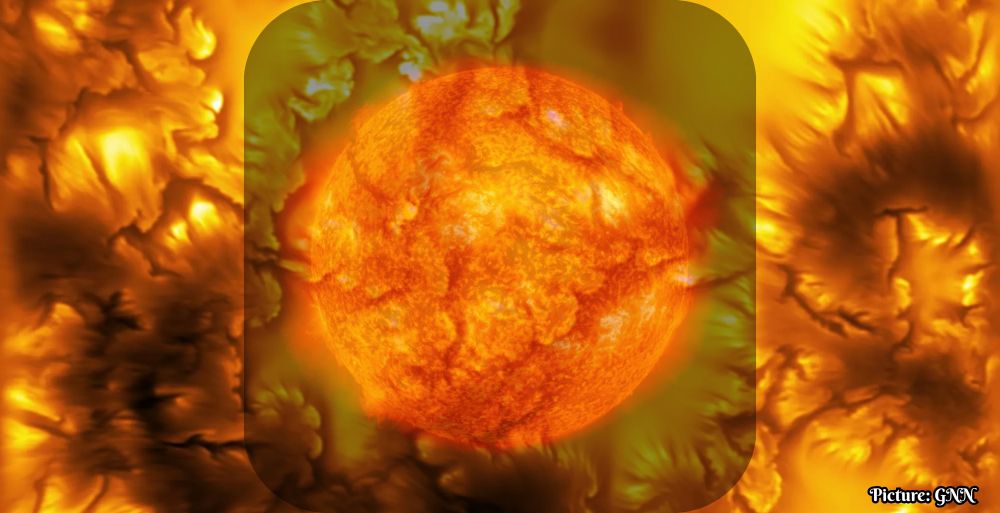
This groundbreaking achievement reveals the Sun’s surface in remarkable detail, showcasing plasma vortices that could enhance our understanding of solar dynamics.
In a remarkable advancement for solar astronomy, researchers utilizing the Daniel K. Inouye Solar Telescope in Hawaii have captured the highest-resolution images of the Sun’s surface, known as the photosphere. These images unveil intricate details of the Sun’s turbulent surface, including plasma vortices as small as 12 miles wide. The findings, published in the journal Nature, provide new insights into the dynamic processes that govern our star.
Unprecedented Detail and Scale
The images obtained represent a milestone in solar observation, akin to the challenge of identifying George Washington’s face on a quarter from approximately 74 miles away. Sami Solanki, co-author of the study and director of the Max Planck Institute for Solar System Research (MPS), underscored the importance of these discoveries in understanding the minute processes that profoundly influence the behavior of the Sun.
The photosphere, while only a thin layer of the Sun’s overall atmosphere, is critical as it is the region from which all of the star’s visible light is emitted. This dynamic environment is characterized by powerful convection currents and magnetic fields, which continuously form large, bubbling structures known as granules. Each granule measures between 310 and 1,240 miles in diameter, collectively covering the Sun’s outermost region. The recent observations provide sharper insight into the interactions of these structures and the underlying physics at play.
Methodology of the Observations
To achieve these detailed observations, scientists utilized data from the Inouye Solar Telescope, the largest solar telescope in the world, along with a broad-band imaging camera at the MPS. By combining these observations with advanced computer simulations, the research team clarified their findings regarding the behavior of solar granules.
Analysis of the images revealed evidence of Kelvin-Helmholtz instabilities, a phenomenon in fluid dynamics that occurs when two fluids flow past one another at different velocities. This interaction can lead to the formation of waves and vortices, a process observed in various environments, including lakes and planetary atmospheres. The new findings indicate that such instabilities also occur on the Sun’s surface, presenting a significant revelation that could enhance our understanding of solar activity.
The Importance of Plasma Vortices
Detecting these vortices required resolving structures on the solar surface down to about 20 kilometers in size, which is at the limit of the capabilities of the Inouye Solar Telescope and contemporary simulation technology. MPS astronomer and co-author Michiel van Noort emphasized the technical challenges involved in achieving this level of detail, highlighting the significance of this breakthrough.
The implications of these findings extend beyond mere observation. Understanding the dynamics of plasma vortices on the Sun could enhance scientists’ ability to predict solar behavior, which is crucial given the Sun’s influence on space weather and its potential impacts on Earth. Solar flares and coronal mass ejections, for instance, can disrupt satellite communications and power systems, making this research vital for both scientific and practical applications.
Future Implications and Research Directions
This study not only sheds light on the granular structure of the Sun but also opens up new avenues for research into solar dynamics and magnetohydrodynamics, which could inform our understanding of similar processes in other stars and celestial bodies. As technology continues to advance, astronomers anticipate that further observations will refine our understanding of solar phenomena, thereby enhancing our knowledge of fundamental astrophysical processes.
According to the researchers, this enhanced imaging capability allows for unprecedented exploration of the Sun’s surface dynamics. These new insights could help address longstanding questions regarding solar activity and its cyclical nature. The detailed observation of plasma waves and vortices may also provide context for understanding solar storms and their frequency, which has implications for both navigation systems on Earth and broader astronomical research.
In conclusion, the successful imaging of plasma waves on the Sun’s surface represents a significant leap in solar research, providing a clearer picture of the intricate and dynamic processes that shape our star. As astronomers continue to analyze these findings, the potential for new discoveries in solar physics remains promising. This breakthrough not only enhances our comprehension of the Sun’s workings but also positions researchers to better predict its behavior, ultimately contributing to our understanding of the solar system and its myriad effects on Earth.