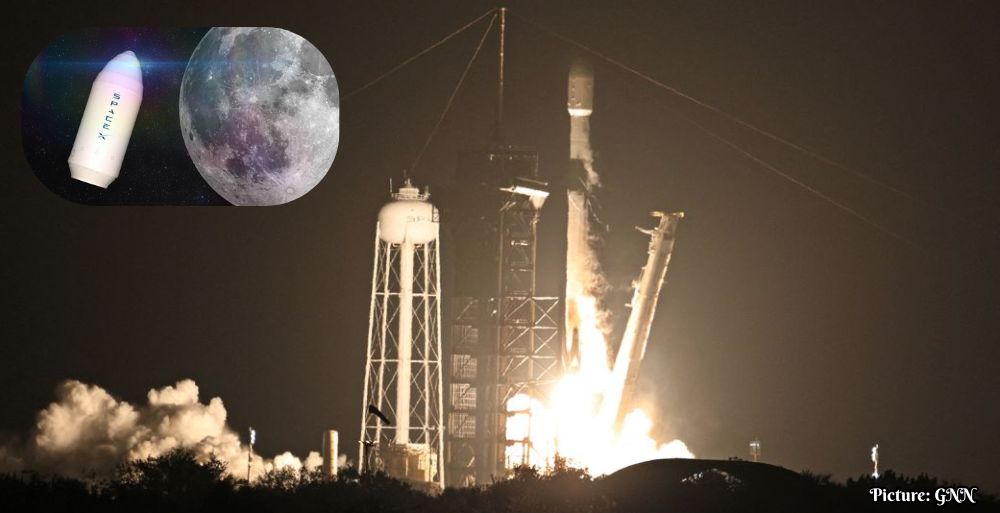
The second stage of a SpaceX Falcon 9 rocket is expected to collide with the moon early Wednesday morning, creating a significant impact site but posing no threat to Earth.
A part of a SpaceX Falcon 9 rocket, weighing approximately four tons and traveling at speeds exceeding 5,000 miles per hour, is projected to unintentionally crash into the moon early Wednesday morning, specifically at 2:35 a.m. ET. This component, which is the upper stage of the rocket, has been orbiting in space since its launch on January 15, 2025, as part of a mission carrying two robotic landers.
The Falcon 9 was launched to deliver the Blue Ghost lander, developed by Firefly Aerospace, and the Resilience lander from Ispace, a Tokyo-based company. The upper stage of the Falcon 9 played a crucial role in transporting these landers towards the moon before being left to drift in space after fulfilling its mission. While the first stage of the rocket successfully returned to Earth, the second stage has been on a trajectory towards the moon due to a combination of solar activity and gravitational forces, explained Julianna Scheiman, director of NASA Science and Dragon Programs at SpaceX, during a Monday news conference.
Details of the Impact
According to a preprint study co-authored by researchers from NASA, the impact is anticipated to create a crater measuring between 65 to 90 feet (20 to 30 meters) in diameter on the lunar surface. Despite this significant event, scientists have confirmed that there is no danger to Earth from this collision. NASA’s Center for Near Earth Object Studies has verified the trajectory and will continue to track the upper stage for training and scientific observation purposes.
Dr. Paul Wiegert, a professor of astronomy and physics at Western University in Ontario, Canada, noted that while the impact may not be discernible to the naked eye from Earth, it could potentially be visible through telescopes, particularly the plume of debris created by the collision. He remarked, “If you imagine the moon is a clock, it’ll sort of roughly hit where the 10 would be. But that part of the moon is lit right now, so the bright flash will be muted by that brightness of the moon itself.”
Tracking and Observations
Independent astronomers have utilized publicly available data to monitor the Falcon 9’s upper stage, confirming its collision course with the moon. This observation is particularly critical as it represents a rare opportunity for scientists to study the effects of artificial objects impacting the lunar surface. The Korean Pathfinder Lunar Orbiter will attempt to capture images of the upper stage prior to impact, while NASA’s Lunar Reconnaissance Orbiter plans to survey the impact site afterward.
Historically, space rocks regularly strike the moon, with astronauts from the Apollo missions and the upcoming Artemis II crew having documented flashes from meteoroids colliding with the lunar surface. However, impacts from man-made objects like the Falcon 9 upper stage have occurred infrequently, making this event noteworthy.
Implications for Future Lunar Exploration
This event is occurring as SpaceX is under scrutiny following its initial public offering in June and the release of its first quarterly earnings report. Increased lunar exploration efforts, particularly through NASA’s Artemis program aimed at establishing a more sustained human presence on the moon, raise concerns regarding space debris management. As the moon lacks an atmosphere, unlike Earth, debris that could pose a risk will not burn up upon entry.
Wiegert emphasized the importance of understanding the implications of lunar impacts, noting that current estimates suggest the rocket stage could eject rocky material as far as 500 miles (805 kilometers) from the impact site. In the future, such events could pose significant risks if astronauts or infrastructure are present in the vicinity.
“The objects are small rocks traveling at very high speeds, sort of comparable to bullets, so we want to understand these processes so that we can eliminate that as a source of risk,” said Wiegert. To address this, researchers are exploring potential strategies for minimizing the likelihood of such collisions.
As a scientist, Scheiman expressed excitement about the observational opportunities presented by this event, stating, “But it’s one of the things that we’re working in partnership with NASA and the other appropriate agencies: What is the best future disposal path for high energy missions that are in the sun-Earth-moon system?” The study detailing the impact predictions is currently awaiting review for publication in The Astrophysical Journal Letters.