Following a month-long nationwide movement led by a satirical youth organization known as the Cockroach Janta Party, Prime Minister Narendra Modi’s administration accepted the resignation of Union Education Minister Dharmendra Pradhan and announced a high-powered task force to overhaul the country’s national examination system. While the concessions mark a historic political victory for young protesters who occupied New Delhi’s Jantar Mantar following widespread paper leaks in the NEET medical entrance exam, underlying anxieties regarding elevated youth unemployment, structural barriers in the labor market, and diminishing social mobility remain deeply entrenched across the nation.
NEW DELHI — Jubilant crowds of young demonstrators began vacating the historic Jantar Mantar protest site in the national capital on Saturday, July 25, 2026, after securing one of the most significant policy climbdowns from Prime Minister Narendra Modi’s government in recent years. The 37-day campaign, which originated as an online satire movement before mobilizing hundreds of thousands of students across multiple states, was formally suspended after central ministers agreed in principle to all core demands—including the resignation of Union Education Minister Dharmendra Pradhan, the withdrawal of police cases against student leaders, and structural reforms to national testing agencies.
The crisis was triggered by the systemic leak of question papers for the 2026 National Eligibility-cum-Entrance Test (NEET-UG), the high-stakes national examination taken by millions of candidates seeking admission to medical colleges. However, as demonstrations spread from digital platforms to urban street marches, the movement evolved into a broader indictment of the government’s ability to provide transparent career pathways and sustainable employment for the world’s largest youth population.
From Satirical Digital Campaign to Mass Street Mobilization
The protest movement was anchored by the Cockroach Janta Party (CJP), an organization formed in May 2026 by digital communications strategist Abhijeet Dipke. The group’s name was chosen in satirical response to controversial remarks made during a judicial hearing by Chief Justice of India Surya Kant, who had compared unemployed youth and vocal social media activists to “cockroaches” and “parasites”.
Within weeks, CJP’s social media channels amassed over 20 million followers, surpassing the online reach of established national political parties. By early June, the digital campaign transitioned into physical demonstrations at Jantar Mantar, drawing coalitions with prominent student groups including the All India Students Association (AISA), the All India Students Federation (AISF), and the Students’ Federation of India (SFI).
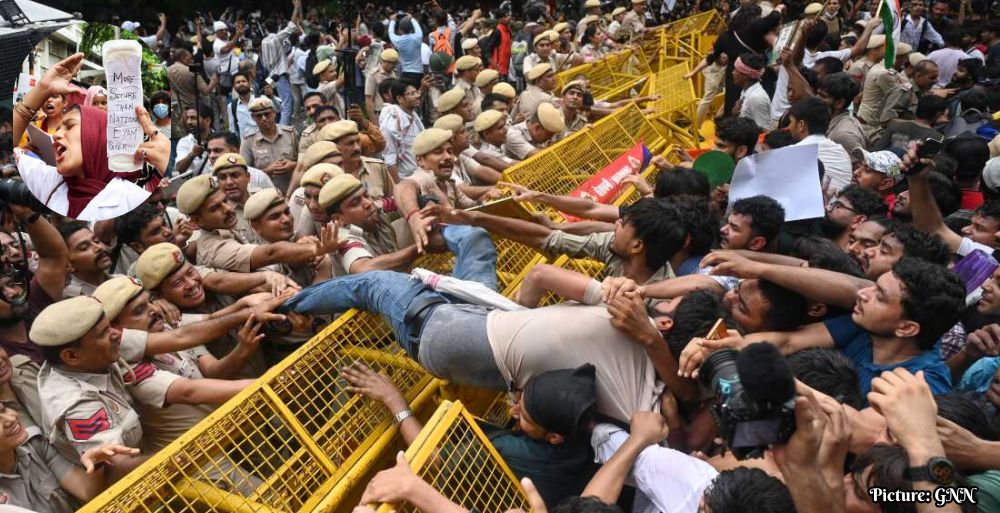
The movement gained further momentum on June 28 when climate activist Sonam Wangchuk initiated an indefinite hunger strike at the site, designating himself an “honorary cockroach” in solidarity with the students. Tensions escalated dramatically on July 20 when tens of thousands of demonstrators attempted to march toward Parliament House. Law enforcement personnel deployed lathi charges and tear gas to disperse the crowds, resulting in injuries to at least 118 police officers and dozens of student protesters. The Supreme Court subsequently indicated it would consider establishing an independent judicial panel to investigate alleged police excesses during the crackdown.
Surrounded by microphones and cheered on by hundreds of exhausted students at Jantar Mantar on Saturday afternoon, CJP spokesperson Ashutosh Ranka delivered a measured address announcing the suspension of the blockade. Speaking with a soft but firm cadence against the backdrop of rustling banners, Ranka noted that the government had acted in good faith during three rounds of negotiations with Union Ministers J.P. Nadda and Jitendra Singh.
“Our core demands—the removal of the minister responsible for this administrative collapse, financial compensation for the families of aspirants who tragically took their lives, and the unconditional dismissal of police FIRs—have been accepted,” Ranka told reporters. “We are suspending our agitation today in good faith, but our five-point charter for fundamental educational reform remains on the table. We will return in four weeks to review implementation.”
High-Powered Task Force and Legislative Overhaul
In a pre-recorded televised address broadcast on Sunday, July 26, Prime Minister Narendra Modi sought to reassure the nation’s youth by announcing the establishment of a six-member “high-powered” task force dedicated to overhauling India’s public examination architecture. Sitting before an official backdrop in his New Delhi office, Modi maintained a stern, composed demeanor as he outlined state interventions aimed at punishing perpetrators of paper leak rackets.
“Those who have tampered with the future of our hardworking students are languishing in jail,” Prime Minister Modi said in the broadcast. “We have established fast-track courts and are introducing stringent legislation in Parliament. However, we must look to the future. Our examination system must be transparent, tamper-proof, and powered by cutting-edge technology.”
The task force is chaired by technology entrepreneur Nandan Nilekani, the co-founder of Infosys and architect of India’s Aadhaar biometric ID infrastructure. The panel includes former Indian Space Research Organisation (ISRO) chairman S. Somnath, former Intelligence Bureau director Tapan Deka, IIT Madras director V. Kamakoti, former Union Education Secretary Anita Karwal, and logistics expert Amrit Lal Meena. The multidisciplinary committee is mandated to restructure the National Testing Agency (NTA), which has faced severe criticism following consecutive irregularities in NEET-UG, UGC-NET, and state-level engineering and recruitment exams in Gujarat, Uttarakhand, and Punjab.
Simultaneously, the central government prepared to introduce the Public Examinations (Prevention of Unfair Means) Amendment Bill, 2026 in the Lok Sabha. The proposed law introduces seven major statutory amendments, establishing designated Special Fast-Track Courts at the Session Court level that must conduct day-to-day hearings and conclude trials within three months of chargesheet filings. It also empowers a federal Special Task Force to investigate cross-border and organized paper leak syndicates while imposing heightened prison terms and steep financial penalties on culpable coaching institutes and service providers.
The Demographic Advantage Meets Labor Market Friction
While the systemic overhaul of competitive entrance examinations addresses immediate administrative failures, labor economists emphasize that the student unrest reflects deeper economic vulnerabilities. India is currently the fastest-growing major economy globally, with projections placing its nominal Gross Domestic Product (GDP) on track to become the world’s third-largest before the end of the decade.
This expansion relies heavily on India’s demographic profile, in which over 65% of its 1.4 billion citizens are under the age of 35. However, translating educational attainment into productive, formal employment has proven increasingly difficult. Official government economic data indicates that India’s youth unemployment rate stood at 9.9% last year—more than triple the national overall unemployment rate of 3.1%.
The psychological and financial strain on young job seekers was underscored in a Deloitte Global survey published in May 2026. According to the report, Generation Z respondents in India reported acute financial anxiety, citing severe housing affordability constraints, wage stagnation, and pervasive job insecurity as primary stressors impacting their career choices.
In India’s socio-economic landscape, competitive entrance examinations like NEET, UPSC, and state public service exams serve as critical bottlenecks. Because formal private-sector positions offering comprehensive health benefits, pensions, and job security remain scarce relative to population size, millions of young people dedicate years to preparing for standardized public tests. When question paper leaks or administrative corruption invalidate these examinations, it disrupts years of personal and financial investment by working-class and middle-class families.
Shifting Political Dynamics Ahead of State Elections
The resolution of the Jantar Mantar standoff comes at a delicate political juncture for the ruling Bharatiya Janata Party (BJP). The rapid growth of the CJP and the widespread public sympathy generated by the student protests have altered political messaging ahead of critical state assembly elections.
Opposition leaders, including Congress MP Rahul Gandhi, seized upon the controversy to attack the administration’s governance record, highlighting simultaneous examination irregularities in Gujarat, Punjab, and Uttarakhand to argue that testing failures were systemic rather than isolated. By agreeing to the CJP’s full slate of demands, Prime Minister Modi’s administration sought to neutralize growing discontent among young voters, a demographic that proved pivotal in past general elections.
As students return to their homes and coaching hubs across Kota, Patna, and Delhi, analysts note that the political climbdown has established a precedent for youth-led civil movements. However, whether the Nilekani-led task force and legislative anti-leak measures can restore faith in public institutions remains uncertain, particularly as millions of young graduates continue to compete for a limited pool of high-quality jobs in an evolving economy.