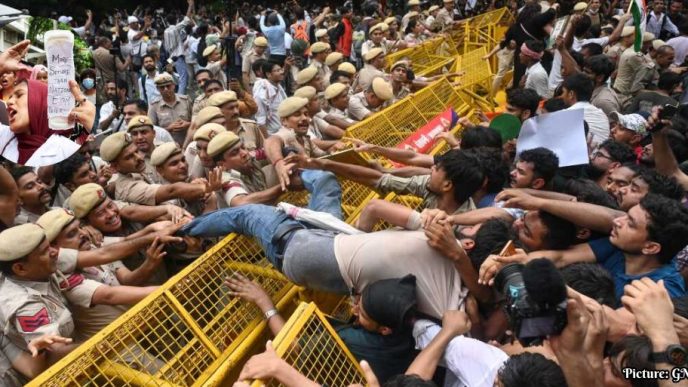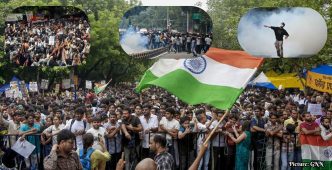
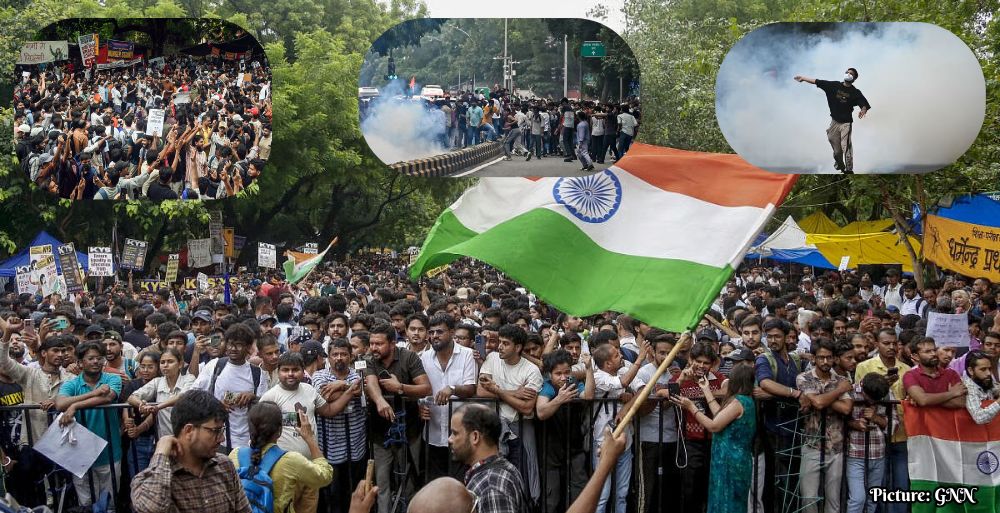
The Cockroach Janta Party has warned of renewed nationwide protests if the government does not withdraw FIRs against student protesters, criticizing a Supreme Court interim order that they claim contradicts prior government assurances.
NEW DELHI: The Cockroach Janta Party (CJP) has issued a warning signaling a potential resurgence of nationwide protests if the government does not retract First Information Reports (FIRs) lodged against student protesters. This warning follows a recent Supreme Court interim order concerning a series of Public Interest Litigations (PILs) related to these protests, which CJP leaders have declared raises significant concerns throughout the country.
In a statement released on social media platform X, CJP chief spokesperson Saurav Das articulated that Direction No. 4 of the Supreme Court’s order contradicts the government’s assurance given on July 25, which stated that FIRs would be withdrawn and that protesters would not face targeting. The court’s directive allows state governments to continue with existing FIRs and conduct investigations, a move that Das deems alarming.
“It was on the strength of that solemn assurance, and in complete good faith, that the Cockroach Janta Party called off its nationwide protest,” Das emphasized. He further expressed concern that the government, particularly in states governed by the Bharatiya Janata Party (BJP), might exploit this Supreme Court order to perpetuate harassment against individual protesters. “This was precisely our concern from day one: that courts could be used, directly or indirectly, to achieve political ends by targeting peaceful dissent,” he stated.
Context of the Supreme Court Order
Das highlighted that the interim order was not contested by the government’s legal representatives, despite ongoing negotiations with the CJP that had continued late into the night prior to the court’s decision. He criticized the lack of opposition from the government’s side, suggesting that this implied an awareness of the commitments made during those discussions. “The court’s uninformed order is therefore wholly unacceptable,” he said, arguing that a public assurance given to thousands of students and protesters cannot simply be undermined or rendered meaningless through subsequent legal actions.
He pointed out that the interim order does not explicitly prevent the government or BJP/NDA-ruled states from withdrawing FIRs or opting not to proceed against peaceful protesters, actions that have already been taken by the governments of Bihar and Assam. “The power to withdraw or not pursue such cases continues to rest with the executive. The court has not mandated that governments must definitely continue with the FIRs. That would be a deliberate misreading,” Das explained.
Demands for Transparency
In light of these developments, Das has called for the government to present the terms of the July 25 assurance to the Supreme Court to ensure transparency regarding the commitments made to the youth of India. “The youth of India entered into this understanding in good faith. That good faith must not be betrayed. Institutions of constitutional importance must never be politicized and weaponized to not honor the guarantees,” he asserted.
Das set a deadline for the government to fulfill its commitments by Tuesday, reiterating the demands for the withdrawal of FIRs and the assurance that no protesters would be subjected to future punitive actions. “We once again call upon it to fulfill every commitment it made: withdraw the FIRs, ensure that no protester is subjected to future punitive action, and honor both the letter and the spirit of the assurance that brought an end to the protest,” he said.
Potential for Renewed Protests
Should the government fail to honor these guarantees, Das warned that the CJP would have “no option but to resume its nationwide protest.” He emphasized, “A government that breaks its word cannot expect the youth to remain silent. If the guarantees are dishonored, the streets of India will once again become the voice of its young.”
The CJP had previously called off its 36-day agitation at Jantar Mantar on July 25 after the government accepted several key demands, including the resignation of then Union education minister Dharmendra Pradhan. The current situation reflects ongoing tensions between the government and student groups, emphasizing the fragility of the commitments made and the potential for renewed unrest among youth activists.
Background on Student Protests
The protests that led to the CJP’s initial mobilization were part of a broader movement advocating for various educational reforms and policy changes. Students across the country have raised concerns regarding issues such as tuition fees, job opportunities, and educational quality. The CJP emerged as a significant voice within these movements, amplifying student grievances and calling for accountability from the government.
The July 25 agreement was viewed as a critical moment for the CJP and its supporters, as it signified an acknowledgment of these issues by the government. However, the subsequent Supreme Court order has reignited fears among protesters that their voices may be suppressed and that the government could leverage legal mechanisms to stifle dissent.
Implications for Future Governance
The unfolding situation raises important questions about the relationship between the government and civil society, particularly regarding the treatment of dissent and the assurance of rights. The CJP’s threats of renewed protests underscore a growing discontent among youth and student groups who feel their concerns are not adequately addressed. The government’s response to this crisis may set a precedent for how it engages with protesters in the future and could impact its standing among younger voters.
As the political landscape evolves, the CJP’s determination to hold the government accountable for its commitments serves as a reminder of the power of organized civil society in shaping policy and governance. The coming days will be pivotal, as the CJP awaits the government’s response to its demands and the implications of the Supreme Court’s ruling continue to unfold.