According to the All India Survey on Higher Education (AISHE) for 2023-24, Computer Engineering has become the leading choice among engineering students in India, reflecting a significant shift towards digital and technological careers.
In a noteworthy development for the Indian education sector, the All India Survey on Higher Education (AISHE) for the academic year 2023-24 has revealed that Computer Engineering has ascended to become the most sought-after engineering discipline in the country. This trend demonstrates an increasing student interest in fields related to software development, artificial intelligence (AI), and other digital technologies.
Enrolment Trends in Engineering Disciplines
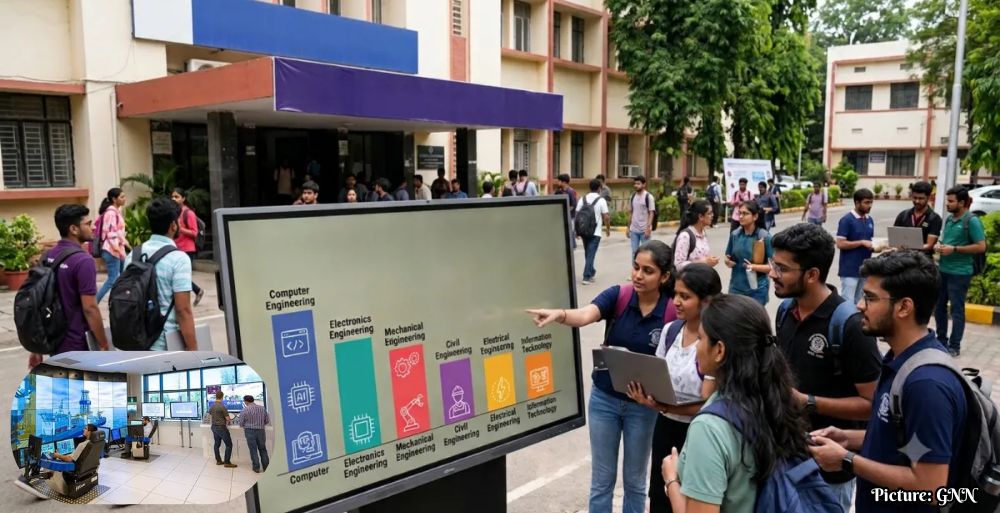
The AISHE report indicates that total enrolment in Engineering and Technology programs across various levels—undergraduate, postgraduate, integrated, MPhil, and PhD—has reached approximately 4.63 million students. Among these, Computer Engineering leads the way with an enrolment figure of around 1.84 million students, representing nearly 39.7% of all engineering enrollees.
Following Computer Engineering, the second most popular field is Electronics Engineering with approximately 570,400 students (12.3%), while Mechanical Engineering, Civil Engineering, and Electrical Engineering follow with enrolments of 444,200 (9.6%), 360,300 (7.8%), and 336,200 (7.3%) respectively. Information Technology, Electronics & Communication Engineering, Architecture, and Chemical Engineering also feature in the top ten disciplines but with significantly lower enrolment numbers.
Graduate Output and Changing Preferences
The shift in student preferences is further underscored by the report’s findings on graduate output. In the 2023-24 academic year, Computer Engineering produced 262,408 graduates, constituting approximately 31.5% of the total 833,808 graduates from engineering programs. This is a stark contrast to Mechanical Engineering, which recorded 113,390 graduates, and Electronics Engineering with 111,242 graduates.
The growing dominance of Computer Engineering aligns with the expanding digital economy in India, which has been increasingly recognized for its contributions to the global tech landscape. As institutions such as the Indian Institutes of Technology (IITs), National Institutes of Technology (NITs), and various state and private colleges continue to attract top-ranking candidates, the preference for Computer Science and allied fields remains strong.
Labour Market Implications
The trends in higher education are reflective of broader changes in the labor market. LinkedIn’s AI Labour Market Report 2026 highlighted that India experienced the fastest growth in AI engineering hiring globally, with a year-on-year increase of 59.5% in AI-related job postings. Furthermore, the World Economic Forum’s Future of Jobs Report 2025 identifies positions such as AI and Machine Learning Specialists, Big Data Specialists, and cybersecurity professionals as among the fastest-growing occupations in India through 2030.
Overall Growth in Higher Education
The AISHE report not only emphasizes the popularity of Computer Engineering but also highlights the overall expansion of technical education in India. This academic year, total higher education enrolment has reached a record 45 million students, with enrolment in Science, Technology, Engineering, and Mathematics (STEM) disciplines surpassing the one-crore mark. Such figures indicate a sustained demand for technical and professional education, reinforcing the importance of these fields in shaping the future workforce.
Historical Context and Future Implications
Historically, engineering has been a prestigious field in India, often viewed as a pathway to financial stability and professional respect. However, the recent shift towards Computer Engineering can be seen as a response to the rapid technological advancement and digital transformation occurring globally. The demand for skilled professionals in IT and related fields has surged, leading to a re-evaluation of academic priorities among students.
This trend is not only significant for individual career prospects but also for the national economy. The Indian government has recognized the potential of the digital economy, with initiatives aimed at bolstering the tech sector, including the Make in India program and Digital India campaign. These initiatives are designed to foster innovation, attract foreign investment, and create a workforce adept at navigating and driving technological change.
Challenges Ahead
Despite the optimistic outlook, the AISHE report also points to some challenges. While the enrolment figures in Computer Engineering are encouraging, there is a need for the educational infrastructure to keep pace with this rapid growth. Quality of education, faculty availability, and access to cutting-edge technology remain critical factors that need to be addressed to ensure that graduates are well-prepared for the demands of the labor market.
Moreover, as the field continues to evolve, educational institutions may need to revise their curriculums to incorporate emerging technologies such as blockchain, data science, and ethical AI, ensuring that students are equipped with relevant skill sets. The introduction of interdisciplinary programs that combine technical education with soft skills training could also enhance employability, preparing students for a competitive job market.
Conclusion
As India continues to adapt to the evolving economic landscape, the preference for engineering disciplines that align closely with technological advancements is likely to grow. The trends noted in the AISHE report serve as an indicator of where the future of higher education and employment may be headed in the country. The focus on Computer Engineering, amidst the backdrop of a booming digital economy, reflects not only changing student preferences but also the broader societal shift towards technology and innovation.