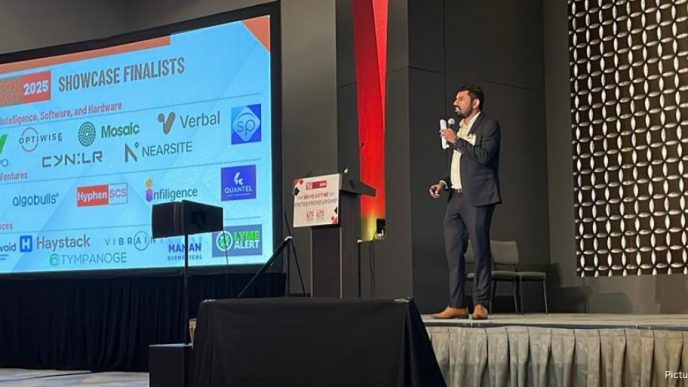

Michael Truell, the 25-year-old CEO of Cursor, has transformed a community-driven Discord server into a talent pipeline, leading to a $60 billion acquisition by SpaceX.
In a significant development in the technology sector, Michael Truell, the founder and CEO of Cursor, recently solidified his status as one of Silicon Valley’s youngest breakout leaders following SpaceX’s acquisition of the company for an estimated $60 billion. At just 25 years old, Truell has not only led the creation of a successful AI coding tool but has also pioneered a unique approach to recruitment by cultivating a community around the product.
Founded in early 2022, Cursor emerged during what Truell described as the “prehistoric times” of artificial intelligence. In his keynote speech at the inaugural Compile conference, published on Monday, he reflected on the initial hesitation he and three fellow programmers felt about entering a market saturated with established players. “We thought, there’s just, there’s no room, there’s not much to do, people have got that covered,” he said. However, as they delved deeper into their projects throughout the year, they began to reconsider their path.
Ultimately, the team caught what Truell referred to as “the bug” and returned to the development of an AI-powered coding environment that they genuinely wanted to use themselves. This dedication led to a rapid development phase, which Truell likened to working “in a cave,” where they spent roughly two weeks coding the prototype. The first version of Cursor was released at the beginning of 2023, although initial user feedback was less than favorable. “The first user didn’t like the product, and the second didn’t either,” Truell recounted, noting that some early testers “ran away from us kicking and screaming.” Nevertheless, a core group of developers remained engaged, providing crucial feedback that helped refine the product.
Community as a Recruitment Tool
As Cursor’s user base grew, the company found an innovative way to recruit talent through its Discord server, which initially served as a platform for users to discuss the product, report issues, and share workflows. Truell noted, “We actually hired many members of [the] Discord server.” This transition allowed the company to tap into a pool of users who were not only familiar with the product but also passionate about its development. Some of these developers, who began as users providing feedback and testing features, ultimately became employees.
Cursor’s approach to recruitment is not entirely unique; other tech companies have similarly leveraged their user communities. Notion, for instance, has credited its global user base with driving growth and has hired community advocates who emerged directly from these groups. Camille Ricketts, Notion’s head of brand and communications, stated, “In the early days, we saw people on Twitter and Reddit sharing tips and providing support to other users. With a small marketing team, it was clear that this would be a way for us to amplify Notion.” Figma has also adopted a similar strategy, engaging designer advocates who were already well-integrated into the design community.
A Shift in Recruitment Strategies
The trend of recruiting from user communities reflects a broader shift within the startup ecosystem. Research by VerityAI indicates that founders are increasingly looking beyond traditional hiring platforms such as LinkedIn and job boards, opting instead for Discord servers, Slack groups, and niche forums where potential hires are already engaged. These communities offer a more organic recruitment channel, enabling companies to build trust and rapport with candidates based on their contributions rather than conventional application materials.
As Cursor scales under SpaceX’s ownership, Truell emphasizes the importance of remaining connected to core users. The company is currently training a more advanced AI model, utilizing 10 to 20 times more compute power than previously used. The goal is to create AI agents capable of managing broader software engineering tasks, not merely code completion. Truell stated, “We need to get to a world where working with agents is really like working with a colleague, and you can treat it just like you have your own team of engineers.” He envisions a future where users can hand off entire projects to these agents, allowing them to work autonomously for extended periods before returning with completed tasks.
In conclusion, Michael Truell’s innovative approach to product development and recruitment through community engagement has positioned Cursor as a notable player in the competitive AI landscape. As the company prepares for its next phase of growth, the lessons learned from its user-driven model may well serve as a blueprint for other tech startups seeking to navigate the complexities of talent acquisition in an increasingly crowded market.