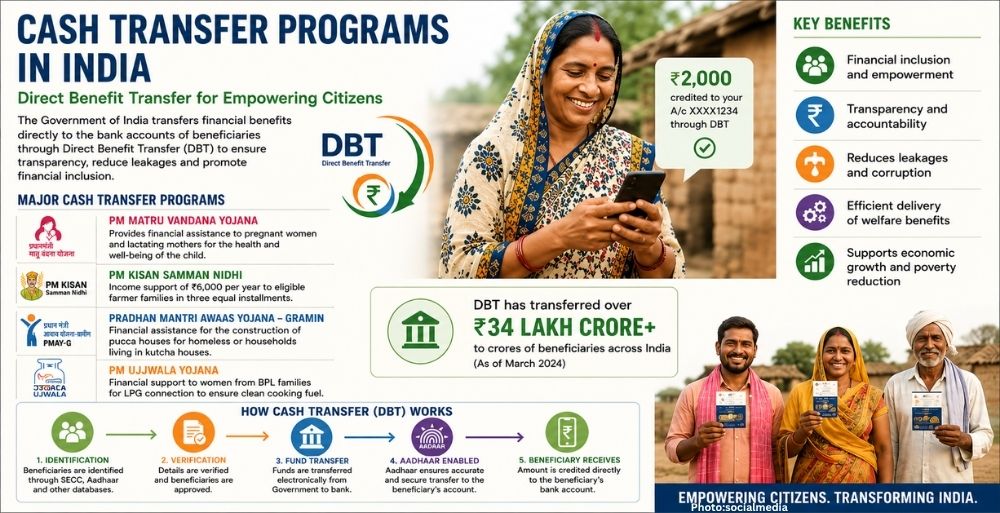
As India’s economic landscape evolves, the expansion of cash transfer programs has become a vital tool for poverty alleviation, though concerns about fiscal sustainability and long-term efficacy remain.
New Delhi, India – Over the past decade, India’s government has increasingly turned to cash transfer programs as a means of alleviating poverty among its most vulnerable populations. With 17 of its 28 states and one federal territory, Delhi, now offering monthly cash transfers, the country has seen a significant shift in its welfare policy aimed at reducing economic distress.
According to data from ProjectDEEP, a non-profit organization focused on cash-based policies, cash transfers have surged from under $2 billion in 2015 to nearly $30 billion today. This growth represents more than a 20-fold increase and now accounts for just under 1% of India’s Gross Domestic Product (GDP) and over 10% of social sector spending. These figures illustrate a dramatic rise in reliance on cash transfers, which have outpaced funding increases in other key social programs aimed at food security and employment.
Trends and Implications of Cash Transfers
The trend toward cash transfers is notable. In 2019, only four states provided these monthly payments, highlighting a rapid expansion in recent years. Direct cash transfers have been criticized by some as wasteful or politically motivated, yet they are increasingly seen as a strategic response to immediate economic challenges, such as weak household consumption and chronic unemployment.
Monthly cash transfers vary by state, ranging from 1,000 rupees (approximately $10.50) to 2,500 rupees. A median transfer of 1,500 rupees is reported to cover 74% of monthly expenses in rural areas and 51% in urban locales for the bottom 20% of households. This financial support serves as a crucial buffer against rising inflation driven by high energy prices and environmental factors, such as the El Niño weather phenomenon.
While the primary recipients of these transfers have largely been women and farmers, there is a growing recognition of the need to support unemployed youth as well. ProjectDEEP reports that nearly ten state governments, including the economically challenged state of Bihar, have initiated cash transfer programs aimed at job-seeking young adults. Most of these initiatives have been launched within the last three years, reflecting a shift in focus toward addressing youth unemployment.
Fiscal Concerns and Sustainability
Despite their immediate benefits, cash transfers pose significant fiscal challenges. The Indian government’s annual economic survey has identified these programs as a potential source of fiscal stress for states, with many experiencing revenue deficits. A report from Crisil indicates that gross market borrowing by states has increased by 15.2% year-on-year, surpassing federal borrowing rates. Twelve states that have adopted cash transfer programs have reported double-digit growth in market borrowing.
This trend raises questions about the long-term sustainability of cash transfer schemes. Axis Research has found that much of the funding for these initiatives is derived from expenditure switching, where increased spending on cash transfers is offset by reduced investment in other critical areas, such as infrastructure and public services. The Economic Survey has urged a reassessment of these programs, noting that they often fail to foster sustainable economic growth or provide a pathway out of poverty.
The Need for Programmatic Innovation
Experts have called for a reevaluation of the structure and impact of cash transfer programs. Pankhuri Shah, co-founder of ProjectDEEP, highlighted that many schemes lack defined end dates and primarily serve to stabilize consumption without addressing underlying poverty issues. She noted that while cash transfers can provide immediate relief, they must be designed to encourage investment and self-employment rather than simply supporting consumption.
Innovative approaches are being explored to enhance the effectiveness of cash transfers. For instance, past experiences with transitioning subsidies for liquefied petroleum gas (LPG) into direct cash payments saved the government substantial funds and streamlined administrative processes. In a recent initiative, Shah and her team distributed lump-sum cash payments to households in drought-affected areas, resulting in significant improvements in livelihood, debt repayment, and asset creation.
Comparative studies from other countries, such as Kenya, suggest that lump-sum transfers yield higher returns on investment compared to monthly payments, emphasizing the importance of targeting and design in these programs.
Challenges Ahead
As cash transfer programs become more entrenched in India’s welfare system, policymakers face the challenge of maintaining fiscal balance while addressing the needs of a growing population reliant on these funds. Dr. Vidya Mahambare, an economist at the Great Lakes Institute in Chennai, cautioned that while cash transfers can mitigate consumption shortfalls, they cannot substitute for job creation. A dependency on these transfers can complicate efforts to withdraw support, potentially leading to long-term economic challenges.
In summary, while cash transfer programs in India represent a critical strategy for poverty alleviation, their expansion brings with it a host of fiscal, structural, and sustainability challenges. Policymakers must navigate these complexities to ensure that such initiatives serve their intended purpose without compromising the country’s financial health.