LEH, Ladakh — In a move that fundamentally redefines the relationship between contemporary art, fragile ecosystems, and tourism, organizers have finalized the program for the inaugural full-scale sā Ladakh Biennale. Billed as the world’s highest contemporary art event, the exhibition will unfold at an altitude exceeding 3,000 meters above sea level across the high-altitude desert of India’s northernmost Union Territory. Eschewing traditional, climate-controlled institutional venues, the ten-day festival—running from August 1 to 10, 2026—will convert the entire 230-kilometer highway corridor connecting Leh and Kargil into a site-responsive, open-air cultural trail. Operating under strict, self-imposed ecological rules, the biennale aims to leverage local and international artistic perspectives to confront the region’s acute environmental challenges, including retreating glaciers and mounting commercial tourism pressures.
Transcending the Gallery: The Philosophy of ‘sā’
The structural concept behind the festival represents a deliberate rejection of what the international art market calls the “white cube” model—sterile, indoor spaces that isolate cultural objects from their geographic and social realities. Instead, the project is built around the concept of “regenerative land art,” where installations are designed to interact directly with the topography, extreme weather systems, and local communities.
The name of the event honors this philosophy; “sā” translates directly to “soil” in the Ladakhi language, representing a grounded relationship with the earth.
Originally launched in 2023 as a localized land art exhibition in Leh by co-founders Tenzin Jamyang, Raki Nikahetiya, and Sagar Singh, the project has evolved into a full full-scale international biennale for the 2026 season. Rather than presenting art as a passive consumer product or a background element for tourist photography, the founders designed the platform to operate as an evolving, open-air laboratory.
The primary goal is to foster deep, non-extractive dialogue between visiting creative professionals and the Indigenous communities who inhabit these high-altitude landscapes long after the peak summer travel season concludes.
Spatial Topography: The 230km Leh-Kargil Corridor
The physical layout of the 2026 biennale turns the act of travel itself into a central part of the artistic experience. Rather than gathering works in a single municipal park, the exhibition spaces are distributed across eight distinct geographic nodes situated along the main highway infrastructure of the region.
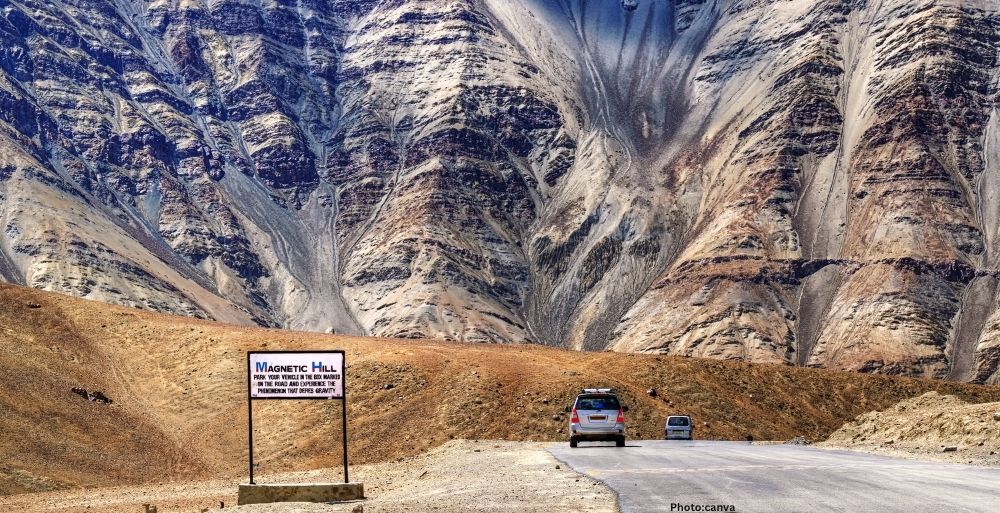
This 230-kilometer route takes visitors through a diverse cultural landscape, including farming villages, historic mountain passes, and ancient monastic complexes. By requiring audiences to travel by local shared taxis, public buses, or rental motorcycles, the biennale forces visitors to adapt to the geographic realities and physical rhythms of the Trans-Himalayan environment.
Artworks are placed inside historic mud-brick settlements, near ancient stupas, and across open, windswept high-altitude plains. This setup blurs the line between human creative intervention and the immense scale of the natural landscape.
Curatorial Vision: Signals from Another Star
The 2026 curatorial framework is directed by lead contemporary artist Vishal K. Dar alongside Associate Curator Tsering Motup Siddho. Together, they have introduced the theme “Signals from Another Star.” This proposition encourages participating artists to treat the high-altitude landscape as a highly sensitive receiving station, broadcasting site-specific frequencies shaped by historical memory, shifting weather patterns, ancient trade routes, and local narratives.
In the context of modern Ladakh, this theme carries significant ecological weight. The region is currently experiencing the direct impacts of global climate change, visible in shifting agricultural cycles, unpredictable precipitation, and the accelerating retreat of glacial ice formations.
By grounding their creative responses in these physical shifts, the artists aim to transform abstract global climate data into tangible visual experiences. The curatorial team seeks to prompt deeper reflection on how modern human consumption patterns impact fragile, isolated ecosystems.
Balanced Representation: Local Knowledge and Global Exchange
A core organizational rule of the 2026 biennale is the commitment to equal representation, ensuring a strict balance between regional Ladakhi practitioners and prominent international contemporary artists. This approach prevents the event from operating as an extractive cultural project, where outside artists simply use the dramatic local landscape as a passive backdrop for imported ideas.
The 2026 roster highlights this collaborative dynamic, pairing Ladakhi artists—such as Tundup Dorjay, Chemat Dorjey, Stanzin Samphel, Stanzin Tsepel, Stanzin Wangail, and Urgain Zawa—with figures from the international contemporary art scene. Notable participants include Indian contemporary artist Jitish Kallat, Austrian multimedia artist Anna Jermolaewa, the Swiss architectural art duo Studio Eidola, Polish conceptualist Agnieszka Kurant, and the experimental multidisciplinary collective Hylozoic/Desires (featuring Himali Singh Soin and David Soin Tappeser).
Institutionalizing the Regenerative Standard
To ensure the festival does not contribute to the environmental strain it critiques, the organizers are testing a specialized “Regenerative Standard Operating Procedure” (SOP) in partnership with sustainability consultancy GLX. This framework goes beyond traditional “carbon offset” or passive sustainability measures, focusing instead on active material circularity and long-term community benefits.
The practical impact of this methodology was demonstrated during a pilot project at the India Art Fair, where a large-scale installation created by Ladakhi artist Skarma Sonam Tashi and German artist Philipp Frank was constructed entirely from discarded cardboard boxes. Following the close of the exhibition, the raw materials were systematically dismantled, shipped back to the region, and repurposed as high-efficiency roof insulation for a school serving the children of migratory workers.
For the August 2026 edition, all installations must adhere to strict zero-to-minimal footprint guidelines, utilizing local, organic materials or upcycled waste products that can be safely returned to the local ecosystem or repurposed for community infrastructure.
Beyond the main highway installations, the biennale includes three major community-driven side projects. In Leh’s historic Old Town, an exhibition supported by the Neekoee Foundation will feature five local Ladakhi artists, revitalizing ancestral domestic spaces as permanent, community-led cultural venues.
Concurrently, researcher Ayan Biswas, with support from the Quiet Art Movement, will lead a specialized project documenting the indigenous medicinal plants of Kargil. This initiative includes educational workshops for local schoolchildren and culminates in a biomass-based sculpture, establishing a clear link between traditional ecological knowledge and contemporary creative expression.