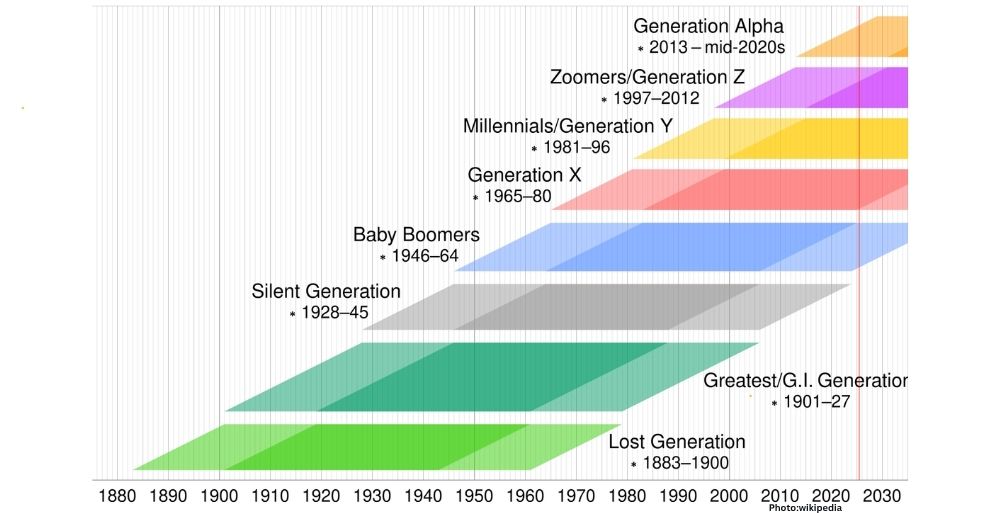
According to Wikipedia, “Silver tsunami is a metaphor describing the rapid aging of the population, specifically as baby boomers (born 1946–1964) turn 65 and older. It highlights the massive demographic, economic, and healthcare challenges and opportunities resulting from this surge. The trend is driving increased demand for healthcare, housing, and financial services.”
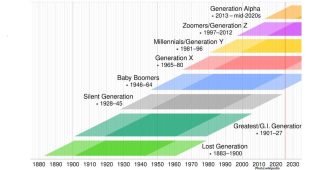
Baby Boomers – born soon after World War II and until 1964 when the landmark Civil Rights Act was signed in the United States ushering the era of human rights globally, and the People’s Republic of China detonated its first nuclear device thus becoming the first nuclear power in Asia – is a large cohort, about 70 million in the United States. Although they represent a broad and diverse population, they share several common strengths and stereotypes. The aging baby boomer generation is creating both opportunities and challenges for society.
The strengths of baby boomers include:
• Strong work ethics and career focus and valuing hard work as a pathway to success
• Strong belief in personal accountability and self-reliance
• Fostering institutional trust with long and dedicated tenures
• Competitive and achievement oriented with an eye on career development
• Value stability with homeownership, job security and pension
• Preference for face-to-face communications
• Participation in civic engagement, such as voting, community service, and public life
The commonly criticized stereotypes or perceptions of baby boomers include:
• Hierarchical view with clear authority lines and seniority in structured organizations
• Resistance to change or slower to adopt to progressive shifts
• Emphasis on work identity, work being central to self-worth, often at the expense of work-life balance
• Perceived entitlement, expecting respect based on age/seniority/tenure rather than adaptability or merit
• “Pull-the-ladder-up” mindset by making the policies that benefitted them harder for the juniors or later generations
To summarize, baby boomers are often characterized by discipline, resilience, and institutional engagement, but are sometimes criticized for rigidity, slower adaptation to change, and benefiting from systems that are harder for younger generations to access.
Impact of Phasing out of Baby Boomer Generation: The phasing out of baby boomer generation is creating significant economic, scientific, and technological shifts. Key effects include a talent gap, reduced productivity, greater healthcare needs. Employers must adjust to a wave of retirements by their most experienced people. This disproportionately impacts certain areas of expertise where imparting tacit knowledge and skills is crucial, such as designing and building new aircraft or surgical procedures or biomedical research.
Silver Tsunami: The World Health Organization predicts that the number of people aging 60 and older worldwide will increase from one billion in 2020 to 1.4 billion in 2030, and 2.1 billion by 2050. Although this trend started in high-income countries (e.g., Japan), it is now low- and middle-income countries experiencing the greatest change. The retirement of baby boomers puts a heavy burden on Social Security and Medicare with fewer workers supporting a larger retired population.
Healthcare Demand: The retiring baby boomers significantly impact on the healthcare system as they become geriatric patients resulting in increase in palliative or hospice care, which often requires home-based healthcare services and remote monitoring systems and telehealth. The need for research on chronic disease management and longevity increases. In parallel, federal support for research not prioritized by older generations will decrease.
Impact on Technology: Due to widespread labor shortage, industries will be forced to adopt AI-driven automation and robotics. The manufacturing and service sectors will be impacted more. Other technology development will likely emphasize smart phone devices, telehealth, and robots designed for elderly.
Workforce Adaptation: There will be increased need to fill the gap necessitating higher investment in workforce training and AI integration to maintain economic growth. For many employers, the challenge will be to attract and retaining skilled workers, along with the need for increased on-the-job training.
Promoting Healthy Aging: With increasing life expectancy, promoting healthy aging takes precedence over managing chronic diseases like diabetes mellitus, high blood pressure etc. Assisted by AI, the current healthcare system of physician centered, visit-based and volume-driven service will evolve into a team-based, continuous care, and value-driven system. Health insurance companies will give incentives for preventive care and lesser hospitalization, thus making healthcare predominantly preventive or intervening early when diseases develop. This is made possible by the power of AI in healthcare as well as the wearable monitors and the use of telehealth by patients from their homes. Healthcare will be the only profession where many “new types” of jobs will be created as it expands to $9 trillion (20% of GDP) by the year 2035 as home-based healthcare becomes a routine. According to US Bureau of Labor Statistics (BLS), healthcare and social assistance sector will be the fastest growing industry, adding 5.2 million new jobs from 2024 to 2034. Many of these new types of jobs require strong social and interpersonal skills as they often bridge the gap between technology and aging patients. The question here is whether or not Gen Z is ready for these jobs.
Massive Transfer of Wealth: Baby boomers are the wealthiest generation in the history of the United States, controlling over $85 trillion in assets, which represents over 50% of total household wealth as of early 2026. They also have the highest net worth per household as compared to other generations.
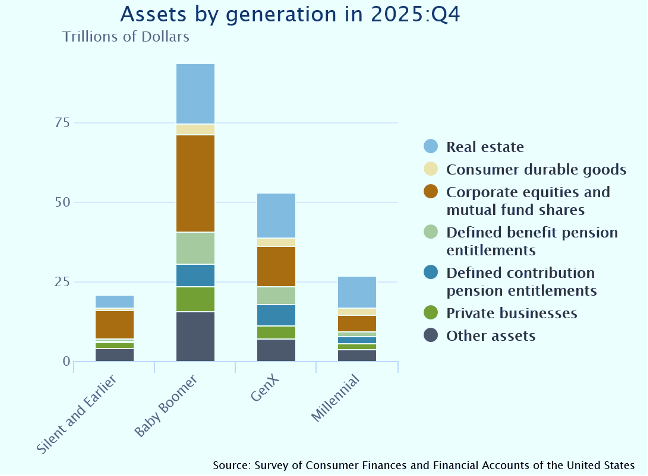
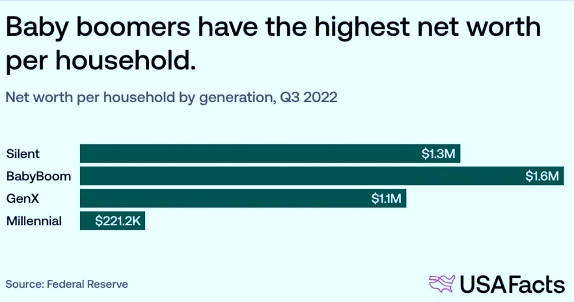
Transferring massive, accumulated boomer wealth would shift investments toward new asset classes. According to the AARP (formerly American Association for Retired People) Longevity and Economy Outlook report, in 2020 those aged 50 and older were responsible for about half or more global spending in these categories: healthcare (60%), miscellaneous goods and services (52%), housing and utilities (51%), food and non-alcoholic beverages (49%), and transport (49%). They also account for most of the spending on recreation and culture (53%) and furnishings and household maintenance (50%). So, an aging population is associated with slower economic growth, greater healthcare spending, and higher demand for “aging-ready homes”, such as nursing homes and assisted living facilities. There will be growth with job opportunities in these sectors.
What Can We Expect? The aging baby boomer population may last for another 10 to 15 years. Until that time, it will have profound effects on our society and economy. But its fundamental effect is positive: a longer and healthier life for most Americans. After that, starting from 2046, there will be another silver tsunami when the millennials start retiring. Like the baby boomers, the millennials also constitute a large cohort (72 million). How that silver tsunami will affect society and economy depends on what the determinants of society and economy will be such as human vs. machines.
Sources of Information:
- “Silver Tsunami”: Challenges and Opportunities of Aging Population.
https://www.investopedia.com/silver-tsunami-8418065 - Understanding the Baby Boomer Age Wave Theory: Economic Impacts.
https://www.investopedia.com/terms/b/baby-boom-age-wave.asp - Baby Boomers Continue to Change the World – Including the Engineering World.
https://180engineering.com/6058-2/ - Baby Boomers Continue to have a Significant Impact on the Economy
https://www.visionmonday.com/business/article/baby-boomers-continue-to-have-a-significant-impact-on-the-economy/ - What does the Retirement of the Baby Boomers Mean for Economic Growth?
https://www.caixabankresearch.com/en/economics-markets/labour-market-demographics/what-does-retirement-baby-boomers-mean-economic-growth - 2029 and Beyond: Anticipating the Economic Consequences of Baby Boomers Reaching Age 65
https://www.insideindianabusiness.com/articles/2029-and-beyond-anticipating-the-economic-consequences-of-baby-boomers-reaching-age-65 - Will Global Aging Change the Pace of Technological Progress and Create a New Consumption Model?
https://link.springer.com/chapter/10.1007/978-3-031-56764-3_13 - Understanding the Boomer Effect in Economics and Markets
https://www.investopedia.com/terms/b/boomer-effect-baby-boomer-factor.asp

Prof. Bellamkonda K. Kishore – a distinguished physician-scientist, innovator, entrepreneur, author, and community leader.