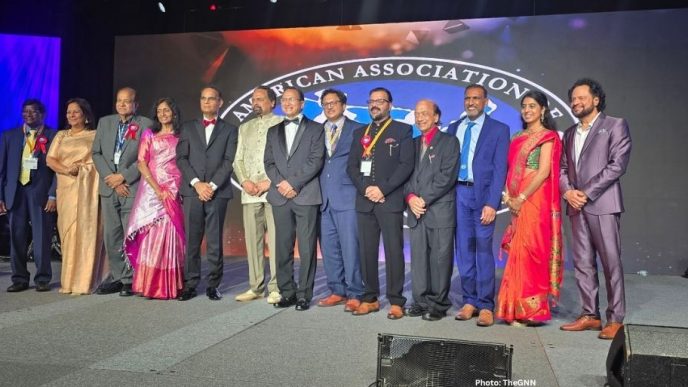
The Indo-American Community Federation’s 25th anniversary of the Unity Dinner brought together leaders to explore the transformative effects of artificial intelligence on communities.
The Indo-American Community Federation (IACF) celebrated the 25th anniversary of its Unity Dinner on April 3, 2023, at the India Community Center in Milpitas, California. The event convened technology and civic leaders to discuss the implications of artificial intelligence (AI) on societal structures under the theme “The Future of AI and Its Impact on Our Communities.” Founded 32 years ago by Jeevan Zutshi, the IACF aims to foster cultural exchange and community empowerment.
Panel Discussion on AI Governance
A central feature of the evening was a panel discussion led by Tasawar Jalali, the author of “Applied AI Governance.” Jalali moderated a conversation that included experts from various sectors, including cybersecurity, healthcare, government, and enterprise technology. He emphasized the balance between technological advancement and institutional oversight, warning that the rapid pace of AI development could outstrip necessary governance frameworks.
“We serve not just the technology, but the trust, the jobs, and the governance gaps that come with it,” Jalali stated, highlighting concerns that without proper governance, the societal impacts of AI could be detrimental. He noted the increasing reliance on AI in city services, healthcare decision-making, and business operations, raising critical questions about whether organizations are strategically adopting these technologies.
“AI’s societal impact will be defined less by the technology itself and more by whether institutions govern it responsibly,” Jalali said. He discussed challenges unique to government adoption, including regulatory hurdles and risk aversion that can inhibit progress without necessarily mitigating risk.
“Moving fast without governance is not innovation; it is unmanaged risk,” he added, emphasizing the need for accountability in AI systems, particularly regarding liability in cases where automated decisions result in harm.
Community Trust and Leadership
Lily Mei, former mayor of Fremont, California, echoed the importance of trust within communities, noting that current societal sentiments reflect deep skepticism and a feeling of exclusion from decision-making processes. “Too many people feel their voices don’t count, that they’re not part of the process or truly included,” Mei remarked, stressing that leadership plays a crucial role in addressing these concerns and fostering community engagement.
Jalali also pointed to the “gray areas” in AI operations, where systems can function correctly yet still lead to unintended consequences, such as financial loss or regulatory violations. “The gray areas are where AI systems can authenticate correctly, call the right APIs, and still cause financial loss or privacy violations,” he explained.
Evolving Roles in Technology
Panelist Krishnan Chellakarai discussed the implications of AI adoption on job security, particularly in light of recent layoffs in the technology sector. He maintained a more optimistic outlook, suggesting that AI will necessitate a shift in the workforce towards higher-level skills, moving from simple task execution to more complex system design and architecture.
“AI is going to actually help,” Chellakarai asserted, stating that while AI can assist with coding and automation, human expertise will remain vital for effective integration and oversight. “People will have to really upskill themselves and think like an architect,” he added.
Chellakarai emphasized the need for educational institutions to adapt and incorporate AI-specific skills into their curricula, noting that the rapid pace of AI advancement requires continuous learning. “AI is changing every two to three months,” he said, advocating for nonprofit organizations and community platforms to provide ongoing training opportunities.
Cybersecurity Challenges
Another panelist, Moinul Khan, co-founder and CEO of Aurascape, addressed the evolving challenges AI poses to cybersecurity. “AI is going to disrupt the way we think about cybersecurity; the entire paradigm is changing,” Khan stated, highlighting that traditional security measures are ill-equipped to handle the dynamic nature of AI systems.
He pointed out that traditional security approaches, designed for static web traffic, must adapt to the evolving threats posed by AI. “Cybersecurity needs to be done in a very different way for the next 20 years,” he warned, calling for new architectures tailored to AI-driven environments.
Khan underscored a shift in organizational attitudes towards AI in security, noting an increasing recognition of AI as an enabler rather than a mere cost center. “That is changing very rapidly and creating new opportunities,” he concluded, encouraging startups and technologists to tackle complex problems rather than chasing quick wins.
The IACF’s Unity Dinner not only marked a significant milestone in the organization’s history but also served as a platform for critical discussions about the future of AI and its role in shaping communities.