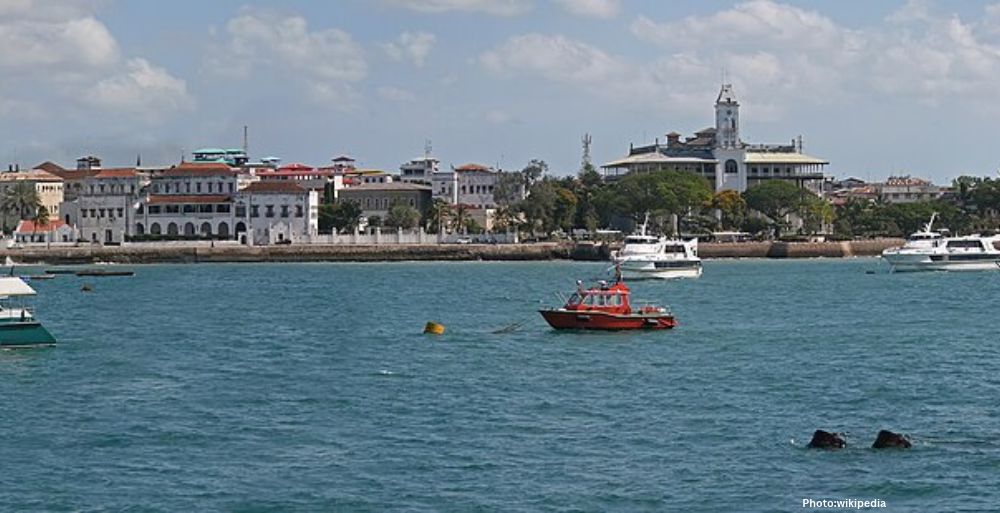
set in Zanzibar, Tanzania
12 November, 2026
The house is a two-storey compound just off Muyuni beach, one of the isolated beach getaways of Zanzibar. It is a little far from the Swahili-styled town where Father used to practice medicine, but it is also his source of rest and respite and sense of home, the perfect place for him now that he is retired. It’s a pink-painted stuccoed cottage designed in the shape of a South Asian mahal, with a dome on the roof and arabesques on the windows and doors. It’s not the type of place Father could have ever imagined being able to build when he was younger and poorer, but money goes far in Tanzania, just as it does everywhere in the world. Every bedroom is fitted with a mosquito net and air conditioner. The kitchen on the ground floor has a robot vacuum cleaner and a smart TV. He gets the house repainted once a year so that he can remember how far he has come. His native village in the Arusha region may have overlooked Mount Kilimanjaro and the tourist-catering hotels underneath it, but in reality it was a cluster of dirt roads and mud huts of more heat and hunger than options.
The location also keeps his mind fresh. Zanzibar can be terribly crowded in the city, but never in these areas in the outskirts of the island, close to the beach. Whenever he is on his morning strolls, the fresh ocean breeze greets him. He pauses on the footpaths to breathe in the jasmine and frangipani, the sukuma and ugali being cooked for breakfast by a neighbour. He grew up having horrible allergies but has never had them in Muyuni. After he returns home tired from his walk, he likes to keep his bare toes against the edge of the hardwood bed and let the fan blow against the skin under his toenails as he reads the newspaper or watches TV.
What a great place he has built for himself, but it was never built just for himself. This was a home he also built for his son. He imagined the dozens of progeny that Son would one day have: the grandchildren as well as their children playing football on the beach, playing cricket in the field, learning maths and sciences and English, inhabiting all these rooms that Father built.
But Son is gay. He has no interest in living in a country as homophobic as Tanzania. He hates the idea of visiting them to the extent that he hasn’t returned home in six years.
What will happen to this house, this beautiful mansion that Father made to be inherited by his only child?
Father tries to keep himself busy by going on his walks on the beach with his neighbours or eating out with friends from the hospital or Rotary Club, but today he is at home. It is nighttime. Christmas jingles are playing from the radio, intermingling with songs in Swahili from Mother’s television. Whether it is the end of the year or the middle of summer, the weather remains muggy, humid, and easy on Father’s body. He is resting barefoot on the roof of his home on a beach chair, staring out at the empty fields, the restless ocean on the other side of the beach, and the gaping grandness amongst the stars. Maybe it’s because it’s the holiday season, and it causes him to reflect on family more than he wishes. He takes a deep breath, shuts his eyes, and finds himself asking a certain question, which resounds in his head.
Who is going to inherit this home if Son will never return?
5 June, 2027
One day Father is out on the porch looking at the stars, and Mother joins him. Mother joins him often at this hour, but on this day, things are different. Mother has a forlorn look in her eyes. She usually likes to speak in Swahili, but today she says in English, ‘The priest who has taught me everything, he is dead.’
This is serious. Father normally leans against the threading of his beach chair with his eyes closed and his head at rest whenever he and Mother talk at this hour, but because of what Mother has said, his entire body springs up. He looks at Mother with a severe look in his eyes.
He asks, ‘Why do you think that?’
‘The cashier, she told me. The body was found some days back. I’m still in shock. I knew he had to have been kidnapped a few years ago, but I had hope. I knew this pastor. He couldn’t have been involved in those drug dealings. He was so kind to me. He said everything I needed to hear when our son came out as gay. Believe in God, believe in Christ. He’ll come back to doing right. And he’ll come back. What a good man. What a kind human being. And now…he’s dead? The poor man…he’s dead?’
Mother turns her face down, and the sadness trickles down from her eyes. There are no attempts to cover her face. There is no distracting from it. Mother is sad.
Father stands up. He knows how important this priest was to Mother. This was the priest who listened to Mother when she had to confide in someone that Son identified as being gay. This was the priest whom Mother spent long hours confessing to once a week. This was a priest who had been in their home, who had laughed at Father’s bad jokes, who sometimes danced to music on the radio.
This was a priest who was closer to Mother than most of her family.
He puts a hand on Mother’s shoulder, but she loses her strength. She collapses into Father’s body. Their awkward stance becomes a firm hug. Father dares not lose his grip on her, because while she has not yet started to sob, she might at any moment, and Father wants to be there when she does.
It’s comforting, in a way, to have this home. It’s extremely comforting. They have a view right out to the ocean, a luxury very few in Tanzania can dare to imagine. The house is fitted with the most modern amenities. They have people who mow the lawn and work extra hard to wash out the stains in their socks.
They have everything, really, even though news of death sometimes takes them out of their privilege.
As Father sees Mother in pain, he tells her something.
‘I love you, my wife. No matter what, I will be here for you.’
Mother looks into his eyes, genuinely touched.
‘I love you too, my husband. We don’t have everything, but at least we have each other.’
Father and Mother kiss, then hold each other. He looks out to the water and strokes her. It doesn’t necessarily console him, but he feels a genuine gratitude, knowing he has this home and that he worked hard for it. Even if no one returns to live in it after he is gone, it gave at least him and his wife a lot of great memories and a life to be truly proud of.
And, at the end of the day, Father didn’t live his life to make his own mother happy; and he doesn’t expect his son to live for the sake of his happiness.
It is a life he has lived ultimately for himself.
18 August, 2051
Father is an old man. He’s alone as he’s always been, walking on the path that he loves. It’s a small little trail between the houses made of dirt. One would think that over the decades it would have been paved, but development has only come to key parts of Kenya, not the entire country. And there’s a rustic charm to the dirt road. It’s small, with tire tracks from the motorcycles and small cars that can somehow fit on it. On the side are the frangipani and jasmine that Father likes to stop and smell.
Father leans in toward the jasmine, takes a deep whiff, remembers how his mother would pick them when he was younger.
And then Father falls. He wasn’t walking, he wasn’t even moving. He just falls. He asks himself what has happened to his legs. He wonders why they have suddenly given out. And then Father feels a sharp numbing in his chest that worries him.
He calls out his wife’s name, then he starts calling for help, but it’s six in the morning, and no one is out. It’s gotten so hot outside. His wife complained earlier that he would give himself a stroke by going out at this hour, but he likes his independence, he likes being able to walk to the beach to smell the sea by himself.
Just as he has done for decades and decades.
His eyesight is starting to blur, he’s starting to lose his ability to shout words. He’s starting to forget them also, whether in Swahili or in English. He has always told himself this day would come. He’s only a few years away from a hundred. It’s a miracle, frankly, that he has lasted this long. He accepts that he might not make it. He accepts that this might be the last thing he sees before he leaves this world.
But in his mind, there is one fixed image that remains clear.
He remembers the pink stucco, the arabesques, the mosquito nets on the beds, and the beach chair on the patio.
That’s his home. It’s the only thing he’s built, the only thing he’s created, just for himself.
And over the course of his good life, he has met people he really cares for, loved ones who have made him who he is, and he has also given them that home.
It’s his home. And he can’t wait to return to it.
There are still so many conversations he is supposed to have with his wife, with his son, with his nephews and nieces. But ego got in the way, as well as fear, or the sense that it wasn’t worth speaking out his innermost thoughts. And so, he kept many things to himself.
He’ll return home. He’ll tell his wife what he’s thinking. He’ll call up his son and talk to his husband and new child as well. He’ll call back to the village and share some words of wisdom with his remaining family members, even if they barely know him. He’ll call his old friends from the hospital and tell them some stories.
He’s trying to sit up, he’s trying to stand.
He’s looking out with his eyes, but he sees only black. What are these words he is hearing? Is he imagining them?
He’s on the dirt path, but he feels like he’s also very much not on the dirt path.
He’s going home.
8 January, 2087
It is 2087, and the world looks incredibly different. For one, most of Zanzibar is underwater. There are only small pockets of land that one can see from the helicopters. No one can live here. No one can even imagine that once there was an island of so much culture, history, and tourism.
Most of the beaches off the coast of Tanzania are under the waves. The closest one can get to a beach is in Handeni county. In its heyday, this was a grassland with wild zebras and hyenas. It is now the late twenty-first century, and very little of the wildlife has survived. It is equally as hard for the humans who do not have the money to transform their bodies to keep up, particularly those who remain in the battered settlements despite the unbearable heat. The ones who live well are in extremely tall skyscrapers with self-cooling footpaths and electric fences, and of course they are only partially human. The human body, artificial intelligence, and certain detachable clothing have merged to help humans think and create and live in a very different way.
John, too, is different in a lot of ways. John, first of all, was conceived in a tube. His father is Tanzanian, and his mother is Tanzanian as well, but they are not married to each other. His mother is a woman who gave her egg to his father because she met him on her travels, and they established a lifelong friendship. His father provided the sperm. And then there is the other man whom his father spent his life with, at least twenty years, another Tanzanian. Given how often John’s father slept around when he was younger, it was a miracle that he stayed with someone for that long. Sadly, John’s other father died prematurely due to an aneurysm. It was a tragedy because John’s other father was almost half John’s blood father’s age, and they constantly talked about who would take over the family affairs when John’s blood father inevitably died before him. When John’s other father died instead, John’s blood father went back to being a slut, and it rubbed off on John. John isn’t gay like his fathers, but he’s slept around with a lot of women from across the world and has never found true love.
John is forty-seven. In some ways he is very old, and in some ways he is very young. People nowadays live far past a hundred, thanks to the advancements in technology, or they die very young due to the sudden floods, extreme changes in temperature, hurricanes, and typhoons. He grew up in the time when artificial intelligence was becoming smart but not in the time when people were finding ways to become one with it, and so that has been a recent adaptation to get used to. He likes that he can talk into his phone and find an immediate result, but he does not like that the infinitude of information on his phone is becoming one with his mind.
John is the product of many worlds. He wasn’t born and brought up in Tanzania. His parents had tried to return before he was born, but the country was just too homophobic, so after a few years they went back to living abroad. They found their luck in other countries for some years, but then there were changes in visa policies caused by sudden wars or genocides. Fortunately, John’s fathers were people of privilege, and they had the money to move. So, John grew up as a nomad. He saw a lot of different cultures and countries and liked growing up that way. He wasn’t relatable to most, but he found he could relate to most people because he had been exposed to diverse ways of living life at a formative age.
Wherever John went, he was constantly asked, ‘Why are you here?’
‘Why did you decide to come to this place?’
‘There are so many other better places in the world. Or why don’t you go back home?’
These comments hurt John, as if the sharp part of an arrowhead were rubbing over his skin. During this period, it was already difficult to live in most parts of the world. Cities like Jakarta and Manila had already sunk into the ocean. The water wars had caused cities like Tehran and Karachi to be devastated and destroyed, transforming what was left of them into ruins in the dust. The best places to live were in the north of Russia or the mountain towns in the Caucasus, but John was the son of gays, and it would have been impossible for him to live in such increasingly strict and religious places.
Unfortunately, that meant John was also marked as unwelcome in Tanzania. While things had changed since his birth because people now had far worse problems to deal with, there had been little actual evolution with regards to how people felt about homosexuals and what they deserved in life.
So, why did John come back, to a part of the world that would not welcome him, a part of the world that his own fathers had a very complex relationship with? His father had even warned him against it. It would be difficult to adapt, given how international John’s way of thinking was, and how little of that thinking was relatable to the locals. When John was young, he would ask his fathers why they never visited Zanzibar despite having a home there, and his father would very bluntly tell him that it had never felt like home for him, so he doubted it would feel like one for John.
The truth is Tanzania is just another foreign country to John.
Yet, John cannot deny that a part of him still belongs to this land, this earth. He wants to return to that part of himself, and there’s nothing wrong with exploring that.
This piece of land he’s now standing on, it’s nothing like where his grandfather’s house once used to be. He will never be able to return to Zanzibar as the island no longer exists. But it’s the closest thing he can find that resembles the beach and bushes he’s seen in his father’s old photographs.
He takes out his phone and looks for the picture, the one from his father’s childhood that he’s always kept saved.
There it is, that two-storey cottage, with the arabesques and the pinkish walls. He has already run the picture through the program, which is able to make it out much more accurately—its size, dimensions, and angles.
He turns on the giant 3D printer he has bought from Scandinavia, spending a whole lot of money and time and energy to get it set up here.
And the machine gets to work. It scans the air, recreates the image that John has given it, not in two dimensions but in three. It’s a giant virtual image, and John adjusts it on the screen to make the windows a little wider like how he likes them to be. He adds a room for the robots that work for him, as well as a cooling room to relax in when the heat gets too overwhelming.
Once the 3D model is ready, John selects “OK.” A giant hand forms from the top side of the 3D printer, as well as several automatons. The automatons pick up the bricks and start to place them at rapid speed, while the 3D printer melts the plaster into stucco. As if in a video game, the bricks stack up layer by layer, and the stucco is melted on it, with the giant hand pinching and moulding it to give the window arches and the doors their shape. The automatons place the wood and glass where needed.
And then the house is complete.
John looks at the picture, then at what is in front of him.
This is no longer his grandfather’s home. It is now his home.
His grandfather might have created the original model, but this structure has been built from the advances in technology that only his time period could have invented. It has been built from John’s own creativity and energy.
This is John’s gift to himself.
He is back. John has come home. He is making this land that refuses to welcome him a part of him. Because he is Tanzanian, and this place belongs to him. He’s going to live here whether they like it or not.