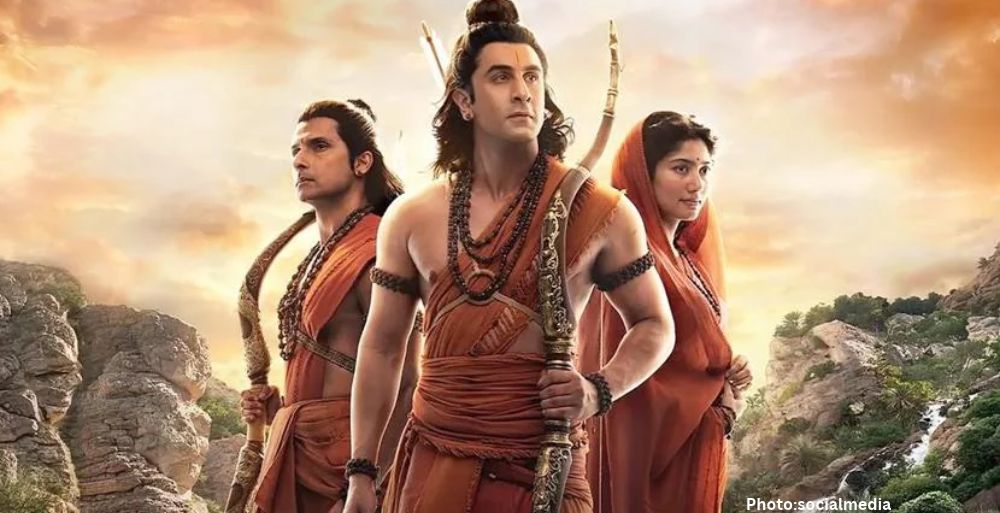
The ambitious two-part adaptation of the Hindu epic ‘Ramayana,’ produced by Namit Malhotra, seeks to redefine Indian cinema’s global presence with a $500 million budget, leveraging cutting-edge technology and a star-studded cast.
London — Namit Malhotra, a prominent film producer and CEO of DNEG, is embarking on a $500 million venture that he believes could transform the landscape of Indian cinema and elevate the cultural narrative of the Hindu epic, “The Ramayana.” As the release date approaches for the first part, titled “Ramayana: Rise of a Legend,” Malhotra remains optimistic about the film’s potential impact.
In an interview conducted in his London office, Malhotra expressed his confidence in the project, stating, “I’m not motivated by the bean-counter logic of, ‘How much money did we make or not make.’” He emphasized that regardless of box office performance, revenue could also be generated through merchandise, theme parks, or other avenues. “This is the story of Lord Ram, OK? There is no version of this where people don’t like (the movies) and it does not drive economic upside,” he asserted.
Historical and Cultural Significance
The “Ramayana,” a narrative that dates back over two millennia and attributed to the sage Valmiki, chronicles the heroic journey of Lord Rama as he battles the demon king Ravana to rescue his wife, Sita. This epic has served as a cornerstone of Indian culture and storytelling, with numerous adaptations across mediums, including a beloved television series in the 1980s. However, this cinematic retelling is poised to reach a global audience and is the most expensive Indian film production to date.
Malhotra, a third-generation filmmaker, is determined to present the “Ramayana” on an unprecedented scale, aiming to showcase the richness of Indian storytelling to a wider audience. “It should be mounted with the resources and the stars and the director and music like any big Hollywood tentpole,” Malhotra stated, underscoring his vision for the film’s production quality. “Until we do that, we will always be the have-nots.”
Production Details and Innovations
The film’s production has been ambitious, with a budget comparable to major Hollywood blockbusters. Part one of the film was primarily shot on soundstages in Mumbai and features extensive visual effects, a hallmark of modern filmmaking. The visual effects team, comprised of DNEG professionals, is known for their work on high-profile films such as “Dune: Part Three.” Additionally, the film’s score features contributions from renowned composers Hans Zimmer and A.R. Rahman.
One of the most innovative aspects of the project is the use of AI-assisted dubbing for the international release, allowing for a seamless adaptation of the film’s dialogue from Hindi to English. Malhotra explained that while the actors recorded their lines in English, advanced technology was employed to synchronize their lip movements with the new dialogue. The process involved significant investment and technical expertise from Brahma AI, a tech company valued at $2 billion.
Anticipated Challenges and Cultural Sensitivity
Despite the extensive planning and investment, the film faces the challenge of meeting the expectations of Indian audiences, who have a deep cultural connection to the “Ramayana.” Past adaptations, such as the recent “Adipurush,” have faced backlash when they failed to resonate with viewers. Malhotra acknowledges the scrutiny that will accompany the film’s release, particularly given the iconic status of Lord Rama in Hindu culture.
Ranbir Kapoor, who plays the role of Rama, reflected on the responsibility of portraying such a revered character. “There is a certain professional and personal baggage that I come with,” he admitted, expressing his initial reluctance to take on the role. “I didn’t have confidence in myself. Will I be able to fit the part?” He ultimately recognized the unique opportunity to tell a story that holds immense significance for millions of people.
Broader Implications and Future Prospects
The release of “Ramayana: Rise of a Legend” comes at a time when adaptations of ancient narratives are gaining traction in global cinema. Recent successes, such as Christopher Nolan’s “The Odyssey,” demonstrate a growing appetite for epic tales. Industry experts believe that the film’s success could pave the way for more Indian narratives to be embraced worldwide, potentially shifting perceptions of Indian cinema.
Malhotra is hopeful about the film’s reception, both domestically and internationally. He aims to present a pan-Indian narrative that resonates with diverse audiences across the country. “Ramayana is every Indian’s story,” he explained, highlighting the importance of inclusivity in casting and storytelling. The film features actors from various linguistic backgrounds, striving to create a representation that transcends regional boundaries.
As the film premiered shortly before Diwali, a festival closely associated with the themes of the “Ramayana,” the filmmakers anticipated that the celebratory atmosphere would bolster its appeal. The film reportedly grossed over $55 million globally during its opening weekend, with significant earnings in the United States, although it remains to be seen how it will perform against historical box office records.
Ultimately, the success of “Ramayana: Rise of a Legend” will hinge on its ability to connect with audiences both in India and abroad. As Yash, who plays Ravana, suggested, the experience of watching the film in theaters will be electric, resembling a stadium atmosphere. The collective experience of Indian cinema-goers is expected to play a crucial role in determining the film’s fate in the competitive landscape of global film.