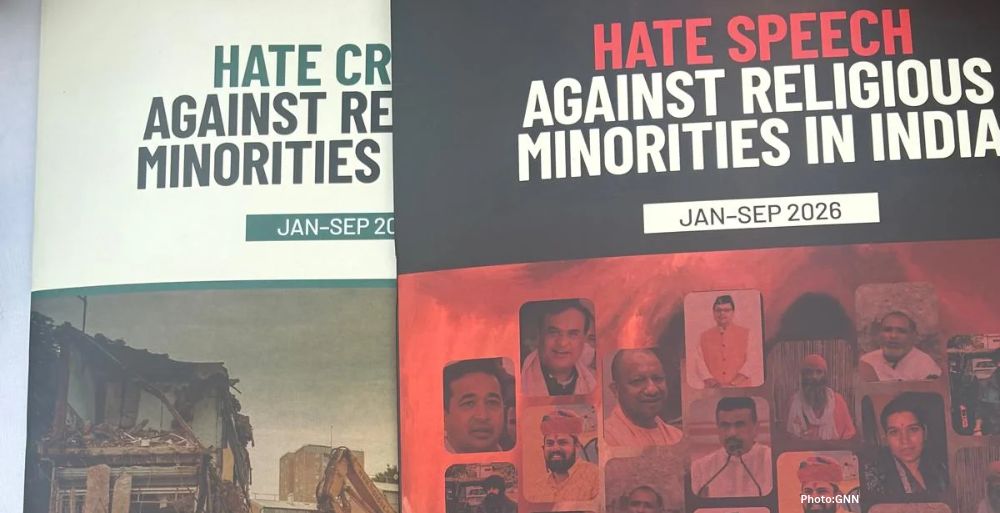
NEW DELHI, November 10 — When words become instruments of intimidation, prejudice becomes public policy, and violence increasingly finds justification in the language of hatred, the consequences extend far beyond the spoken word. That sobering reality framed a gathering of academics, journalists, lawyers, human rights advocates, and community leaders in Jamia Nagar, New Delhi, on Tuesday, November 10, 2026, where the Association for Protection of Civil Rights (APCR) released its important compendium, Hate Speech Against Religious Minorities in India.
The publication comes at a time of mounting concern over religious polarization, the normalization of inflammatory rhetoric, and the growing vulnerability of minority communities. The meeting was not simply a book release. It became an urgent conversation about the relationship between hate speech, institutional accountability, and the violence that can follow when communities are repeatedly portrayed as outsiders or enemies.
Over time, speakers observed, speech has increasingly become a technology of violence, impunity a method of governance, and the rule of law an increasingly fragile promise when confronted by the power of the mob. The central question, they suggested, is no longer whether inflammatory rhetoric will disappear, but how long society can tolerate its continued production, circulation, and political legitimization.
The scale of the problem was underscored by figures from India Hate Lab’s 2025 monitoring. The organization documented 1,318 in-person hate speech events targeting religious minorities across India during the year—nearly four every day. Approximately 98 percent targeted Muslims, either exclusively or alongside Christians. Anti-Christian hate speech also registered a 41 percent increase. Researchers further found that videos from 1,278 gatherings were subsequently circulated online, demonstrating how digital platforms extend the reach and influence of inflammatory public rhetoric.
These figures point to a disturbing pattern: hate speech is no longer confined to isolated public meetings or provocative political statements. It has become part of a wider ecosystem in which public mobilization, digital amplification, and social hostility reinforce one another.
The compendium examines the experiences of religious minorities through documented incidents, legal analysis, media narratives, and policy perspectives. Its central argument is that hate speech must be understood not merely as offensive expression but as a political and social process capable of normalizing discrimination, dehumanizing vulnerable communities, and creating conditions in which hate crimes become increasingly conceivable.
A recurring theme during the discussion was the progression from words to action. Speakers drew attention to historical and contemporary examples demonstrating how sustained campaigns of vilification can precede physical violence, social exclusion, and discriminatory practices. When an entire community is repeatedly presented as a threat, its members can gradually be stripped of the protections and empathy that should accompany equal citizenship.
“The greatest danger of hate speech is not merely the words themselves, but the atmosphere they create,” one speaker observed. Repetition, the argument went, can transform prejudice into social acceptance and make discrimination appear legitimate.
Participants also examined the role of social media in accelerating this process. Videos recorded at rallies and public gatherings can reach thousands, sometimes millions, of viewers within hours. The digital circulation of inflammatory material gives hateful narratives a life far beyond the location where they originated, making accountability increasingly difficult.
The human consequences were equally prominent. Community representatives described growing insecurity among minority populations, while educators highlighted the anxiety and social isolation experienced by students as communal divisions enter classrooms and university campuses. Journalists, meanwhile, spoke of the challenge of confronting misinformation and entrenched stereotypes without compromising accuracy, fairness, and professional responsibility.
Legal experts emphasized that constitutional democracy requires a careful distinction between freedom of expression and speech that incites hatred, discrimination, or violence. India’s Constitution protects freedom of speech while permitting reasonable restrictions under Article 19(2). Speakers argued that these constitutional safeguards must be applied consistently, without political selectivity or discrimination.
The discussion also placed considerable responsibility on the media. Participants called for ethical journalism, rigorous fact-checking, and resistance to sensationalism. Media organizations, they argued, must avoid becoming vehicles for communal propaganda and instead defend the principles of truth, accountability, and responsible public discourse.
The gathering concluded with calls for stronger legal accountability, interfaith dialogue, civic education, and coordinated efforts by civil society, religious institutions, policymakers, and media organizations.
Ultimately, the significance of Hate Speech Against Religious Minorities in India lies in its insistence that violence cannot be understood only at the moment it erupts. It must also be examined in the language, narratives, and institutional failures that make it possible.
A democracy is not measured solely by the promises written into its Constitution, but by the protection it extends to those most vulnerable to majoritarian hostility. Safeguarding India’s pluralistic character therefore requires vigilance not only against lynchings, assaults, and acts of discrimination, but also against the words and prejudices that prepare the ground for them.
Ajay Ghosh is a journalist, clinical social worker, and media leader with more than three decades of experience. A former Delhi Youth Director, he is the founding president of the Indo-American Press Club and chief editor of several media platforms. His work has focused on community leadership, advocacy, and ethical journalism.