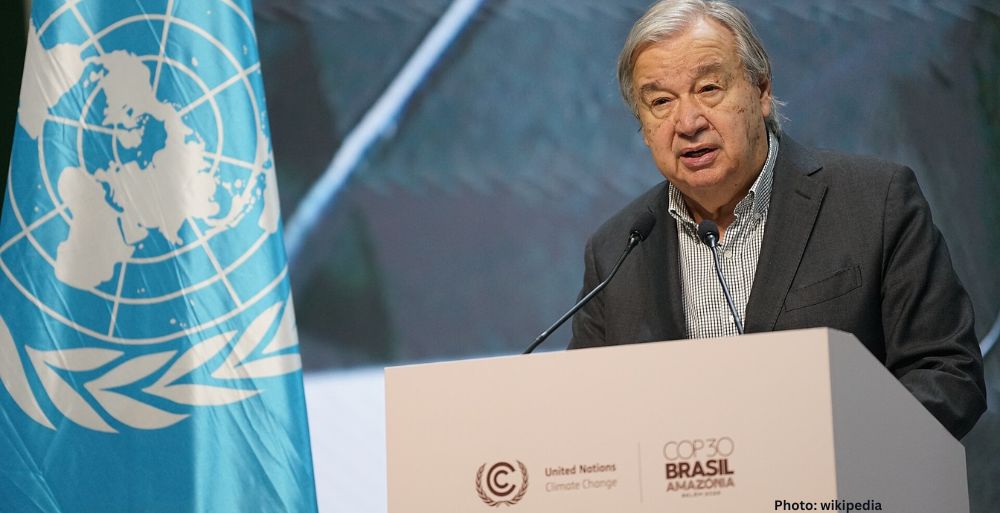
United Nations Secretary-General António Guterres emphasized the urgent need to recognize the legitimate grievances driving global protests, linking rising living costs to broader geopolitical conflicts.
NEW YORK — Ahead of his upcoming visit to Egypt, United Nations Secretary-General António Guterres addressed growing public unrest in Europe and around the globe, as citizens increasingly take to the streets to voice their dissatisfaction over surging living costs. In a press briefing, Guterres highlighted that pressures from rising prices for essentials such as food and fuel are mounting, leading to widespread discontent.
“Everywhere, pressures are building over the price of food, fuel, and other basics,” Guterres observed. “Interest rates are up – for people and countries. And for young people, the promise of a better future is slipping further out of reach.” His remarks come at a time when many European nations are grappling with inflation rates not seen in decades, with recent data indicating that the eurozone’s annual inflation rate reached 5.3% as of September 2023, leading to public demonstrations across several countries.
Legitimate Grievances Amid Protests
While Mr. Guterres condemned the violence and destruction witnessed during protests in France, Italy, and other nations, he underscored the importance of acknowledging the legitimate grievances expressed by protesters. “We must connect the dots and better understand how deeply linked those very real and peacefully expressed grievances are to the wider turmoil in our world,” he stated, emphasizing the need for holistic solutions that address the root causes of these protests.
The Secretary-General compared today’s conflicts to the El Niño climate phenomenon, which disrupts weather patterns across the globe. “We are now witnessing an El Niño of war,” he warned, reflecting on how conflicts are not only intensifying but also expanding. This metaphor highlights the interconnected nature of global crises, as localized conflicts can ripple out, affecting distant regions.
Widespread Consequences of Conflict
Guterres pointed to several critical regions—including the Middle East, Ukraine, and Sudan—where civilians and essential infrastructures such as homes, hospitals, and schools are facing increasing military threats. “But the consequences do not stop in the battle zones,” he cautioned, noting that these conflicts disrupt energy markets, shipping routes, supply chains, and financial systems globally.
He argued that the ongoing wars exacerbate existing inequalities, stating, “War does not create all these inequalities, but it feeds and exploits them – and exposes the fundamental unfairness of an economic system that forces those with the least to absorb the greatest shocks.” This perspective resonates with recent studies showing that the wealth gap continues to widen, particularly in regions hardest hit by conflict and economic instability.
The Middle East: A Region in Turmoil
Focusing on the Middle East, Guterres expressed deep concern over the escalating violence in Yemen, particularly around the city of Taiz, where ongoing Houthi attacks against civilian targets in Saudi Arabia have raised alarm. He described the humanitarian toll as “immense,” with continued violence adding to regional tensions and increasing the number of people in need of humanitarian assistance.
In the Occupied Palestinian Territory, Guterres noted that Israel continues to impose severe restrictions on essential aid, exacerbating the humanitarian crisis as winter approaches. He highlighted the ongoing challenges in implementing the UN Security Council-backed Comprehensive Plan to End the Gaza Conflict and underscored the daily attacks faced by Palestinians in the West Bank from Israeli settlers.
In light of these challenges, Guterres appealed for increased contributions to the UN World Food Programme (WFP), which urgently requires $450 million to sustain its operations in Gaza and the West Bank over the next six months. This funding is critical to ensuring that vulnerable populations receive food and support during a particularly challenging season.
A Vision for Peace and Security
Throughout his remarks, Guterres reiterated the importance of pursuing a two-state solution between Israelis and Palestinians, emphasizing the need for security and dignity for all people in the region. In his forthcoming message in Egypt, he plans to advocate for an end to the widening conflicts, the protection of civilians, and the creation of political space for diplomacy.
“People everywhere want security. They want dignity. They want governments and international institutions to deliver,” he concluded. Guterres stressed that addressing the inequalities that divide societies and halting the conflicts that exacerbate human suffering are crucial steps toward fostering a more equitable and stable world.
The Secretary-General’s comments reflect a growing recognition among global leaders that the challenges of today’s interconnected world require comprehensive and coordinated responses. As public discontent continues to rise, the international community faces the pressing task of addressing the root causes of unrest while promoting peace and stability in a rapidly changing global landscape.