The American India Foundation’s 25th anniversary town hall in San Francisco highlighted the organization’s commitment to leveraging artificial intelligence for social impact while addressing existing inequalities.
The American India Foundation (AIF) celebrated its 25th anniversary with an annual town hall meeting held at the Consulate General of India in San Francisco on September 30, 2023. The event gathered community leaders, philanthropists, and technology innovators to explore the potential of artificial intelligence (AI) in advancing social impact without exacerbating existing disparities.
Focus on AI and Social Impact
The discussions centered on the role of AI in education, public health, and livelihoods, emphasizing the necessity for human-centered technologies that cater to underserved communities. Speakers at the event underscored that access to digital devices, reliable internet connectivity, robust infrastructure, language-appropriate resources, and public trust are vital to ensuring that technological advancements benefit individuals across various socioeconomic backgrounds.
In his opening remarks, Consul Abhishek Sharma commended AIF’s efforts, particularly in rural India, where the foundation has worked to expand access to education, healthcare, and skills training. “I have been reading about AIF,” Sharma stated. “This is my first opportunity to be physically present at an event, and I am really impressed with the kind of work they have done in 25 years.” He noted that the foundation has directly impacted 23 million people in India, highlighting its significant contributions to rural communities.
A Foundation Built on Crisis Response
AIF Co-Founder and Board Co-Chair Lata Krishnan reflected on the organization’s origins, which trace back to the aftermath of the 2001 Gujarat earthquake. She recounted how members of the Indian diaspora rallied to support affected communities, laying the groundwork for a long-term commitment to uplifting underserved populations in India. “Twenty-five years ago, we were just coming off the dot-com boom. Technology was reshaping how we lived and worked,” Krishnan recalled, illustrating the evolution of technology from a novelty to an essential tool for social good.
Krishnan highlighted the foundation’s multifaceted impact, citing instances of children continuing their education despite family migration and young individuals gaining access to science, technology, engineering, and mathematics (STEM) education. “We need to ask what it means to design both futures in the age of AI and how we can make sure that the benefits of this great technological shift are shared,” she emphasized. “AI is not a movie. It is our responsibility.”
Strategic Vision for the Future
AIF’s CEO, Nishant Pandey, delivered the keynote address, outlining the organization’s plans to integrate AI and machine learning into its programs over the next 25 years. He aligned AIF’s initiatives with India’s Viksit Bharat 2047 vision, which aims for the country to achieve developed nation status by the centenary of its independence. “We spent the last 25 years trying to close the digital divide. We cannot spend the next 25 watching it become the AI divide,” Pandey asserted.
Pandey further explained that the communities AIF serves often face challenges that go beyond access to technology. In many remote areas, basic needs such as access to devices, literacy, and consistent school attendance remain pressing concerns. He proposed that AI could serve as a tool for frontline workers to identify needs and allocate resources more effectively, while also emphasizing that technology should enhance rather than replace human judgment and relationships. “AI can help a frontline health worker identify risk, but it cannot replace her judgment,” he stated.
AI Literacy Initiatives
In a separate interview, Pandey elaborated on AIF’s efforts to introduce AI literacy in government schools through its flagship Digital Equalizer program. The foundation is collaborating with state governments in Delhi, Karnataka, and Telangana to provide AI skills to approximately 375,000 children across 1,029 government schools. With around 150 million children enrolled in government schools in India, many from underserved areas, he underscored the importance of ensuring that these students are not excluded from the ongoing changes brought about by AI in education.
Earlier digital education initiatives focused primarily on familiarizing teachers and students with tools like PowerPoint. In contrast, current efforts aim to demonstrate how AI can support classroom instruction. Pandey also discussed a predictive health tool designed using data from 22,000 children in Madhya Pradesh and Odisha, which assists frontline health workers in identifying children at risk of undernutrition.
Community Engagement and the Role of Diaspora Networks
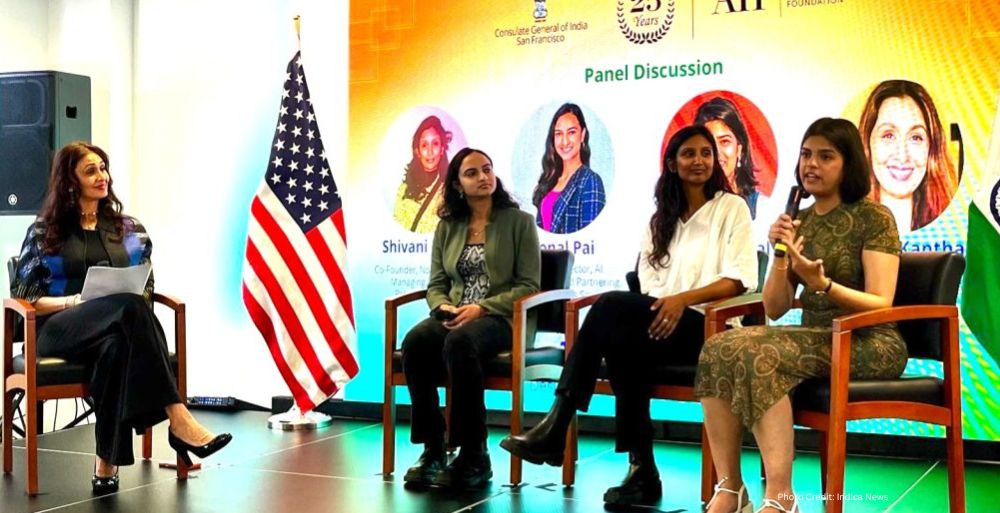
During the event, a panel discussion highlighted the importance of engaging educators and students with AI while maintaining foundational literacy and math skills. Anchal Sayal, senior global partnerships manager at CodeAI and a former educator with Teach For India, shared insights on how AI could empower students and enhance their learning experiences. She advocated for accessible tools that foster enthusiasm among educators and students alike.
The panel also included Shivani Mitra of Nous Research and Prometheia, and Sonal Pai of Bristol Myers Squibb, moderated by AIF’s Chief Development and Marketing Officer Kalpana Kanthan. They examined AI through various lenses, including equity, inclusion, human-centered design, cultural context, and social impact, emphasizing the necessity of developing technology tailored to local needs.
As AIF embarks on its next quarter-century, the discussions at the town hall highlighted the ongoing challenge of ensuring that advancements in AI reach communities historically disadvantaged in terms of technology and resources. Speakers concluded that the measure of success would not only be technological adoption but also the tangible benefits in educational opportunities, health outcomes, and improved livelihoods.