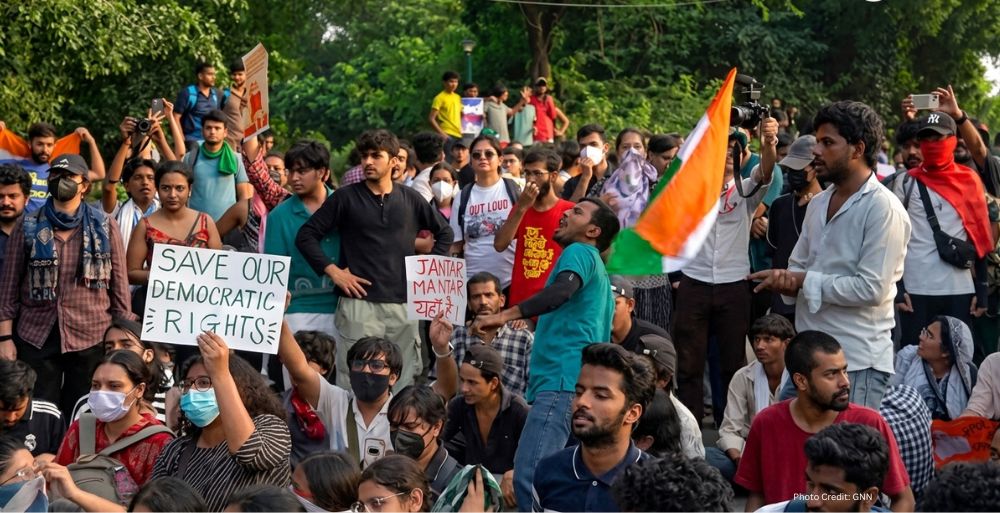
A protest led by the Cockroach Janta Party at Jantar Mantar escalated into a confrontation with police, following the government’s recent decision to remove the site as a designated area for public demonstrations.
New Delhi, October 10, 2023 – In a defiant display of dissent, members of the Cockroach Janta Party (CJP), led by Ashutosh Ranka and Saurav Das, staged a protest at Jantar Mantar early Tuesday morning. This demonstration occurred just a day after the Central Government officially denotified the site, historically recognized as a significant venue for public protests in India. The protest highlights ongoing tensions between civil society and government authorities regarding the right to assembly and freedom of expression.
In a video shared on social media by CJP founder Abhijeet Dipke, protesters were seen scaling an iron gate and overcoming police barricades to access the site. As they entered, the group waved flags and chanted slogans such as “Bharat Mata Ki Jai” and “Inquilab Zindabaad,” which translates to “Long live the revolution.” Their actions led to a brief confrontation with police officers stationed at the scene, as law enforcement attempted to prevent their entry. Ultimately, the protesters were detained by police, a move criticized by Dipke as an infringement on their rights.
Background of Jantar Mantar as a Protest Site
Jantar Mantar has long served as a pivotal location for protests in India, situated in a high-security area of central Delhi. Historically, it has provided a platform for various social movements, allowing citizens to voice grievances and demand accountability from the government. The recent denotification is part of a broader shift in policy regarding public demonstrations, raising concerns among activists and political opposition about the government’s intent to restrict dissent.
Following the recommendation of a committee under the Union Home Ministry, the government has designated three new locations for protests: Ramlila Ground, Burari Ground, and CBD Ground in East Delhi. This shift has prompted significant backlash, as many view it as an attempt to limit the visibility and impact of public dissent. Dipke criticized the government’s actions, stating, “You cannot denotify the resistance.” He further asserted that the Prime Minister’s decision reflects a fear of public dissent and will not deter protests, claiming, “Jantar Mantars will now emerge across the country.”
Recent Protests and Government Response
The timing of this protest coincides with heightened tensions in the capital, particularly surrounding the actions of Chief Election Commissioner Gyanesh Kumar. Protests organized by the opposition bloc INDIA and other groups have been met with extensive police presence and preemptive detentions. Since October 10, the Delhi Police have reinforced their presence around Jantar Mantar, effectively barring potential protesters from entering the area. This security crackdown has led to thousands of detentions over the weekend, as authorities sought to manage public dissent in the capital.
On the same day as the CJP protest, top leaders of the party were detained upon their arrival in Delhi, further illustrating the government’s aggressive stance toward dissent. This escalation in police action against activists raises questions about the balance between maintaining public order and upholding democratic rights.
Implications for Democratic Freedoms
The denotification of Jantar Mantar as a protest site reflects a significant moment in India’s political landscape, prompting broader discussions about the right to protest and civil liberties. Critics argue that the government’s actions undermine the fundamental principles of democracy, particularly the right to assembly and free expression. The establishment of new protest locations does not alleviate concerns regarding accessibility, effectiveness, and the potential for further government control over public dissent.
As various activist groups respond to the denotification, the emergence of new protest sites across the country could indicate an ongoing struggle between governmental authority and civil society. Observers are closely monitoring how these developments will affect opposition strategies and public sentiment, especially with upcoming elections on the horizon. The government’s approach to managing dissent may significantly influence political discourse and activism in the coming months.
Future Outlook
The recent protest by the CJP serves as a reminder of the ongoing challenges faced by activists in India. As they navigate a shifting landscape of protest rights and government regulations, the potential for new forms of resistance and mobilization appears strong. Whether the government’s response to dissent will evolve or harden in the face of public outcry remains to be seen.
The actions taken by the CJP and the government’s response will likely reverberate throughout the political landscape, shaping the relationship between the state and civil society in the years to come. As the situation develops, it will be crucial for citizens and political actors to remain vigilant in defending democratic principles and the right to voice dissent.