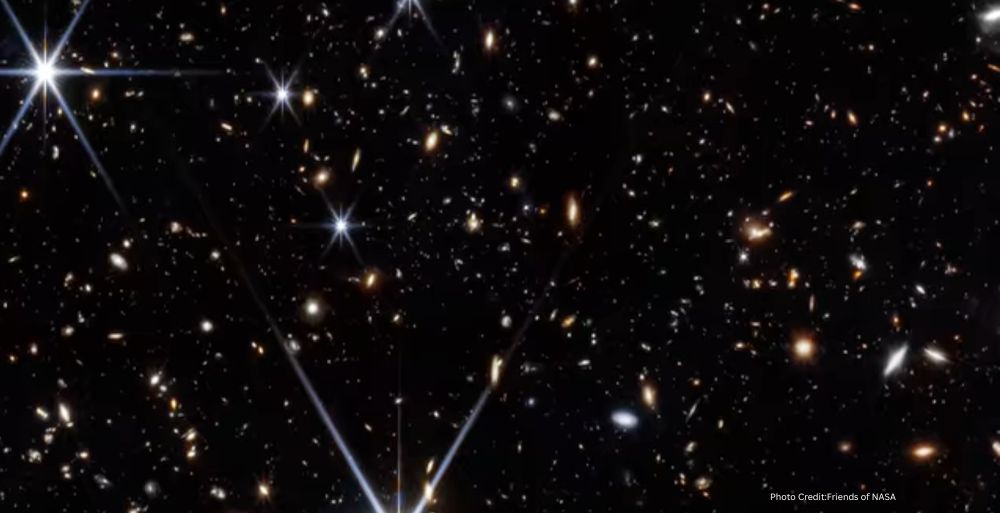
Astronomers using NASA’s James Webb Space Telescope have identified the host galaxy of the most distant fast radio burst (FRB) ever detected, providing new insights into the origins of these enigmatic cosmic phenomena.
NASA’s James Webb Space Telescope has successfully pinpointed the host galaxy of the most distant fast radio burst (FRB) discovered to date, a significant advancement in understanding these brief but powerful flashes of radio emission from the universe. The discovery was made by astronomers from the University of Sydney and the MeerTRAP team, with their findings published in the journal Science on March 4, 2024.
Fast radio bursts, which were first identified in 2007, are millisecond-long bursts of radio waves that have puzzled scientists due to their brief nature and uncertain origins. Most FRBs appear only once, complicating efforts to study their characteristics and origins. The latest FRB, designated as FRB 20240304B, was detected by the MeerKAT telescope and subsequently localized using Webb’s advanced instruments.
Detection and Analysis
The MeerTRAP team detected FRB 20240304B on March 4, 2024, and preliminary radio data indicated its extreme distance. However, to confirm the distance and study the FRB’s host galaxy, astronomers required the capabilities of the James Webb Space Telescope. The NIRCam (Near Infrared Camera) instrument on Webb confirmed the presence of a galaxy located precisely where the burst was observed. The NIRSpec (Near Infrared Spectrograph) instrument then measured the galaxy’s redshift at 2.148, indicating that the light we observe today originated approximately 3 billion years after the Big Bang.
This redshift is significant because it places FRB 20240304B in a period of cosmic history when the universe was much younger. The majority of previously detected FRBs have been associated with galaxies that formed billions of years later, making this discovery particularly noteworthy.
Characteristics of the Host Galaxy
Upon analyzing the host galaxy of FRB 20240304B, the research team found that it deviated from the typical characteristics of galaxies known to host FRBs. Most associated galaxies are large, star-forming entities; however, the newly identified host is 1,000 times less massive than expected. “We thought it would be a big, nicely formed galaxy with lots of stars, and instead it was a little dwarf galaxy, although it was actively forming stars,” said Manisha Caleb, lead author of the study and a researcher at the University of Sydney.
Co-author Ben Stappers from the University of Manchester expressed surprise at the findings, stating, “The host sticks out in the whole galaxy sample that we have. And it definitely was not what we were expecting.” This finding raises questions regarding the mechanisms that produce FRBs, particularly in relation to the mass and structure of their host galaxies.
Implications for Fast Radio Burst Theories
The discovery has broader implications for the prevailing theories about the origins of FRBs. One prominent theory suggests that FRBs may result from the merger of two neutron stars. However, this process is expected to take billions of years, which would correlate with older galaxies that have evolved stellar populations. Alternatively, FRBs could originate from young, highly magnetic neutron stars known as magnetars, which can produce bursts shortly after a massive star explodes as a supernova. The characteristics of the host galaxy of FRB 20240304B point more towards the latter scenario. “Our work suggests that it’s very unlikely that this FRB was produced by a merger,” Caleb noted.
Future Prospects and Cosmic Exploration
The research team is optimistic about the potential for discovering even more distant FRBs. They estimate that the MeerKAT telescope may detect several FRBs per year at a redshift greater than 1.0, indicating they existed more than halfway back to the beginning of the universe. As advancements in radio telescope technology continue, the rate of these discoveries is likely to increase. The James Webb Space Telescope will play a crucial role in characterizing these distant galaxies, allowing scientists to glean further insights into the nature of FRBs and the cosmic environment through which their signals travel.
J. Xavier Prochaska from the University of California, Santa Cruz, emphasized the importance of these findings, stating, “A fast radio burst is almost like a cosmic flashlight. It lights up everything along the path. It carries an imprint of everything that it travels through, so you can use it to trace the ‘cosmic web’ – the otherwise invisible matter and structures that it encounters along the way.” The research team found evidence of two cosmic structures along the burst’s signal: a previously unknown galaxy cluster and the nearby Virgo Cluster, expanding our understanding of the universe’s structure.
The James Webb Space Telescope is recognized as the world’s premier space science observatory, dedicated to solving various mysteries across our solar system and beyond. Webb is an international collaboration led by NASA, with contributions from the European Space Agency (ESA) and the Canadian Space Agency (CSA).