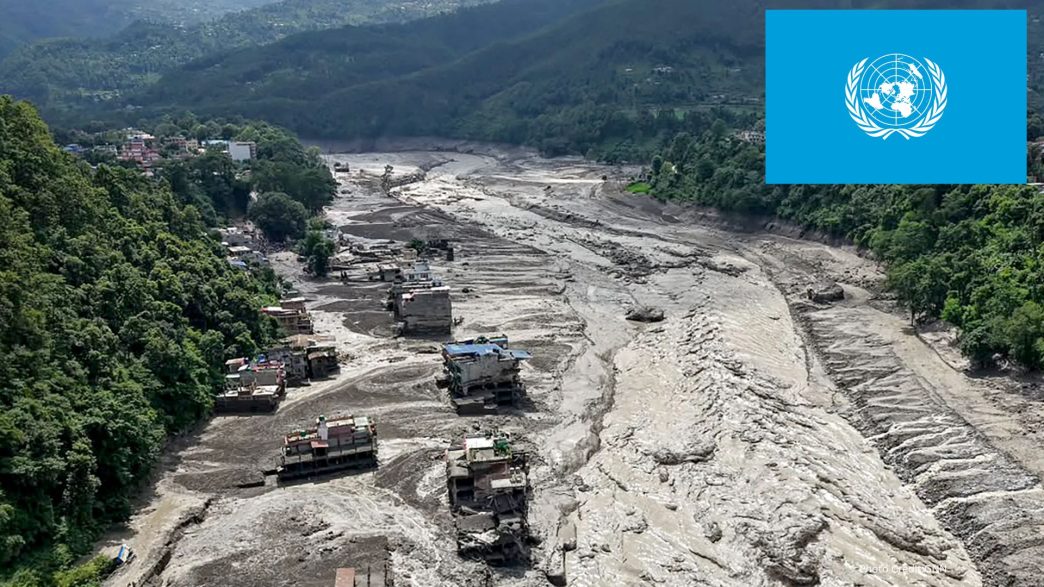
Nepal is preparing to request approximately $20 million from the UN Fund for Responding to Loss and Damage, following catastrophic floods last month that resulted in significant loss of life and property, as a new study highlights the role of climate change in the disaster.
Nepal is set to leverage a recent study linking climate change to the devastating floods that swept through the Nepal-Tibet border region last month, resulting in thousands of deaths and missing persons. The government aims to file a request for approximately $20 million from the United Nations Fund for Responding to Loss and Damage, which is designed to assist countries impacted by climate change.
As of Wednesday, official figures indicate that around 1,400 individuals have died and approximately 6,150 are still unaccounted for following the floods and landslides that ravaged the region. The disaster has been attributed to a collapse of rock and glacier ice near Langtang Lirung, a peak located on Nepal’s side of the Himalayas.
Study Finds Climate Change a Likely Factor
A report published by the research group World Weather Attribution on Thursday states that climate change was a likely contributing factor in the catastrophic events of last month. Dr. Friederike Otto, a climatologist at Imperial College London and co-author of the study, asserted that there is “absolutely no doubt that human-induced climate change played a role here in the preconditioning of the disaster.”
The study suggests that the floods resulted from a “compound event” influenced by rising temperatures, thinning glaciers, thawing permafrost, and pre-existing geological vulnerabilities. According to the findings, temperatures in the area during July and August were approximately 1.5°C (2.7°F) higher than historical averages, a change attributed to human activity. Additionally, glaciers have been thinning at a rate of about half a meter (1.6 feet) per year, which could exacerbate existing fractures and lead to increased instability.
Financial Impact and Reconstruction Needs
In the aftermath of the disaster, Nepalese leaders have estimated that the nation requires around $5 billion (£3.7 billion) for reconstruction efforts. The UN Fund for Responding to Loss and Damage, which became operational last year, necessitates that countries provide evidence demonstrating that their losses stem from climate change impacts.
Nepalese officials are compiling satellite and drone imagery, along with preliminary reports, to support their claim to the fund. The World Weather Attribution report is seen as crucial evidence for asserting that climate change significantly contributed to the catastrophic collapse of rock and ice.
Maheshwar Dhakal, spokesperson for Nepal’s Ministry of Agriculture, Forest and Environment, noted, “The report will be the main basis of our claim as it has detailed what role climate has played in this disaster.”
Global Call to Action
Nepalese authorities have emphasized the need for global action on climate change, highlighting that while the country is among the lowest emitters of greenhouse gases, it remains highly susceptible to the adverse effects of global warming. Prime Minister Balendra Shah, in his first foreign trip, is set to address the United Nations General Assembly in New York next week, where he will discuss the recent disaster and advocate for climate justice.
Danya Liu, a climate adaptation specialist at BloombergNEF, remarked, “Nepal has repeatedly used the term ‘compensation’ to describe much-needed recovery funds,” suggesting a desire for a framework where polluters are held accountable for the damages caused by their emissions, rather than reliant on aid alone.
Challenges Ahead
Despite garnering support from some nations for expedited funding, challenges remain. Nearly 120 countries have submitted claims to the UN fund, amounting to requests of nearly $3 billion (£2.2 billion), while only about $400 million (£300 million) is currently available for disbursement. Officials responsible for the UN fund are scheduled to convene in December to determine which requests will be approved and if an urgent decision can be made regarding Nepal’s needs.
Additionally, the World Weather Attribution study referenced a magnitude 7.8 earthquake that struck Nepal in 2015, suggesting it could have weakened the geological structure that contributed to the recent disaster, although they could not definitively confirm the earthquake’s impact.
Scientific Perspective
The World Weather Attribution study has not yet undergone peer review, though it adheres to established peer-reviewed methodologies for analyzing extreme weather events. Dr. Simon Cook, a glacier expert at the University of Dundee, expressed that while attributing a specific event to climate change remains complex, “climate warming ultimately destabilises these high mountain environments.” He added that the study provides compelling evidence of climate change’s role, though further research is needed to fully understand the processes involved and improve monitoring of high-mountain regions to facilitate early warnings for similar events in the future.