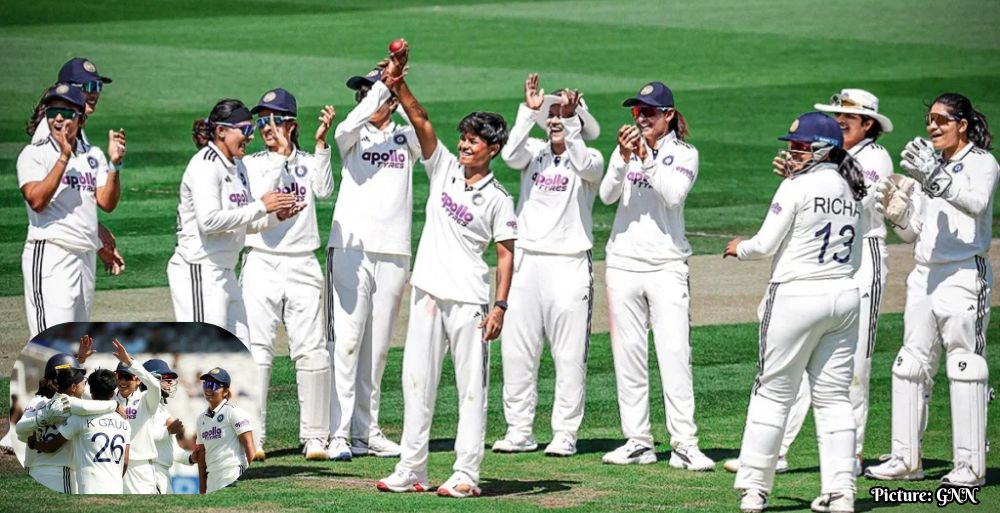
In a historic turning point for international women’s cricket, the Indian national women’s cricket team achieved a monumental 270-run victory over England in the first-ever women’s Test match hosted at Lord’s Cricket Ground. The four-day red-ball contest, which drew an impressive cumulative attendance of nearly 38,000 spectators, featured groundbreaking individual milestones, including Yastika Bhatia becoming the first woman to score a Test century at the venue and young medium-pacer Kranti Gaud securing a place on the prestigious honors board with a crucial five-wicket haul. Legendary former batter Sachin Tendulkar, who addressed the team before the final morning, hailed the match as a “golden moment” that signals a new era of structural growth and financial equity in the sport.
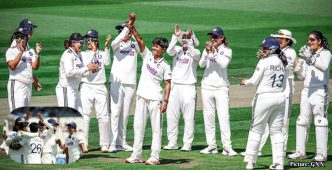
LONDON — The historic architecture of the Lord’s Pavilion stood as a silent witness to a new chapter in sporting history on Monday morning as the Indian women’s national cricket team wrapped up a clinical, dominant 270-run victory over England. The triumph concluded the first-ever women’s Test match in the 142-year international history of the ground, signaling an unmitigated shift in the landscape of the women’s game.
Chasing a mountainous fourth-innings target of 457 runs—a figure that would have shattered the all-time record for a successful fourth-innings chase in women’s Test cricket—England resumed the final morning at a precarious 130 for 6. Despite a defiant 54 from wicketkeeper-batter Amy Jones and a fighting maiden half-century from Sophie Ecclestone, the English lower-order resistance collapsed under the pressure of India’s disciplined spin attack. Off-spinner Sneh Rana dismantled the tail to finish the innings in style, while Deepti Sharma claimed two rapid breakthroughs, bowling England out for 186 in the opening session of the fourth day.
The victory marks India’s second-highest win by a margin of runs in women’s Test history, trailing only their 347-run triumph over the same opponents in Navi Mumbai in 2023.
A Convergence of Eras at the Home of Cricket
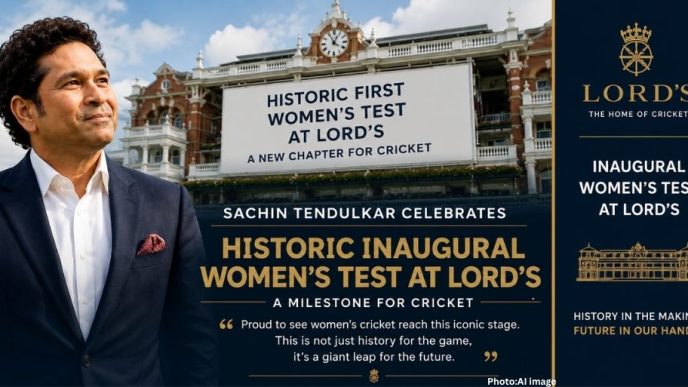
The gravity of the occasion drew numerous legendary figures to the ground, none more prominent than former Indian batting maestro Sachin Tendulkar. Tendulkar, who visited the Indian dressing room to deliver an inspirational address before the start of play on Monday morning, watched from the iconic standard of the Lord’s balcony as the final wickets fell.
Reflecting afterward on the rapid trajectory of the women’s game, Tendulkar contextualized the 50-year evolution it took for red-ball cricket to be granted to female athletes at the Home of Cricket.
“Feels nice to be walking back on the green again,” Tendulkar remarked in a video released by the Board of Control for Cricket in India (BCCI). “A big moment for women’s cricket because I remember in 1976, if I’m not mistaken, the first ODI for women was played here. I think that it was a 40-over match and literally now 50 years down the line, we’re playing a Test match here at Lord’s. I’ve always considered Test cricket to be the pinnacle of cricket. So, I think it’s a fantastic occasion, a golden moment in women’s cricket, I would say.”
Tendulkar explicitly linked the on-field success to structural reforms carried out within the domestic and international governing bodies, pointing toward pay parity protocols as a key catalyst.
“All credit to the ICC,” Tendulkar added, his expression earnest as he gestured toward the playing field. “I know that back home in India, a few years ago, Jay Shah started this initiative and when it came to pay parity, women’s cricket was benefited equally as men’s cricket. And today to see a women’s Test match here at Lord’s, it’s heartening.”
Rewriting the Lord’s Honors Board
The match was defined by extraordinary individual performances that broke structural barriers. Indian wicketkeeper-batter Yastika Bhatia, returning to the international squad following intensive knee surgery earlier in the year, anchored India’s second innings with a masterful 113 off 158 balls. Her elegant strokeplay—culminating in a crisp drive through extra cover to reach the triple-figure mark—made her the first woman in history to score a Test century at Lord’s, automatically inscribing her name onto the historic Lord’s honors board.
Bhatia’s historic century built upon a firm foundation laid in the first innings by captain Harmanpreet Kaur, Smriti Mandhana, and Deepti Sharma, all of whom registered crucial half-centuries to post an initial total of 285.
On the bowling front, 22-year-old Indian medium-pacer Kranti Gaud tore through the English batting lineup during the first innings. Gaud registered her maiden five-wicket haul in the red-ball format, finishing with outstanding figures of 5 for 37, which restricted England to a mere 170 runs and gave India a decisive 115-run first-innings advantage.
“That’s a big moment,” Tendulkar emphasized when discussing the feats of Bhatia and Gaud. “Because there will be many great performances, many more victories, new records, but these names will always be the first ones to be there. So, fantastic achievement by both of them.”
The Political and Structural Landscape
The commercial and public success of the fixture has challenged long-held skepticism regarding the viability of the multi-day format in women’s cricket. The cumulative four-day attendance reached 37,846 spectators, reflecting robust ticket sales that match or exceed several men’s neutral Test fixtures.
“I was reading and it was 30,000-something over four days, which is fantastic,” Tendulkar noted. “This is just the beginning. I’m sure there are bigger things in store for us.”
The match also carried immense emotional and structural weight for the hosts. The defeat capped a challenging summer for the England women’s national team, following a loss to Australia in the Women’s T20 World Cup final. Furthermore, the conclusion of the Test marked the formal end of the international careers of two stalwarts of English cricket: Tammy Beaumont and Heather Knight. Both players, who were instrumental in England’s iconic 2017 ICC Women’s World Cup victory at this very ground, announced their retirements from all formats of international cricket at the end of the match, closing a definitive era for the domestic game.
Following the trophy presentation, an elated Indian captain Harmanpreet Kaur looked ahead, demanding an expanded international calendar for the long format.
“God is a better writer and he has written it pretty well,” Kaur said, smiling broadly as she held the match trophy. “The last couple of series have not been in our favour… but we came back strongly in the Test match. Hopefully, we will get ten more Test matches and we can keep performing. Playing at Lord’s is always special.”