The analysis argues that the government’s claim of India being the world’s fourth most equal country is based on an inaccurate comparison of consumption- and income-based inequality measures, asserting that comparable global data places India among the world’s more unequal economies.
A recent analysis by The Wire has challenged the Indian government’s claim that the country has become the world’s fourth most equal nation, arguing that the assertion is based on an incorrect interpretation of World Bank data and a flawed comparison of different measures of inequality.
The controversy stems from a Press Information Bureau (PIB) statement that cited a World Bank brief reporting India’s consumption-based Gini index at 25.5 for 2022–23. The government subsequently described India as the world’s fourth most equal country, with several media organizations reporting the claim.
The analysis argues that the World Bank made no such global ranking.
Instead, it states that the PIB incorrectly compared India’s consumption-based inequality index with income-based Gini indices used for most other countries, describing the comparison as statistically invalid.
The World Bank brief states:
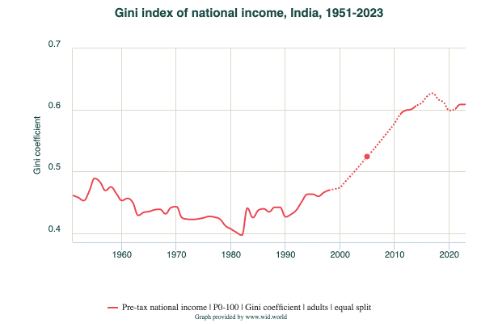
“India’s consumption-based Gini index improved from 28.8 in 2011–12 to 25.5 in 2022–23, though inequality may be underestimated due to data limitations. In contrast, the World Inequality Database shows income inequality rising from a Gini of 52 in 2004 to 62 in 2023. Wage disparity remains high, with the median earnings of the top 10 percent being 13 times higher than the bottom 10 percent in 2023–24.”
According to the analysis, consumption-based inequality measures generally produce lower estimates than income-based measures because higher-income households save a significant portion of their earnings rather than spend them. As a result, consumption inequality often appears lower than actual income inequality.
It further notes that the World Bank itself cautioned against drawing broad conclusions from the consumption-based estimate, stating that methodological changes and survey limitations may have resulted in an underestimation of inequality.
To compare countries using a common standard, the analysis relies on figures from the World Inequality Database, which places India’s income-based Gini coefficient at approximately 61 in 2019 and 2023.
Based on those figures, it argues that India ranks 176th out of 216 countries in terms of income equality, rather than fourth. It also notes that India’s relative position has worsened over time, compared with a ranking of 115th in 2009.
The analysis further highlights India’s wealth inequality, citing a wealth Gini coefficient of 75 in 2023 according to the World Inequality Database, indicating a high concentration of wealth.
To examine consumption inequality separately, it notes that the World Bank report does not compare India’s consumption Gini with those of other countries. Instead, it references international food consumption data processed by Our World in Data, based on the United Nations Food and Agriculture Organization (FAO), which places India 102nd out of 185 countries in terms of inequality in per capita calorie intake in 2019, compared with 82nd in 2009.
The analysis concludes that, regardless of whether inequality is assessed using income, wealth, or comparable consumption indicators, the available evidence points to India remaining a highly unequal country. It argues that misinterpreting statistical measures can distort public understanding of economic conditions and obscure the need for policies aimed at addressing widening inequality.