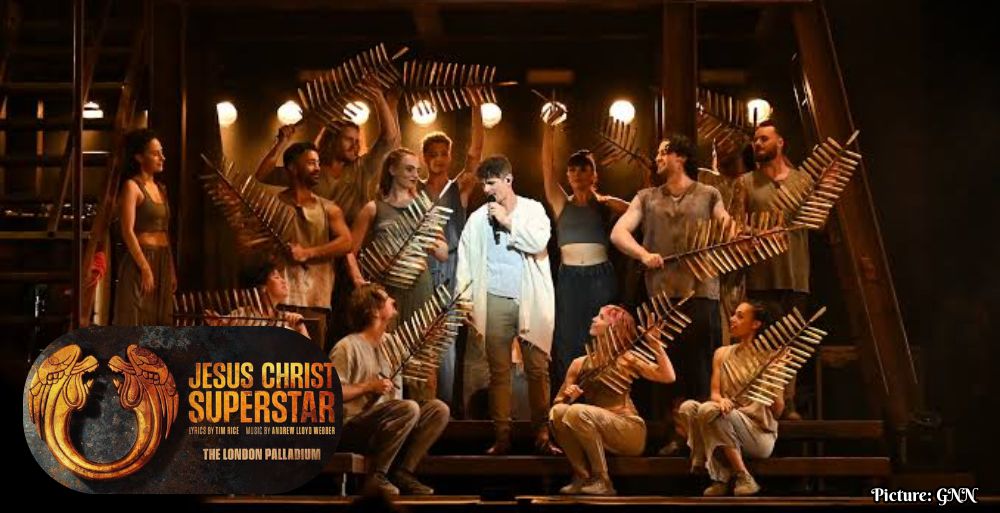
The seminal rock opera “Jesus Christ Superstar” has made a high-profile return to London’s West End, launching a new revival at the London Palladium that intentionally strips away decades of traditional theatrical embellishment to return the show to its raw, standard-setting musical origins. Co-creator Andrew Lloyd Webber announced that this latest iteration features a prominent, highly visible on-stage orchestra designed to mirror a live concert experience rather than a conventional piece of musical theater. Boasting a diverse, rotating star cast that includes Eurovision breakout performer Sam Ryder and pop icon Boy George, the production seeks to fulfill the creators’ original 1970 vision by treating the iconic score as a driving piece of rock-and-roll history
LONDON — The roaring guitars and driving rhythms that defined a generation of musical theater have returned to the heart of London’s West End. “Jesus Christ Superstar,” the historic and occasionally controversial rock opera crafted by composer Andrew Lloyd Webber and lyricist Tim Rice, officially celebrated its press opening night at the legendary London Palladium on Tuesday. According to the creative team, this high-octane revival represents a conscious effort to peel back the layers of traditional theatrical staging accumulated over the past 50 years and return the masterpiece directly to its raw, unadulterated rock-and-roll roots.
The production, which is scheduled to run at the London Palladium until September 5, 2026, before transferring to the Theatre Royal Drury Lane for an extended autumn and winter engagement from October 16 to January 9, 2027, has already generated significant box office momentum. Theater historians and critics present at the opening noted that the revival lands at a time when the West End is increasingly embracing immersive, concert-style formats to attract younger audiences.
Returning to the Concert Roots of a Global Phenomenon
Standing on the red carpet outside the London Palladium amidst a flurry of flashbulbs and standard opening-night fanfare, an enthusiastic Andrew Lloyd Webber, now 78, reflected candidly on the long, complicated structural history of the show.
“It was a very successful album originally,” Lloyd Webber stated, speaking to reporters with a visible sense of pride about the project’s unique genesis. “And one of the things that’s happened with it is because the album was so successful, that it’s always been really at its best when it’s like a concert, because we never got the chance to work on it specifically for the theatre, because we couldn’t get anybody interested to do it in the theatre.”
The history of “Jesus Christ Superstar” is distinct in the annals of musical theater. In 1970, unable to secure financial backing or standard theatrical venue interest for a stage production due to the sensitive nature of the subject matter, the young creative duo of Lloyd Webber and Rice recorded the work as a concept rock album. Driven by soaring vocals, distorted guitars, and a 19-piece orchestral backing, the record became an unexpected global commercial juggernaut, topping the U.S. Billboard charts and selling millions of copies worldwide.
Only after this profound recording success did the theater industry take note. The show made its official Broadway debut the following year, in October 1971, at the Mark Hellinger Theatre. It eventually transferred to London’s West End in August 1972, playing at the Palace Theatre, where it defied initial expectations by running for an astonishing eight years and 3,358 performances. By the time it closed in 1980, it had secured its place as the longest-running musical in West End history at the time, grossing millions and generating professional productions in over 40 countries.
However, Lloyd Webber maintained that the transition to physical theater often diluted the propulsive energy of the original score. This new 2026 production aims to rectify that decades-old compromise by shifting the physical layout of the stage.
“What’s great about this production is you’ve a band in vision, and it’s much, much more like a very highly staged rock concert than it’s like a theatre show,” Lloyd Webber explained, gesturing toward the auditorium where the musicians sit exposed to the audience. “I’ve always really fought for the band being involved, being on stage, and I think that’s what makes this one work so well.”
A Controversial Perspective and Star-Studded Vocal Lineup
Narrated entirely through the critical, politically charged eyes of Judas Iscariot, the musical dramatizes the final seven days in the life of Jesus of Nazareth, focusing heavily on the personal, ideological, and psychological friction between the two figures. The score features several of musical theater’s most enduring hit singles, including Mary Magdalene’s introspective ballad “I Don’t Know How to Love Him,” the anguished and musically complex “Gethsemane,” and the driving, brass-heavy title track “Superstar”.
To execute the demanding vocal score, the production has enlisted a diverse array of contemporary musical talent. Starring as Jesus is Sam Ryder, the charismatic singer-songwriter who achieved widespread fame as the runner-up for the United Kingdom in the 2022 Eurovision Song Contest. Known for his soaring falsetto and classic rock sensibilities, Ryder’s casting represents his official West End theatrical debut.
Lloyd Webber did not hold back in his praise for the young vocalist during the opening event, declaring that Ryder possesses “very possibly the best-ever vocalist we ever had as Jesus.”
In stark contrast to the permanent casting of Ryder and Tyrone Huntley—who returns to his critically acclaimed, Olivier Award-nominated interpretation of Judas Iscariot—the role of the antagonistic King Herod is being managed via a unique, rapidly rotating roster of high-profile performers. Throughout the summer and autumn runs, the flamboyant, brief role will be shared by a diverse list of stars, including Culture Club frontman Boy George, Emmy-nominated actor Jesse Tyler Ferguson, Golden Globe winner Matt Bomer, and veteran screen actor Richard Armitage.
The Mechanics of the Rotating Cast
This unusual casting strategy is designed to inject fresh, unpredictable energy into the production while accommodating the tight schedules of international screen and music stars. It also serves an operational purpose for the actors involved, minimizing the standard vocal and physical fatigue associated with grueling, multi-month West End contracts.
Acclaimed comedic actor Omid Djalili, who is officially scheduled to take over the role of King Herod for a brief, high-intensity stint from December 14 to December 19, expressed immense enthusiasm for the rotating structure.
“It’s a great idea because you’re just coming for a week,” Djalili said during an interview in the Palladium’s crowded lobby. “When you do these long runs, by month two or three, you slow down. We’ve only got eight shows to do it. We’re going to go hell for leather in each one.”
By limiting individual runs to short blocks, the production ensures that each performance of Herod’s satirical, vaudevillian musical number remains sharp, eccentric, and distinct. Industry analysts suggest that this strategy could also encourage repeat ticket sales, as theater enthusiasts return to see how different pop culture figures interpret the same track.
With its open stage design, exposed 19-piece orchestra, and raw vocal delivery, the London Palladium revival of “Jesus Christ Superstar” stands as a bold retrospective. By looking backward to the foundational 1970 album, Lloyd Webber and his contemporary cast may well have mapped out the future of how classic rock operas are presented to 21st-century audiences.