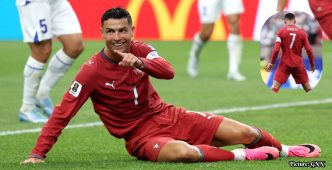
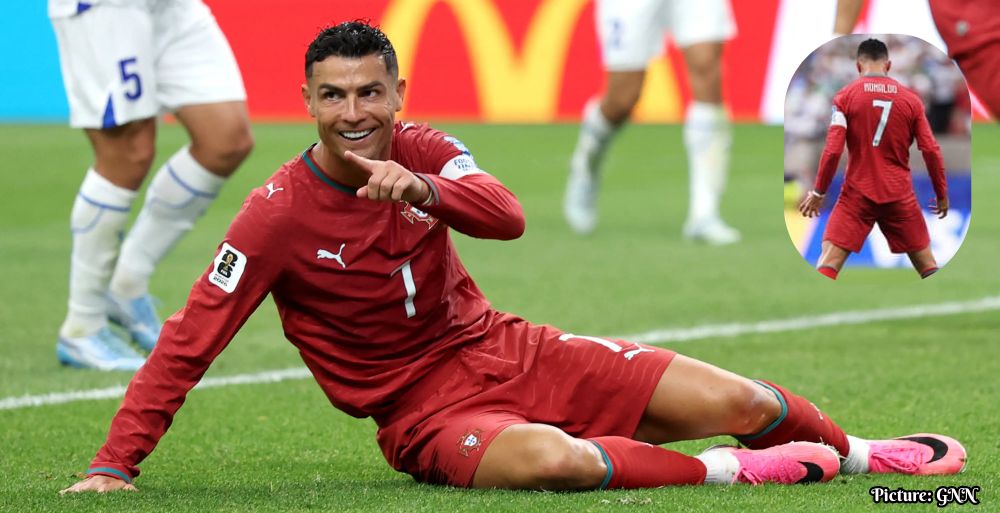
At 41 years old and under intense scrutiny following a 10-game major tournament goal drought, Cristiano Ronaldo silenced critics by scoring two goals in Portugal’s decisive 5-0 victory over Uzbekistan in Houston. His performance was historic, making him the first male player to score in six different editions of the FIFA World Cup and eclipsing Eusébio to become Portugal’s all-time leading scorer in the tournament. Despite early missed chances and calls for his benching after a sluggish opening match against the Democratic Republic of Congo, Ronaldo’s clinical finishes and a selfless tactical decoy role proved his undiminished value to the national team as Portugal successfully revitalized its World Cup campaign.
HOUSTON — Facing intense international scrutiny following a disappointing tournament opener, 41-year-old captain Cristiano Ronaldo answered critics by scoring two goals to lead Portugal to a commanding 5-0 victory over Uzbekistan at Houston Stadium on Tuesday. The Group K fixture of the 2026 Men’s FIFA World Cup saw Ronaldo make tournament history as the first male player to score in six separate editions of the global finals, while simultaneously eclipsing Eusébio as Portugal’s all-time leading World Cup goal-scorer. The emphatic win revitalizes Portugal’s campaign following their initial 1-1 draw against the Democratic Republic of Congo, placing Roberto Martínez’s squad on the precipice of the knockout rounds.
A Historic Night in Houston
The narrative surrounding Portugal’s national team arriving in Texas was fraught with internal and external tension. Following a sluggish 1-1 opening draw against the Democratic Republic of Congo—a match where Portugal managed just three shots on target despite possessing 68% of the ball—public pressure had intensified significantly on veteran forward Cristiano Ronaldo. Analysts and supporters openly questioned whether the 41-year-old’s presence was hindering a star-studded Portuguese squad often described as the nation’s “golden generation,” which features elite European talents like Bruno Fernandes, Vitinha, and Bernardo Silva.
Ronaldo entered the match under the weight of an unprecedented major tournament goal drought that spanned 10 consecutive matches across the European Championships and the World Cup. Statistically, he had registered 33 shot attempts and accumulated an expected goals (xG) metric of 4.5 across those 10 appearances without finding the back of the net. However, in front of a capacity crowd of 68,777 spectators at Houston Stadium, the veteran forward delivered a clinical performance that systematically dismantled Uzbekistan’s defensive framework.
Breaking Records and Defying Age
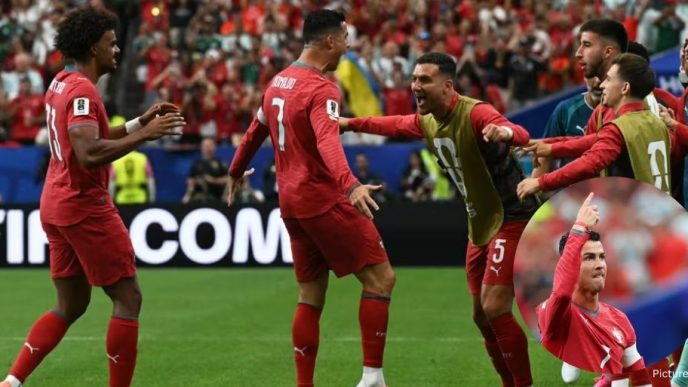
The breakthrough occurred early in the first half, relieving the palpable anxiety within the Portuguese technical area. In the 6th minute, fullback João Cancelo delivered a sharp, low cross from the right flank into the penalty area. Anticipating the trajectory, Ronaldo darted between Uzbek center-back Abdulla Abdullaev and midfielder Odiljon Hamrobekov to execute a precise first-time finish past goalkeeper Abduvohid Nematov from six yards out.
The opening goal carried immense historical weight. It marked Ronaldo’s entry into an exclusive statistical tier as the only male footballer to score in six distinct FIFA World Cups, spanning twenty years of international competition (2006, 2010, 2014, 2018, 2022, and 2026).
In the 39th minute, Ronaldo doubled his personal tally and extended Portugal’s lead to 3-0. Capitalizing on a vertical transition through the midfield, Bruno Fernandes delivered a perfectly weighted through-ball into the right side of the penalty box. Ronaldo met the pass without breaking stride, driving a low, angled strike into the far corner of the net. This second goal raised his career World Cup total to 10 goals, officially surpassing the long-standing national record of nine goals held by legendary forward Eusébio since 1966.
Tactical Reinvention and Match Progression
While Uzbekistan, managed by former Italian World Cup winner Fabio Cannavaro, showed brief flashes of offensive intent, they struggled to establish sustained possession against Martinez’s tactical adjustments. The Uzbek side, making their historic World Cup debut, had shown promise in a 3-1 opening loss to Colombia, recording an xG of 1.16—the highest for a tournament debutant since Slovakia in 2010. However, the tactical discipline of Portuguese midfielders Vitinha and João Neves limited Uzbekistan’s talismanic forward Eldor Shomurodov to speculative efforts, including a second-half half-volley that sailed well over Diogo Costa’s crossbar.
Portugal’s second goal in the 17th minute demonstrated a calculated psychological shift on the pitch. After winger Pedro Neto drew a foul at the absolute edge of the penalty box, Ronaldo stood over the ball in what has historically been his signature set-piece territory. Instead of striking, Ronaldo acted as a deliberate decoy, stepping aside for Nuno Mendes to curl a spectacular left-footed free kick into the top left corner, leaving Nematov stationary.
The European side maintained absolute structural control through the second half, registering 64% total possession and restricting Uzbekistan to just one shot on target. In the 60th minute, structural pressure forced a fourth goal. Bruno Fernandes delivered a dangerous corner kick toward the near post, where a deft flick from João Félix caused a defensive scramble. The ball deflected off defender Abdukodir Khusanov before striking Nematov’s glove and crossing the line for an own goal. Substitute Rafael Leão finalized the 5-0 scoreline in the 87th minute, capitalizing on a loose ball inside the box to fire a powerful strike into the upper corner of the goal.
Addressing the Critics: Post-Match Reactions
The emotional relief within the Portuguese camp was visible immediately following the final whistle. Ronaldo, who had faced a week of relentless media scrutiny regarding his age and physical durability, walked directly toward the television broadcast cameras on the touchline, visibly emotional as he gestured to celebrate the victory.
“God helps those who work hard,” Ronaldo stated during the post-match presentation, speaking in a measured but firm tone. “It was a difficult, dark week; it felt like I’d already retired from football. But I held on, as I always do, because I believe more in hard work than in luck. It was difficult, I have to admit, but we’re back. It’s already 23 years I’ve been a professional, and whenever things don’t go well it’s, ‘Cristiano, he’s finished, he’s old.’ But it was a good response from me and my teammates, which is what we wanted.”
Portugal’s manager Roberto Martínez echoed this sentiment in his post-game press conference, emphasizing the squad’s collective mental growth following their opening-day setback. “This was the response we had in the dressing room,” Martínez told reporters. “There are times when you need a game like the first one in order to grow in the tournament. Today we saw a team with the same attitude and commitment, but with greater maturity because it was no longer the opening match.”
The Broader World Cup Landscape
With this victory, Portugal moves to the top of Group K, accumulating four points from their first two fixtures and significantly improving their goal difference to +5. Colombia currently occupies second place with three points but retains a game in hand, setting up a critical final set of group stage matches to determine seeding for the Round of 32. Conversely, Uzbekistan remains at the bottom of the group with zero points from two consecutive defeats, mathematically confirming their elimination from advancing further in their debut World Cup campaign.
The performance by Ronaldo places him alongside global contemporaries Lionel Messi, Kylian Mbappé, and Erling Haaland, all of whom registered multi-goal performances during the current matchday cycle in North America. As the tournament progresses into the critical final group stage fixtures, Portugal appears to have found the offensive rhythm that eluded them during the qualification aftermath, answering fundamental structural questions ahead of the knockout phase.