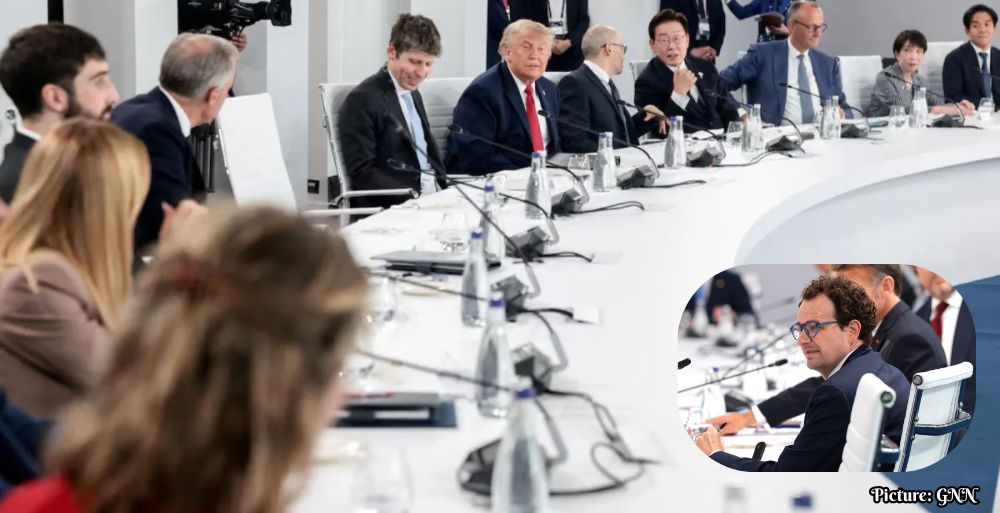
During a closed-door diplomatic luncheon at the 52nd G7 Summit in Évian-les-Bains, France, the chief executives of Anthropic and Google DeepMind formally urged world leaders to establish an international, U.S.-led coalition tasked with defining global rules and compliance standards for advanced artificial intelligence. The high-level meeting, which included President Donald Trump and key members of his cabinet, highlighted deep industry anxieties over the rapid proliferation of frontier models possessing highly advanced cyber capabilities. As national security concerns prompt unprecedented export controls and the selective withholding of elite software variations, tech executives are lobbying for a structured multilateral framework that secures hardware supply chains and isolates geopolitical competitors like China.
ÉVIAN-LES-BAINS, France — In a private, closed-door meeting on Wednesday at the annual G7 Summit, the leaders of the Western world’s most advanced artificial intelligence firms delivered a direct message to heads of state: the United States must immediately take the lead in forming an international coalition to govern frontier AI technologies. Anthropic CEO Dario Amodei and Google DeepMind CEO Demis Hassabis both proposed a unified international structure under American leadership to manage the catastrophic and national security risks associated with emerging models, according to two people with knowledge of the matter who spoke on the condition of anonymity because they were not authorized to discuss the private proceedings.
The high-stakes luncheon occurred against the backdrop of the 52nd G7 Summit in the Alpine lakeside resort of Évian-les-Bains, where issues of geopolitical stability, supply chain security, and advanced technology dominated the agenda. The consensus among multiple international participants in the room appeared to favor an active American role. Canadian Prime Minister Mark Carney explicitly agreed during the discussion that the United States could lead an AI coalition, a detail corroborated by another source familiar with the diplomatic talks.
When reached for comment regarding the specifics of the summit proceedings, Anthropic declined to provide a statement. Google DeepMind and the Office of the Prime Minister of Canada did not immediately respond to inquiries.
Geopolitical Friction and Frontier Models
The closed-door gathering follows months of escalating tension between the breakneck pace of corporate technological advancement and the tightening grip of federal statecraft. Tech executives and state officials alike have expressed growing alarm over the latest iteration of large language models, many of which exhibit autonomous cyber capabilities so sophisticated that industry watchdogs fear they could cause major infrastructure disasters or assist in weapons development if left unmonitored.
The real-world friction of these policies manifested directly on the eve of the summit. Anthropic disabled global access to its newest flagship frontier models, Fable 5 and Mythos 5, following the sudden implementation of stringent export controls by the U.S. government, which explicitly cited immediate national security concerns. Representatives from Anthropic remain locked in intense, sensitive negotiations with the Trump administration to establish compliance parameters after those export blockades officially took effect late Friday evening.
The meeting featured a select group of approximately a dozen tech executives, including OpenAI CEO Sam Altman and OpenAI Global Affairs Chief Chris Lehane. On the diplomatic side, the table was flanked by the highest echelons of the American government. Alongside President Trump, the United States was represented by Secretary of the Treasury Scott Bessent, Secretary of Commerce Howard Lutnick, and Secretary of State Marco Rubio—reflecting a coordinated approach across the federal economic, trade, and foreign policy apparatuses.
Strategic Isolation of Global Competitors
In his formal address to the gathered leaders, Anthropic’s Amodei outlined a rigid blueprint for international collaboration designed around defensive containment. According to a person familiar with his remarks, Amodei asserted that effective international cooperation must encompass a system of “structured access” to frontier models, ensuring that entities undergoing vetting are the only ones capable of utilizing elite neural networks.
Furthermore, Amodei emphasized that a primary pillar of the coalition must be the strict regulation of the semiconductor trade. He argued that the global flow of advanced microchips and critical hardware components must explicitly exclude China, preventing Beijing from acquiring the computational infrastructure necessary to train equivalent systems. The proposed framework would treat high-end compute clusters as a tightly controlled resource, mirroring Cold War-era non-proliferation strategies. Amodei concluded by stating that member countries must coordinate directly to neutralize the acute risks AI poses to cybersecurity, intelligence operations, and potential bioterrorism.
Establishing Global Testing Protocols
Taking a parallel approach, OpenAI’s Sam Altman pushed for the implementation of a institutionalized regulatory body. According to an official briefing document circulated by OpenAI, Altman called for “an international forum for discussion that establishes globally accepted standards for testing, provides expert and impartial analysis of capabilities and risks, and serves as a venue for cooperation among nations.”
The defense-minded trajectory of these firms was underlined just last month when OpenAI announced that a highly specialized variation of its latest infrastructure, dubbed GPT-5.5 Cyber, was being deployed in a limited preview capacity. Rather than a public release, access to GPT-5.5 Cyber has been strictly restricted to thoroughly vetted cybersecurity teams tasked with testing defensive digital infrastructure.
Following the conclusion of Wednesday’s session, OpenAI’s global affairs chief, Chris Lehane, noted that the international contingent of world leaders in attendance showed little resistance to the concept of American hegemony over the tech sector. Lehane remarked that non-U.S. leaders in the room openly acknowledged that the United States “certainly could play the lead role in working to establish” the foundational testing benchmarks, definitions, and security standards around artificial intelligence globally.
A New Era of Multilateral Techno-Nationalism
The alignment between tech companies and Western heads of state indicates a profound shift away from the borderless, open-source ideals that characterized the early days of the digital boom. Observers at the summit noted that the willingness of executives like Amodei and Hassabis to invite federal oversight and state-led coalitions is a pragmatic response to a landscape where code has become as strategically vital as conventional munitions.
For the Trump administration, an international tech alliance aligns closely with broader goals regarding trade leverage and decoupling supply chains from geopolitical adversaries. By utilizing export controls as an active diplomatic tool, the federal government is positioning itself to dictate not just who builds the next generation of AI, but who is permitted to access it. As G7 delegates depart Évian-les-Bains, the task ahead shifts from high-level agreements to the complex logistical reality of monitoring code, tracking silicon shipments, and codifying treaties for a digital landscape that changes by the day.