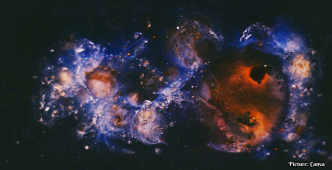
Using data from NASA’s Chandra X-ray Observatory, astronomers have identified a potential supernova remnant located approximately 26,000 light-years from Earth, near the Milky Way’s central black hole.
NASA’s Chandra X-ray Observatory has provided new insights into the cosmos, as astronomers unveil what may be a supernova remnant situated in the heart of the Milky Way galaxy. The findings were detailed in a study published in The Astrophysical Journal, shedding light on the significance of supernova remnants in the cosmic ecosystem.
Supernova remnants are crucial to our understanding of stellar evolution because they represent the aftermath of star explosions, dispersing essential elements—such as iron, oxygen, and silicon—into space. These elements are fundamental for the formation of future stars and planets, contributing to the chemical complexity necessary for life as we know it.
Location and Characteristics of the Discovery
If confirmed, this new supernova remnant would be one of the closest ever detected to the central supermassive black hole of our galaxy, an area characterized by an abundance of massive stars, intricate magnetic fields, and dense gas clouds orbiting rapidly around the Galactic Center.
The evidence supporting the existence of this potential supernova remnant comes from X-ray data collected by Chandra and the European Space Agency’s XMM-Newton mission. The data reveals a distinct “blob” of X-ray emission that researchers believe may originate from the remains of a massive star that underwent a supernova explosion, concealed within a larger cloud of expanding gas.
The proposed supernova remnant is encased in a bubble of ionized gas, known as an “H II region,” which indicates a dynamic environment surrounding a young, massive star. This bubble is a prominent source of radio emissions, designated as Sagittarius C.
Expanding and Aging
Should this discovery be validated, the supernova remnant would be expanding at a remarkable rate of approximately two million miles per hour and is estimated to be at least 1,700 years old. Previous observations from NASA’s now-retired SOFIA (Stratospheric Observatory for Infrared Astronomy) mission had previously indicated the existence of an expanding shell of gas around Sagittarius C, hinting at the occurrence of a stellar explosion in this vicinity.
Accompanying the X-ray observations, a composite image has been created, integrating data from various sources: X-rays from Chandra and XMM-Newton (depicted in blue), radio data from the MeerKAT telescope in South Africa (shown in red), and optical images from the Pan-STARRS telescopes in Hawaii. The layout of the galaxy is oriented horizontally in the image, with the central black hole positioned off to the left.
Further Analysis and Implications
The team of astronomers conducted thorough searches of the X-ray data for markers indicating increased amounts of key elements in the remnant—elements that would have been expelled by the supernova explosion. However, no enhancements were detected, which might suggest that the stellar debris has already intermixed with the surrounding gas. This finding illustrates the complexities involved in analyzing supernova remnants and their interactions with the interstellar medium.
An alternative hypothesis regarding the observed X-ray emissions proposes that they may originate from a cluster of massive stars in the area. Nonetheless, the researchers maintain that this alternative explanation is less likely, as the intensity of the X-ray emission from the blob exceeds that of known stellar clusters containing bright, massive stars by a factor of more than ten.
Additional images incorporating data from NASA’s James Webb Space Telescope have also been produced, revealing further details. The light blue coloration in these images corresponds to infrared light emitted by gas in the H II region, while darker blue areas indicate X-ray emissions from the potential supernova remnant.
Contributors to the Study
The study was conducted by a team of astronomers including Zhenlin Zhu and Mark Morris from the University of California, Los Angeles; Gabriele Ponti from Italy’s National Institute for Astrophysics; and Ping Zhou from Nanjing University in China. NASA’s Marshall Space Flight Center in Huntsville, Alabama, manages the Chandra program, while the Smithsonian Astrophysical Observatory oversees science operations from Cambridge, Massachusetts, alongside flight operations from Burlington, Massachusetts.
This discovery, if confirmed, would not only enhance our understanding of supernova remnants but also contribute significantly to the ongoing study of the Milky Way’s dynamic central region. As astronomers continue to analyze the data, the implications of this potential supernova remnant may provide new insights into the lifecycle of stars and the evolution of our galaxy.