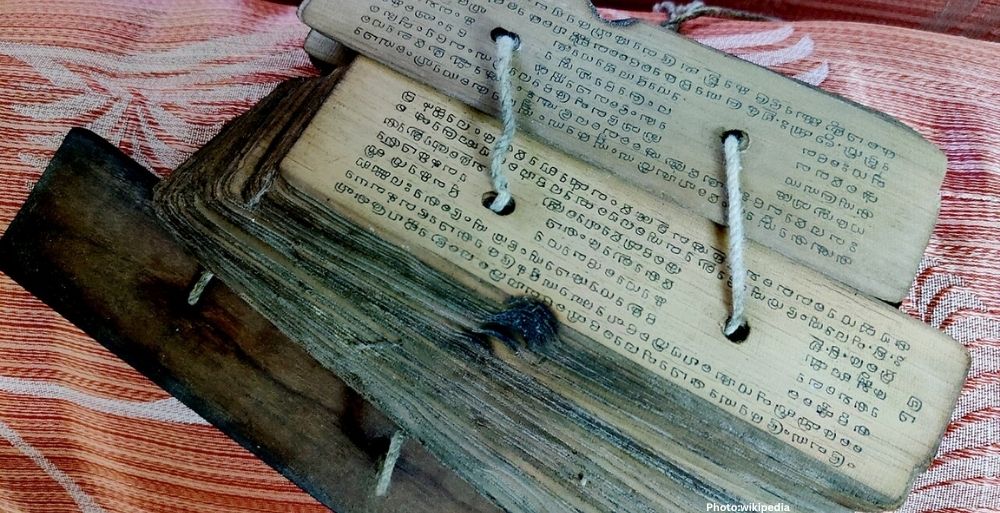
A team of historical researchers examining rare palm leaf manuscripts at the Vilwadrinatha Temple in Thiruvilwamala, Thrissur district, has uncovered a collection of late 17th-century and early 19th-century records that challenge existing understandings of medieval and early modern Kerala. The documents, preserved across four distinct bundles known as Granthavaris, have historically remained unread in modern memory, treated primarily as sacred objects for ritual use rather than historical records. Preliminary translation of the texts, written in Sanskrit using the traditional Malayalam script, has revealed a highly complex, multi-tiered bureaucratic structure governing medieval temple society alongside cross-border economic networks that bound the princely state of Cochin to neighboring royal houses, particularly the Tharur Swaroopam. The discovery highlights a sophisticated system of strict administrative customs, punitive penalties, and interstate financial reliance that sustained religious institutions amid deep-seated regional rivalries.
THIRUVILWAMALA, INDIA — A systematic examination of rare palm leaf manuscripts at the historic Vilwadrinatha Temple has yielded an invaluable collection of historical records that experts state will reshape contemporary scholarship on late medieval and early modern Kerala. Conducted by a team of dedicated history enthusiasts and epigraphists, the investigation uncovered four rare bundles of manuscripts, structurally classified as Granthavaris, which have spent recent centuries largely unread and preserved exclusively for occasional ritualistic sanctification.
The research initiative was organized and led by K. Rajan, a Professor of History at the Government College, Pattambi. Working alongside researchers Kiran Vasudev, Ramkumar Nambiyath, and Suresh Kumar K.A., the team successfully secured administrative access to the temple’s inner archives. Their subsequent discovery provides a rare, unbroken window into the administrative, socio-economic, and political mechanisms that dictated life across the central Malabar and Cochin regions for over half a millennium.
“The manuscripts are an invaluable find. They throw a lot of light on our late medieval and early modern history,” stated Prof. Rajan, speaking with a measured, scholarly composure inside the study office where the transcription process is currently underway. His team’s initial text tracking indicates that the physical records date directly back to the late 17th century.
Crucially, the team identified that three of the uncovered manuscript bundles are explicitly linked to 18th-century temple renovation activities, logging precise labor expenditures, material sourcing, and financial donations. The fourth bundle contains a highly detailed, comprehensive chronicle of the temple’s foundational history, stretching continuously from the early 14th century to the late 18th century. This historical chronicle, compiled systematically in 1822, was explicitly written based on highly fragile, older primary records that have since been entirely lost to time, effectively positioning this bundle as the sole surviving repository of the temple’s earliest structural history.
Deciphering the Socio-Political Hierarchy of Temple Society
The texts are composed entirely in the Sanskrit language, using the traditional historical Malayalam script. Structurally, the core narrative opens with an elaborate theological exposition detailing the incarnation of Lord Vishnu as the presiding deity of Vilwadrinatha—a temple prominently perched atop a 100-foot-high hillock in the village of Thiruvilwamala, overlooking the plains of the Thrissur district. Beyond its religious framework, however, the overwhelming majority of the document pivots into a rigorous, detailed account of secular temple administration, detailing a highly stratified agrarian and economic society.
The text illuminates the deeply intertwined roles of the Samudayam (the managing authorities or trustees), the Uralars (the traditional Brahmin landlords who held hereditary ownership over temple properties), the Karalars (the tenants or managers tasked with direct land cultivation and revenue collection), and the Manushyam (the broad class of temple employees, artisans, and manual laborers). Through these descriptions, the manuscripts reveal how the temple functioned not merely as a site of spiritual worship, but as a sovereign corporate entity that strictly regulated local commerce, social standing, and agricultural output across the region.
Furthermore, the documents emphasize a rigorous system of administrative customs, dictated by traditional legal codes that carried severe, non-negotiable penalties for structural violations or financial defalcations. The presence of these highly codified disciplinary records reflects the powerful, unyielding role that local traditions and institutional governance played in maintaining social cohesion and compliance, long before the centralization of judicial powers by colonial or modern state authorities.
Inter-State Subsidies and Royal Geopolitics
A major revelation within the Granthavaris is the complex financial map of medieval Kerala’s royal houses, known locally as Swaroopams. While the Vilwadrinatha Temple was physically located within the territorial borders of the erstwhile princely state of Cochin (the Perumpadappu Swaroopam), the newly decrypted records show that a substantial percentage of the institution’s primary operating revenue was derived from extensive agricultural lands situated under the jurisdiction of independent, external royal houses.
The documents place particular emphasis on the Tharur Swaroopam, a powerful regional dynasty whose land holdings provided consistent financial subsidies to the temple. The text also explicitly chronicles official diplomatic visits and major endowments made by the independent rulers of the Nediyirippu (the Zamorins of Calicut) and the Arangottu (Valluvanad) Swaroopams. This cross-border economic configuration demonstrates that medieval temples acted as neutral, extraterritorial economic hubs capable of generating interstate revenue, even during periods of intense military conflict between competing regional monarchs.
Among the most historically significant entries identified by Prof. Rajan’s team is a direct, detailed reference to an official state visit by King Ramavarma, the ruler of Cochin, in the year 1363. According to the text, the monarch traveled to the hilltop shrine specifically to perform extensive personal penance and ritual purification following a period of violent, internal temple conflicts that had broken out between rival administrative factions. This precise 14th-century date provides historians with a firm chronological anchor, offering a clear window into the political instability of the era and highlighting how deeply early Cochin monarchs were involved in resolving local institutional crises.
Centuries of Structural Decay and Resilience
Beyond detailing political alliances and socio-economic governance, the manuscripts provide a continuous, meticulously detailed chronicle of periodic temple maintenance, preservation efforts, and architectural reconstructions extending all the way into the late 19th century. The scribes recorded highly specific ledger entries accounting for widespread structural decay brought about by natural weathering, tropical humidity, and termite damage.
The records also preserve historical accounts of catastrophic structural fires that swept through the temple complex on multiple occasions over the centuries. By tracking the subsequent fundraising drives, raw material procurement logs, and labor deployments required to rebuild the temple shrines, the Granthavaris effectively map out the long, volatile, and highly complex institutional life of the Vilwadrinatha complex. It shows how the temple repeatedly served as a physical manifestation of regional recovery and resilience, surviving localized wars and natural disasters alike.
The research team is currently working in collaboration with conservation experts to ensure the physical stabilization of the fragile palm leaves, which are highly susceptible to environmental degradation from shifting humidity levels. Plans are currently underway to digitize the collection completely, generating high-resolution photographic archives and comprehensive modern translations to make these newly discovered insights fully accessible to the global academic community.
“This is not merely a localized chronicle of a single temple,” Prof. Rajan concluded, emphasizing the broader historical implications of the project. “It is a vital structural blueprint of the economic and political networks that bound medieval Kerala together. The fact that an institution in Cochin depended so fundamentally on revenues from the Tharur Swaroopam reveals a high level of diplomatic and economic interdependence that standard political histories have often overlooked. We are looking at a highly practical, sophisticated administrative ecosystem that managed to survive the rise and fall of multiple kingdoms.”