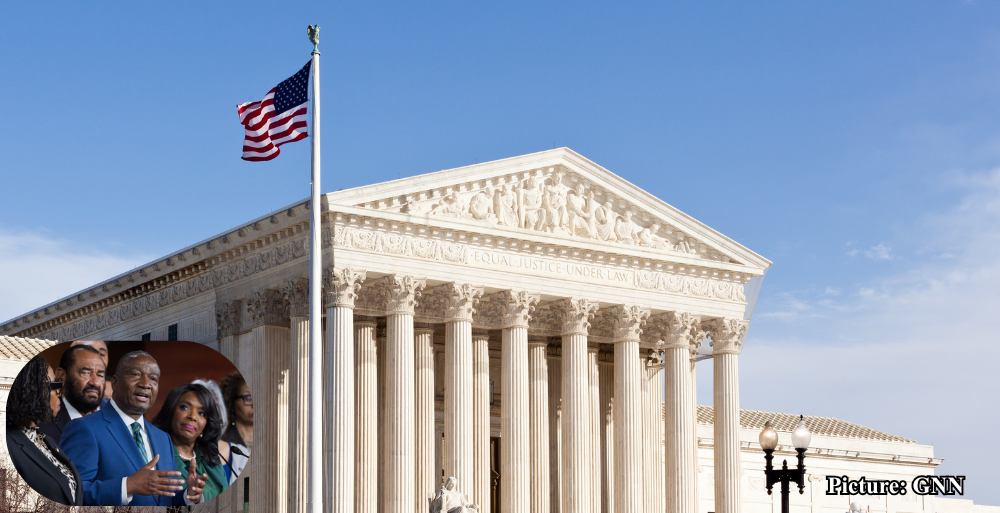
A recent U.S. Supreme Court decision has raised alarm about the future of Black representation in Congress, potentially leading to the largest decline in decades as states begin redistricting efforts.
A significant shift in the political landscape may be underway following a landmark decision by the U.S. Supreme Court on Wednesday, which has drastically changed the interpretation of the Voting Rights Act, specifically under Section 2. This ruling is expected to have profound implications for Black representation in Congress, with experts warning that it could lead to the largest decline in Black congressional members in over a century.
The Supreme Court’s conservative majority ruled in the case of Louisiana v. Callais that a congressional district designed to comply with Section 2 was an unconstitutional racial gerrymander. This reinterpretation essentially limits the protections previously afforded to minority voters, allowing Republican-controlled state legislatures to redraw congressional maps in ways that could diminish Black representation.
Immediate Political Reactions
In the wake of the ruling, calls for redistricting from Republican lawmakers have already begun. The timeline for implementing these changes before the upcoming midterm elections in November remains uncertain, particularly as many states are preparing for congressional primaries. However, redistricting experts anticipate that states, especially in the South, will seek to eliminate districts with significant Black populations that have historically been represented by Black Democrats.
According to an NPR analysis conducted earlier this year, at least 15 congressional districts from Louisiana to North Carolina are at risk of being redrawn or eliminated entirely due to this ruling. This list could expand further to include districts in states like Missouri and Texas, which were not part of the initial analysis. The potential loss of even a few districts could set the stage for a historic decline in Black representation, breaking a record set in the late 19th century when the number of Black congressional members dwindled significantly after the Reconstruction era.
Historical Context of Black Representation
To grasp the significance of these developments, it is essential to consider the historical context of Black representation in the U.S. Congress. Following the end of Reconstruction in 1877, Black-represented districts plummeted to single digits or even zero for nearly a century. It was not until the enactment of the Voting Rights Act in 1965 that the number of Black lawmakers began to rise, peaking at 63 districts, which currently represent approximately 14% of the House of Representatives.
This historical backdrop underscores the gravity of the current situation, as many fear that the Supreme Court’s ruling could reverse decades of progress. Representative Yvette Clarke of New York, chair of the Congressional Black Caucus, voiced her concerns during a press conference shortly after the decision was announced. She stated, “With this decision in Louisiana v. Callais, the Supreme Court has opened the door to a coordinated attack on Black voters across this country. This is an outright power grab. It’s about silencing Black voices, dismantling majority Black districts and rigging the maps so that politicians can choose their voters instead of the other way around.”
Legislative Responses and Future Implications
In light of the ruling, Representative Terri Sewell of Alabama, who has been a leading advocate for strengthening the Voting Rights Act, announced her intention to revise her legislation to address the challenges posed by this and similar court rulings. “Listen, we cannot give up,” Sewell declared. “We’re not going to give up.” Her determination reflects a broader commitment among Democratic lawmakers to safeguard voting rights amid a backdrop of increasing partisan gerrymandering.
Legal experts, including Atiba Ellis, a law professor and associate dean at Case Western Reserve University, warn that the ongoing partisan battles over district maps may intensify under the weakened Voting Rights Act. Ellis noted, “This could distort politics in Washington substantially by preventing communities of color from genuinely being heard. I think it highly ironic that under the guise of a colorblind Constitution, communities of color in a diversifying America could lose the lion’s share of their voice in government.”
Looking Ahead: Redistricting Challenges
As states prepare for redistricting in light of the Supreme Court’s ruling, the political landscape remains fluid and contentious. Some Democratic-led states may consider altering their majority-minority districts to distribute voters more evenly, potentially aiming to gain additional seats in the House. Conversely, Republican-led states might opt to retain certain districts to concentrate Democratic voters, thereby influencing the overall balance of power in Congress.
The outcomes of these redistricting efforts will be critical not only for the immediate midterm elections but also for the long-term representation of Black Americans in Congress. The reverberations of this Supreme Court decision will likely shape political discourse and electoral strategies for years to come, as both parties grapple with the implications of a redefined Voting Rights Act.
As the redistricting process unfolds, there will be an urgent need for vigilance from civil rights advocates, lawmakers, and voters to ensure that the progress made in representation over the past several decades is not undone. The stakes are high, and the upcoming elections will serve as a litmus test for the health of democracy and equitable representation in the United States.