
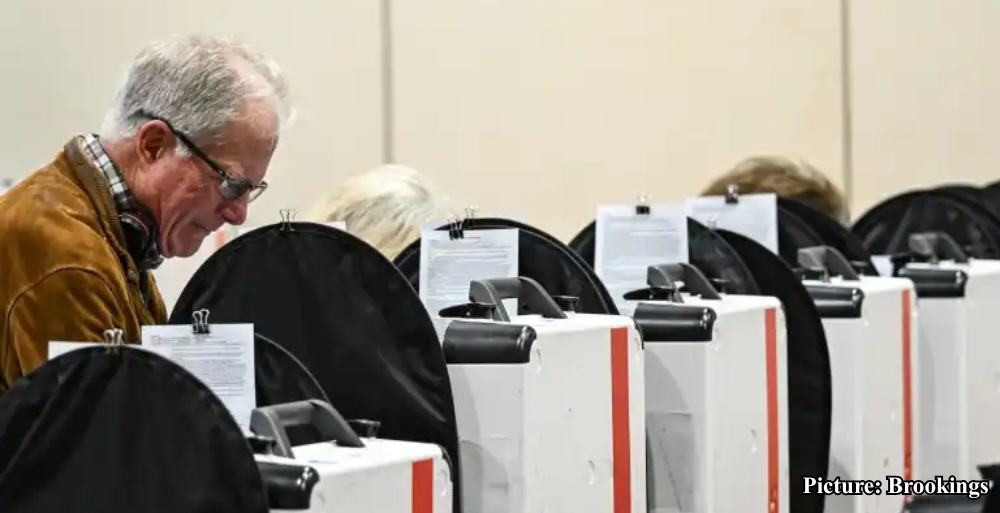
- In the first four months of 2026, the midterm prospects for Republicans have darkened further.
- Trump’s perceived lack of focus on kitchen table issues may explain why, for the first time since 2010, Democrats are more trusted than Republicans to handle the economy.
- Democrats have a serious chance of flipping Republican-held seats in North Carolina, Maine, Alaska, and Ohio, while Iowa and Texas are no longer regarded as sure bets for Republicans.
By the end of 2025, most political analysts agreed that Republicans faced an uphill battle in the forthcoming midterm elections. Here’s why. First, the party of the incumbent president usually loses ground in the midterms, and because these elections are referenda on the president and his party more than a choice between parties, the public’s low approval rating for the Democrats would not be a barrier to substantial Democratic gains. Second, by December, President Trump’s approval had fallen significantly from its peak at the beginning of his second term, and the public had grown unhappy about his handling of core economic issues, especially high prices.
In the first four months of 2026, the midterm prospects for Republicans have darkened further. The president’s job approval has fallen to new lows, discontent has deepened with his handling of a wide range of issues, now including the war with Iran, and the mood of the electorate has soured. These and other key indicators now point to substantial Democratic gains in November, including a new majority in the House and wider opportunities in the Senate, even if regaining control of the Senate remains at best an even-money bet.
The evidence: Key leading indicators
Let’s begin with the president’s job approval. This is important in every midterm election, and it is likely to prove especially important in 2026 because the Republican-controlled House and Senate have done little to separate themselves from President Trump. His job approval, which stood above 50% when he took office for his second term, has fallen to around 40% while public disapproval has risen by 13 points—from 44% to 57%.
Also important is the public’s evaluation of the president’s handling of key issues. Polls conducted regularly have consistently identified inflation/prices, jobs and the economy, and health care as the public’s top concerns. As of mid-late April 2026, approval for the president’s handling of inflation stood at just 30%; the overall economy, 37%; and health care, 29%. Public approval for tariffs, the centerpiece of the president’s economic agenda, was 38%, and the public overwhelmingly disapproves of his entire trade policy. Only 41% approve of his handling of the Iran war, an issue that has dominated media coverage for the past two months.
Trump did much better on immigration (45%) and crime (46%), issues about which his base cares much more than does the public as a whole. But the president’s failure to focus on core economic issues has cost him with the wider public. A poll conducted in January 2026 found that only 21% of respondents thought that the president was focusing on the right priorities, compared to 47% who thought that his priorities were wrong. The president’s unpopular decision to attack Iran, which led to a wider and longer war than he expected, has done nothing to ease the public’s sense that the president’s priorities are not aligned with theirs. And his perceived lack of focus on kitchen table issues may explain why, for the first time since 2010, Democrats are more trusted than Republicans to handle the economy.
Another key indicator is the “generic ballot,” which represents the public’s stated voting intentions for House candidates. As of the end of April, Democrats led the generic ballot by about 6 points. Because Democrats trailed Republicans by 2.5 points in votes cast for the House in 2024, the current generic numbers imply a swing of about 8.5 points toward the Democrats. If this swing persists until the midterms, it would be more than enough to generate a Democratic majority in the House—unless the Supreme Court finds that congressional districts created pursuant to the Voting Rights Acts are unconstitutional. Specifically, if Democrats were to carry all the congressional districts that Republicans won by 8.5 points or less in 2024 while holding onto their own 2024 victories, they would pick up 21 seats and end up with a healthy majority of 236.
While this gain sounds impressive, a swing of 8.5 points would have generated much larger gains in the 1990s. Since then, the number of safe seats that the parties win by supermajorities has risen while the number of contested districts has fallen sharply, a trend that has accelerated in recent cycles. By 2024, more than 84% of candidates elected to the House won with majorities of 10 points or more. As recently as 2018, a swing of 9.7 points netted Democrats 41 seats, while the same swing in 2026 would garner Democrats only 23.
This figure reflects not only the reduced number of swing districts, but also an important asymmetry between the parties. Of the 69 seats candidates won by less than 10 points in 2024, Democrats hold 46, Republicans just 23. Otherwise put: 90% of Republicans won in 2024 by 10 points or more, compared to just 79% of Democrats. To achieve gains comparable to those in 2018, the popular vote swing toward the Democrats would have to be significantly higher than 10 points.
This outcome may not be out of reach. In the six special elections for the House conducted in 2025-2026, the swing toward Democratic candidates averaged about 15 points, while the swing toward Democratic gubernatorial candidates in New Jersey and Virginia averaged 14 points. While the current generic ballot suggests a significantly smaller pro-Democratic swing, these margins tend to expand as the election nears.
What about the Senate?
Although Senate races are shaped by national political conditions, they tend to be more individualized than House contests. Only one-third of Senate seats are contested in each election, and the luck of the draw often favors one party. (This year’s tranche leans Republican.) The character and record of the candidates matter more than in House races, there is more media focus on the candidates, and typically more money is spent on advertising and get-out-the-vote efforts.
To gain a majority in the Senate, Democrats need to net four additional seats. As President Trump took office in January 2025, a gain this large was regarded as out of reach. But Democratic prospects have improved: the party has a serious chance of flipping Republican-held seats in North Carolina, Maine, Alaska, and Ohio, while Iowa and Texas are no longer regarded as sure bets for Republicans.
This math assumes that Democrats will hold the 13 seats up this year that they now control. This is by no means certain. Incumbent Senator Jon Ossoff (D-Ga.) is running a strong race and is favored for reelection, but Georgia is a hotly contested swing state. Sen. Gary Peters’ (D-Mich.) decision to retire has sparked a spirited three-way fight for the state’s Democratic nomination. If both mainstream candidates stay in the race, Abdul El-Sayed, a member of the Democratic Socialists of America, could emerge as the plurality winner. It is unclear how he would fare in the general election in a swing state whose electorate is very different from New York City’s.
On the other hand, the Republican primary runoff in Texas could end up improving the odds for James Talarico, the winner of the Democratic Senate primary. Although incumbent Sen. John Cornyn (R-Tex.) would be strongly favored to win the general election, he is receiving a strong challenge from Ken Paxton, the state’s controversial attorney general, favored by President Trump’s MAGA base. If Paxton emerges as the winner, which is entirely possible, Talarico’s prospects among moderate and independent voters could improve significantly.
The mood of the country
As the midterm elections draw nearer, the American people are dissatisfied with current conditions and pessimistic about the future. Only 27% of the population is pleased with the state of the country, and barely one-third thinks that the country is on the right track. More than two-thirds rate the economy as fair or poor, and by a margin of 2-to-1, they think it is getting worse. Only 1 in 5 say that they are better off financially than they were a year ago, and just 3 in 10 expect to be better off a year from now. Against this backdrop, it is hardly surprising that consumer sentiment hit an all-time low in April.
Nor is it surprising that the coalition that restored President Trump to power in 2024 is showing signs of fraying. Although the president’s MAGA base remains staunchly supportive, non-MAGA Republicans are increasingly uneasy. Among the groups who moved strongly toward Trump in the presidential election—Hispanics, young adults, and independents—the disappointment is palpable. Only 35% of Hispanics, 28% of young adults, and 27% of independents approve of his performance in office, and Democrats enjoy a generic ballot edge averaging 16 points among voters in these groups.
A recent poll found that Democrats are significantly more likely than Republicans to say that they are “extremely” motivated to vote this year. If dispirited Republicans face an aroused and angry army of Democrats this fall, Democratic gains in the House could rival those of 2018, and Democrats would have a shot at retaking the Senate. The time is growing shorter for President Trump and Republican leaders to change the flow of public opinion before it hardens into a fixed determination to change the balance of power in Washington.