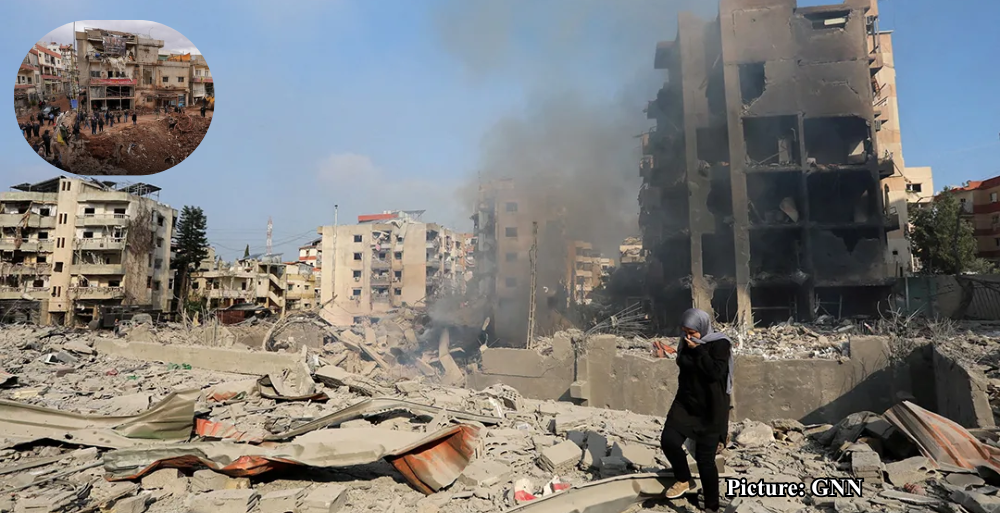
In a series of coordinated military operations, the Israeli Defense Forces (IDF) have demolished entire villages in southern Lebanon, igniting concerns about potential war crimes and the humanitarian impact on displaced populations.
The Israeli military has executed sweeping demolitions of villages in southern Lebanon, employing remote detonations to raze homes in a significant escalation of hostilities along the Israel-Lebanon border. This military action, which reportedly includes the destruction of the villages of Taybeh, Naqoura, and Deir Seryan, follows a directive from Israel’s Minister of Defense, Israel Katz, advocating for the total destruction of homes in border regions to mitigate perceived threats from Hezbollah.
Multiple sources, including video evidence reviewed by The Guardian, illustrate the scale and methodology of these demolitions. The IDF has employed mass detonations on at least seven occasions across various locations, with Lebanese media reporting additional demolitions in other border villages. However, the verification of these claims remains challenging due to the absence of satellite imagery and on-the-ground assessments.
Context of Demolitions
The demolitions are framed within the broader context of Israel’s military strategy, which has previously seen similar tactics employed in Gaza. There, the mass destruction of civilian infrastructure has been characterized by experts as “domicide,” a strategy aimed at rendering areas uninhabitable under the guise of military necessity. In the past, Israel has been accused of committing war crimes due to the extensive destruction of civilian homes, a violation of the laws of war that prohibit such actions unless absolutely necessary for lawful military objectives.
According to the Israeli military, the demolitions target Hezbollah’s military infrastructure, which they allege is embedded within civilian residences. However, critics argue that the scale of destruction far exceeds what could be justified under international humanitarian law. Human Rights Watch’s Lebanon researcher, Ramzi Kaiss, stated, “The possibility that Hezbollah may use some civilian structures in Lebanon’s border villages for military purposes does not justify the wide-scale destruction of entire villages along the border.” This sentiment echoes widespread concerns about the potential for these actions to constitute war crimes.
Impact on Local Residents
The ramifications for local residents have been profound. Many individuals who have witnessed the destruction of their homes express feelings of loss and despair. Ahmad Abu Taam, a 56-year-old shop owner from Taybeh, described the moment he saw his town square being obliterated. “A person’s whole life is in that place, their work, their memories, everything. Suddenly you see it exploding in front of you,” he recounted, emphasizing the deep emotional impact of this loss. Abu Taam, who had previously been displaced during the 2024 Hezbollah-Israel war, remarked, “I feel like I have no home. Everything has been wiped out.”
Similarly, Ahmad Ibrahim, a 50-year-old farmer from Deir Seryan, expressed his heartbreak over the prospect of his children missing out on the joys of spring in their village, now marred by conflict. “For the children, it was a beautiful place to grow up,” Ibrahim lamented, recalling fond memories of family gatherings and outdoor activities that now seem lost to the ravages of war.
Long-Term Displacement and Historical Context
The ongoing conflict in southern Lebanon has a complex history, characterized by cycles of invasion and occupation since the late 1970s. This region has long been a focal point of Israeli military operations, leading to significant displacement among its residents. Many families from border villages have sought refuge across the globe, creating a diaspora that once found solace in the hope of returning to their ancestral homes during seasonal visits. The recent demolitions have shattered this hope for many, as generations of memories and community ties are obliterated.
Dr. Mohammed Hashem, a 65-year-old doctor and business owner, shared his experience of building the Luna motel in Naqoura, a project that took him 15 years to complete. The hotel, once a thriving destination for tourists and UN peacekeepers, now lies in ruins. Hashem noted the overwhelming support he received from former customers upon news of the hotel’s destruction, highlighting the collective loss felt by the community. “We received thousands of likes and comments. People expressed how much they loved the place,” he said, reflecting the broader impact of these military operations on local economies and social fabrics.
Conclusion
As the situation evolves, the potential for long-term displacement looms large over the affected populations in southern Lebanon. The establishment of a proposed Israeli “security zone” extending to the Litani River may further complicate the return of displaced residents, raising serious humanitarian concerns. Rights organizations, international observers, and local residents remain vigilant in monitoring the implications of these demolitions, emphasizing that the pursuit of military objectives must not come at the cost of civilian lives and communities.